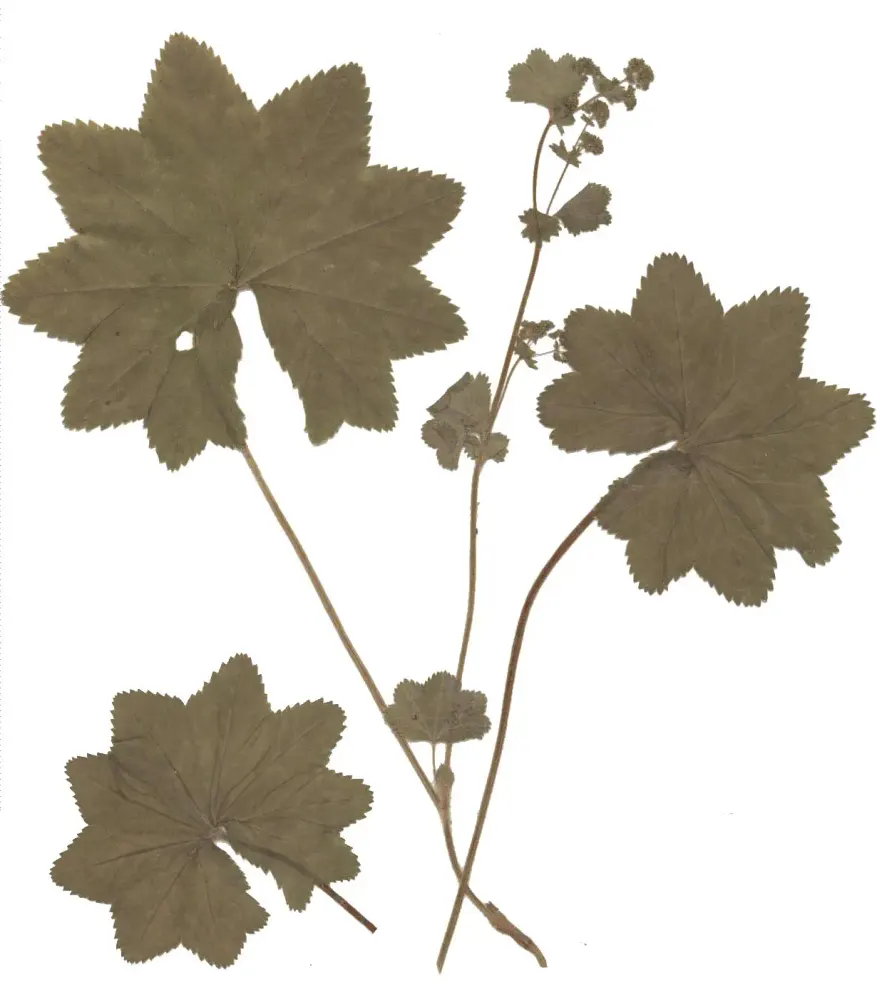
© Unknown (see Commons) · CC BY-SA 3.0 · Commons
Alchemilla vulgaris
Spitzlappiger Frauenmantel · (Alchemilla vulgaris)
Rose family (Rosaceae)
Description
Round, pleated leaves with scalloped edges that gather glistening dew drops at their centre each morning earned lady's mantle a reputation as an almost magical plant in the Middle Ages — the source of its genus name Alchemilla. This rose-family herb grows in meadows and along roadsides across Central Europe; the flowering herb is harvested from June to August and is rich in ellagitannins, chiefly agrimoniin. Commission E positively assesses an astringent tea for mild, non-specific diarrhoea. Since Hildegard von Bingen described it in the 12th century, the herb has been valued as a women's remedy for menstrual complaints and menopausal symptoms, and traditionally also as a mouth rinse for aphthous ulcers and a wound dressing. WARNING: the high tannin content may irritate the stomach in sensitive individuals or on an empty stomach; classical phytotherapy recommends courses of four to six weeks followed by a break.
Classic Commission E indication: astringent infusion of lady's mantle herb for mild non-specific diarrhea, mediated by ellagitannins (agrimoniin).
Preparation & dosage
Pour 250 ml boiling water over 1-2 tsp (approx. 1-2 g) dried lady's mantle herb, steep covered for 10 min, strain. For mild non-specific diarrhea drink 2-3 cups daily between meals. Daily drug dose should not exceed 5-10 g.
- Dry amount
- 1–2 g
- Doses per day
- 3×
- Max duration
- 4 weeks
Traditional women's herb since Hildegard von Bingen (12th c.): for menstrual pain, cycle irregularities, PMS and menopausal complaints.
Preparation & dosage
Pour 250 ml boiling water over 1-2 tsp lady's mantle herb, steep 10 min. Drink 2-3 cups daily as a 4-6 week course for menstrual cramps, PMS and menopausal complaints. Traditionally from mid-cycle or throughout the cycle.
- Dry amount
- 1–2 g
- Doses per day
- 3×
- Max duration
- 6 weeks
⚠ Age restriction: ≥ 12 years — Traditional use; cautious in children under 12 due to lack of data.
Astringent mouth and throat rinse for aphthous ulcers, mild gum inflammation and throat irritation, based on tannin action.
Preparation & dosage
Pour 250 ml boiling water over 2-3 tsp lady's mantle herb, steep 15 min, strain and cool to lukewarm. Rinse or gargle for 30 seconds 2-3x daily after brushing teeth, then spit out (do not rinse with water afterwards).
- Dry amount
- 2–3 g
- Doses per day
- 3×
- Max duration
- 2 weeks
Traditional wound compress: lady's mantle has been a classic vulnerary since the Middle Ages due to the styptic action of its tannins.
Preparation & dosage
Pour 250 ml boiling water over 3-5 g (approx. 3 tsp) lady's mantle herb, steep 15 min, strain, cool to body temperature. Soak clean cotton cloth, wring lightly and apply to minor wounds, abrasions or irritated skin for 15-20 min. 1-2x daily.
- Dry amount
- 3–5 g
- Doses per day
- 2×
- Max duration
- 2 weeks
Traditional sitz or full bath for gynecological complaints, mild lower abdominal discomfort, poorly healing skin areas and postpartum care (midwife practice).
Preparation & dosage
In the evening soak two handfuls (approx. 50-100 g) of lady's mantle herb in 2 L of cold water, leave overnight, briefly boil in the morning, strain and add to warm sitz bath water (approx. 36-38 °C). Sit for 15-20 min, 2-3x per week for lower abdominal complaints or wound care.
- Dry amount
- 50–100 g
- Doses per day
- 1×
- Max duration
- 3 weeks
Alcoholic extract for concentrated internal use in cycle complaints, menopause and mild digestive issues.
Preparation & dosage
Ready-made lady's mantle tincture (1:5 in 40-50% ethanol): take 20-40 drops in some water 3x daily. Start low (3x 3-7 drops). Course of 4 weeks, then at least 2 weeks break. Contraindicated in pregnancy, lactation, children under 12, and alcohol dependence.
- Doses per day
- 3×
- Max duration
- 4 weeks
⚠ Age restriction: ≥ 12 years — Alcoholic tincture only from age 12, at half dose; contraindicated in pregnancy/lactation and alcohol dependence.
Lady's mantle herb is considered well tolerated in folk medicine and by Commission E when used correctly; systematic clinical safety data are largely lacking. The high tannin content (6-8%) can cause gastric irritation or nausea in sensitive individuals or on an empty stomach. Classical phytotherapy (Hildegard von Bingen, Madaus) recommends courses of 4-6 weeks followed by a break.
⏱ Max continuous use: 6 weeks
Due to lack of sufficient data, do not use during pregnancy without consulting a midwife or physician. Folk medicine sometimes uses it in the last trimester for birth preparation, while other sources caution about possible uterine stimulation. External use (sitz bath, compress) is considered less problematic.
No sufficiently documented experience for internal use during lactation; therefore only after consultation. High tannin amounts could theoretically impair iron absorption in mother and child.
Use cautiously in children under 12 due to lack of data. Tinctures are generally not appropriate due to alcohol content. External applications (compress, bath, mouth rinse) at reduced dose may be used short-term, preferably after consulting a pediatrician.
Drug interactions
Eisenpräparate (orale Eisensubstitution)
Tannins (6-8 % in the herb) form poorly soluble complexes with iron and markedly reduce absorption. Maintain an interval of at least 2 hours between intake.
Alkaloidhaltige Arzneimittel (Codein, Atropin etc.) und basische Arzneistoffe
Tannins may reduce the absorption of alkaloid-containing and basic drugs; keep an interval of 1-2 hours between intake.
Contraindications
- Known hypersensitivity to lady's mantle or other Rosaceae.
- Concurrent use with iron supplements (tannins reduce iron absorption); maintain sufficient time interval.
- Tincture: pregnancy, lactation, children under 12, alcohol dependence, liver disease.
Harvested part: flowering herb
- Time of day:
- Harvest on dry mornings during full bloom (June-August) after the morning dew has fully dried, ideally following 2 sunny days.
- Drying:
- Dry flowering stems in small bundles hanging upside down or spread in a single layer on cloths in a warm, shaded, well-ventilated place. Max temperature 35-40 °C. Drying takes approx. 24-48 hours, until the material is crisp-dry.
- Storage:
- 12 months — Store in airtight, light-proof containers (dark screw-top jars, tins) in a cool, dark and dry place.
- Gerbstoffe (Ellagitannine — Agrimoniin, Pedunculagin, Laevigatin)TanninContent: 6-8 %Aerial parts
Main active group; primarily agrimoniin (lead substance, approx. 3.5%), pedunculagin (approx. 1.2%) and laevigatin. European Pharmacopoeia requires at least 6% tannins. Responsible for the astringent, antidiarrheal and styptic effects.
- GallotannineTanninContent: 0,5-2 %Aerial parts
Accompanying hydrolyzable tannins, reinforcing the astringent effect.
- Flavonoide (Quercetin- und Kämpferol-Glykoside, Leucocyanidin)FlavonoidContent: ca. 2 %Aerial parts
Predominantly quercetin and kaempferol glycosides plus leucocyanidin; antioxidant and anti-inflammatory, traditionally cited as explanation for the gynecological effects.
- BitterstoffeBitterContent: SpurenAerial parts
Not precisely quantified; support the digestive and appetite-stimulating effect of the tea.
- Phytosterole und SaponineGlycosideContent: SpurenAerial parts
Present in small amounts; traditionally associated with hormone-modulating effects in women medicine (folk hypothesis, not clinically confirmed).
- Salicylsäure (Spuren) und ätherisches ÖlEssential oilContent: bis 0,5 %Aerial parts
Trace amounts; contribute slightly anti-inflammatory effects. Madaus mentions small quantities of essential oil.
- [4]MonographKommission E Monographie Alchemillae herba (Frauenmantelkraut), BAnz Nr. 173, 18.09.1986(accessed: 2026-05-19)
- [1]BookAlchemilla vulgaris - Plants For A Future(accessed: 2026-05-19)
- [2]BookAlchemilla vulgaris - King's American Dispensatory (1898)(accessed: 2026-05-19)
- [3]BookFrauenmantel - Volksmedizinische Anwendung (Heilkräuter-Lexikon)(accessed: 2026-05-19)