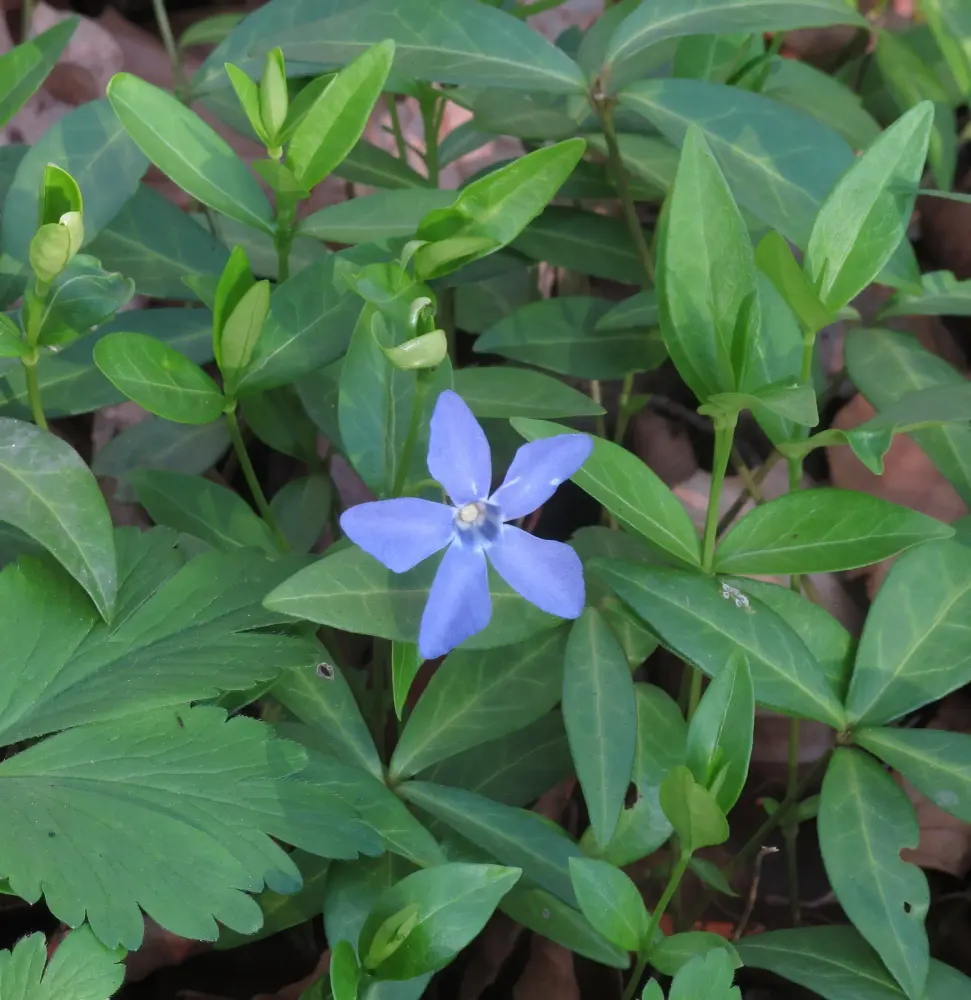
© Robert Flogaus-Faust · CC BY 4.0 · Commons
Vinca minor
Toxic🐾Kleines Immergrün · (Vinca minor)
Dogbane family (Apocynaceae)
Description
Vinca minor is a species of flowering plant in the dogbane family, native to central and southern Europe. Other vernacular names used in cultivation include small periwinkle, common periwinkle, and sometimes in the United States, myrtle or creeping myrtle.
CONTRAINDICATED during pregnancy
Use during pregnancy contraindicated — both the whole herb and vincamine preparations.
CONTRAINDICATED during breastfeeding
Breastfeeding: contraindicated due to lack of safety data and alkaloid toxicity.
CONTRAINDICATED for children
Not suitable for children — alkaloid content toxic, no paediatric safety data.
- TeaAerial partsExternalFolk medicine
Historically used in European folk medicine externally as an astringent compress for small wounds and skin irritations, as the herb contains tannins. This external application is not affected by the German approval revocation but is not well scientifically documented.
Preparation & dosage
Historical documentation only — do NOT use
These internal applications are historically documented. This plant is highly toxic — self-treatment can cause severe poisoning or death. For documentation only, explicitly NOT a recommendation.
- TinctureAerial partsInternalTraditional use
Vincamine, the main alkaloid from the leaves of lesser periwinkle, acts as a vasodilator and increases regional cerebral blood flow. In European folk medicine, preparations from the herb were used for dizziness, tinnitus, and cerebrovascular insufficiency. Since 1986, approval for whole-herb preparations has been revoked in Germany; isolated vincamine (synthetic or plant-derived) remains approved.
Preparation & dosage
- TinctureLeafInternalTraditional use
In the folk medicine of central and southern Europe, periwinkle tincture was used for memory weakness, concentration difficulties, and age-related cognitive impairments. Vincamine shows neuroprotective and anti-hypoxic properties in studies, as well as modulating effects on neuronal homeostasis.
Preparation & dosage
- TinctureLeafInternalFolk medicine
Used in folk medicine in Europe for heart rhythm disorders and peripheral circulation problems. Vincamine improves oxygen and glucose utilisation in the brain through vasodilation. Use for heart conditions without medical supervision is not recommended.
Preparation & dosage
- TeaAerial partsInternalFolk medicine
Used in medieval and early modern European folk medicine for menstrual complaints. Albertus Magnus mentioned the plant in the 13th century. Due to the documented toxicity of the whole herb, internal use as an infusion is no longer recommended today.
Preparation & dosage
- TinctureAerial partsInternalFolk medicine
Used in folk medicine for anxiety and nervous exhaustion. Recent research shows that whole plant extracts can have a sevenfold higher oral bioavailability compared to isolated compounds — this synergy effect is discussed but does not justify self-medication with non-approved preparations.
Preparation & dosage