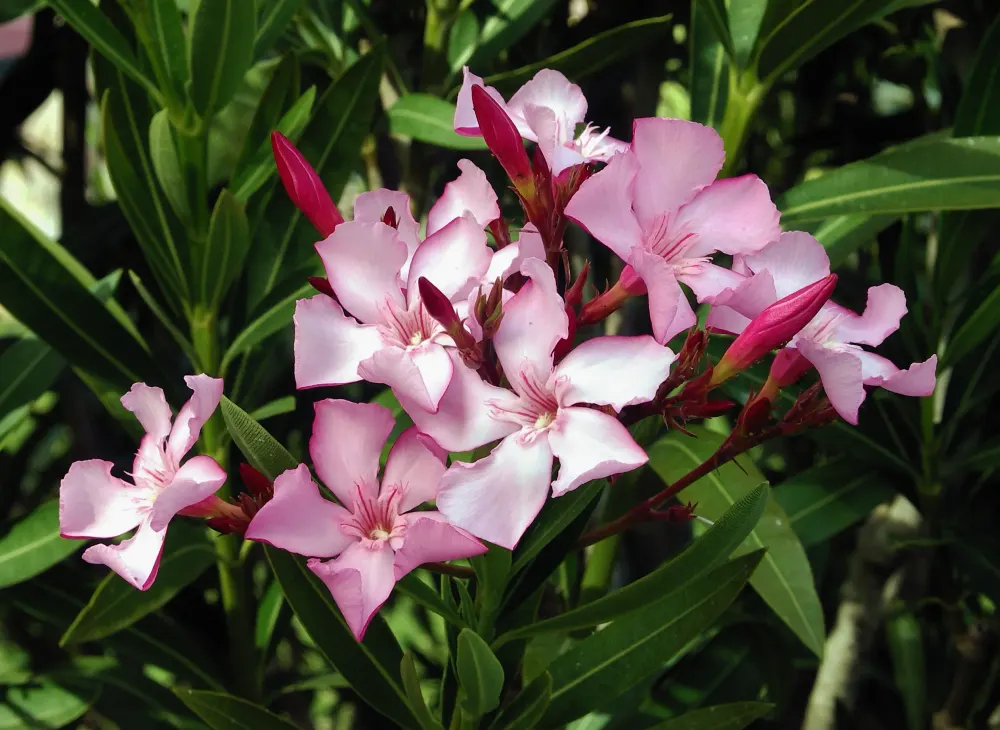
© Alvesgaspar · CC BY 2.5 · Commons
Nerium
Toxic🐾Oleander · (Nerium oleander)
Dogbane family (Apocynaceae)
Description
Nerium oleander, commonly known as oleander, rose laurel, be-still tree or rosebay, is a shrub or small tree cultivated worldwide in temperate and subtropical areas as an ornamental and landscaping plant. It is the only species currently classified in the genus Nerium, belonging to subfamily Apocynoideae of the dogbane family Apocynaceae. It is so widely cultivated that no precise region of origin has been identified, though it is usually associated with the Mediterranean Basin.
🌿 Risk of confusion — read before wild-harvesting!
NEVER use oleander twigs as grill skewers — fatal picnic poisonings are documented.
External use only!
This plant must NOT be taken internally. Use only as compress, salve, or bath.
CONTRAINDICATED during pregnancy
Cardenolides cross the placental barrier and can trigger fetal arrhythmias and abortion. Any oral or large-area dermal application during pregnancy is strictly contraindicated.
CONTRAINDICATED during breastfeeding
Cardiac glycosides may pass into breast milk and induce cardiotoxic effects (bradycardia, AV block) in the infant. Lactation: strictly contraindicated.
CONTRAINDICATED for children
Children are particularly at risk due to low body mass and sensitive cardiac physiology — even a single leaf or a few seeds can be lethal. Oleander potted plants on balcony and terrace must be kept out of reach of children. Swallowed flowers or leaves: IMMEDIATELY call poison control.
Critical drug interactions with:
Herzglykoside (Digoxin, Digitoxin, Strophanthin, Convallaria-Glykoside) · Kaliumverlust-Diuretika (Thiazide, Schleifendiuretika wie Furosemid) · Intravenöses Calcium / Calcium-Salze · Beta-Blocker und Calciumkanal-Blocker (Verapamil, Diltiazem)
- SalveLeafExternalFolk medicine
Folk medicinal external use of oleander leaf decoctions for scabies and parasitic skin infestation in the Mediterranean region and in India. Treatment of leprous skin lesions with root-bark oil is also documented in the Ayurvedic tradition. No longer recommended today due to strong skin irritation and percutaneous glycoside absorption through damaged skin.
Preparation & dosage
- SalveRootExternalFolk medicine
Indian Ayurvedic application of oleander root paste on genital ulcers and skin sores. Root-bark oil is also applied to scaly skin diseases and leprosy-related lesions. Despite traditional spread, this application is considered dangerous today due to percutaneous toxicity.
Preparation & dosage
Historical documentation only — do NOT use
These internal applications are historically documented. This plant is highly toxic — self-treatment can cause severe poisoning or death. For documentation only, explicitly NOT a recommendation.
- TinctureLeafInternalTraditional use
Historical pharmaceutical use of standardised oleander leaf extracts (Folia Nerii) as a cardiac glycoside source in heart failure and dropsy — analogous to Digitalis purpurea. Mechanism: inhibition of cardiac Na+/K+-ATPase by oleandrin and related cardenolides, resulting in a positive inotropic effect. Obsolete today because digoxin and digitoxin are more standardised and more safely dosable; the therapeutic window of oleander extracts is extremely narrow.
Preparation & dosage
[#src_wp_en_nerium_oleander] [#src_wp_oleandrin_nerium_oleander] [#src_pfaf_nerium_oleander]
- TinctureLeafInternalFolk medicine
Homeopathic use of Nerium oleander (mother tincture, D2–D30) for cardiac weakness, arrhythmia and ascites in classical homeopathy. In high dilutions (from D6 onwards) preparations are considered safe because no pharmacologically active glycoside amount remains. Mother tincture and low potencies remain highly toxic.
Preparation & dosage
[#src_wp_en_nerium_oleander] [#src_wikidata_nerium_oleander]
- TinctureRootInternalFolk medicine
Ancient and medieval use as an alleged antidote for snake bites (mixed with rue, taken orally) — already mentioned by Pliny the Elder and Dioscorides. According to current knowledge this application is toxicologically counterproductive and additively dangerous.
Preparation & dosage
- TinctureLeafInternalTraditional use
Investigation of oleandrin and oleander extracts (e.g. Anvirzel, PBI-05204) as experimental cancer and antiviral therapy in clinical trials. Results have been negative so far: the US FDA rejected an application for oleandrin as a dietary supplement in 2020; clinical efficacy is not established. Use outside controlled trials is dangerous.
Preparation & dosage
[#src_wp_oleandrin_nerium_oleander] [#src_wp_en_nerium_oleander]