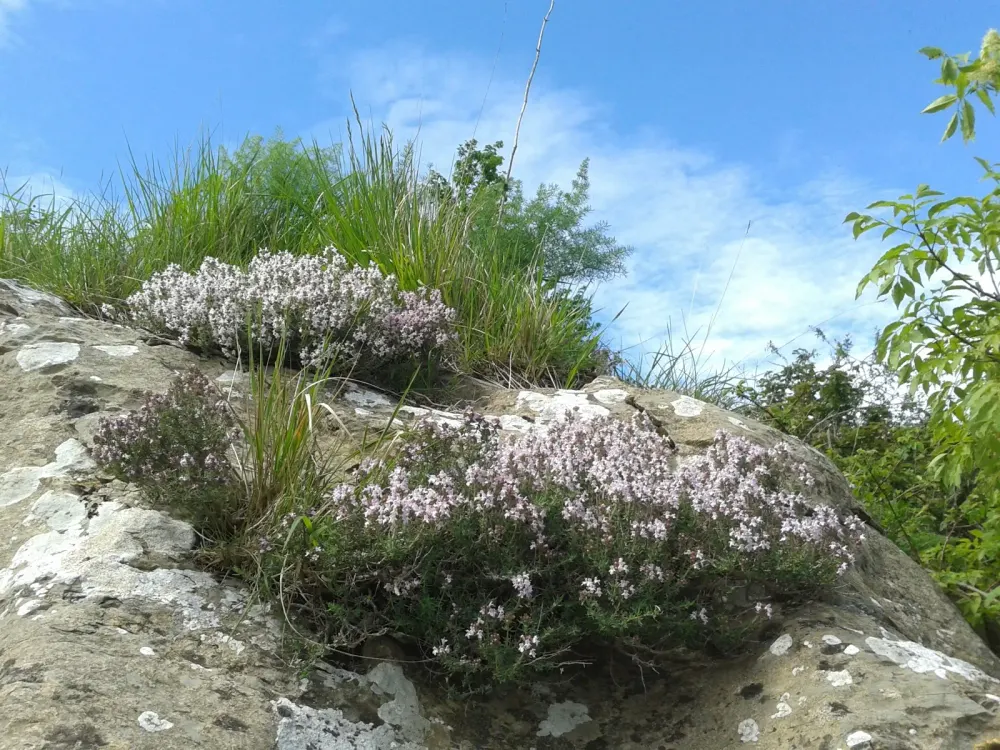
© Fontema · CC BY-SA 3.0 · Commons
Thymus vulgaris
CautionEchter Thymian · (Thymus vulgaris)
Mint family (Lamiaceae)
Description
Thymus vulgaris is a species of flowering plant in the mint family, Lamiaceae.
- TeaAerial partsInternalTraditional use
Classic cough tea for productive cold-related cough — the essential oil has an expectorant and antibacterial action.
Preparation & dosage
HOT INFUSION: Pour 150 ml boiling water over 1–2 g comminuted thyme herb, cover, steep for 10 minutes, strain. Drink one fresh cup 3–4 times a day. The essential oil helps loosen thick mucus in the bronchi — particularly useful for productive cold-related cough.
- Dry amount
- 1–2 g
- Doses per day
- 4×
- Max duration
- 1 weeks
⚠ Age restriction: ≥ 12 years — Per EMA, for adults, adolescents and children from 12 years. Insufficient data for 4–12 years. Not for under 4 years.
- InhalationAerial partsExternalTraditional use
Steam inhalation for bronchitis and congested upper airways.
Preparation & dosage
STEAM INHALATION: 5 g dried thyme in a bowl, 1 litre hot (not boiling!) water on top. Inhale steam under a towel for 5–10 minutes through nose and mouth. Eyes closed. 1–2 times daily. NOT for infants/toddlers or in asthma.
- Dry amount
- 5–5 g
- Doses per day
- 2×
- Max duration
- 2 weeks
⚠ Age restriction: ≥ 12 years — Steam inhalations with essential oils can trigger life-threatening glottic spasm in infants and toddlers.
- GargleAerial partsExternalTraditional use
Antiseptic gargle for sore throat, tonsil irritation and inflammation of the oral mucosa.
Preparation & dosage
GARGLE: Pour 150 ml boiling water over 1–2 g comminuted thyme, steep 10 minutes covered, strain and cool to lukewarm. Gargle vigorously 2–3 times a day, then spit out.
- Dry amount
- 1–2 g
- Doses per day
- 3×
- Max duration
- 2 weeks
⚠ Age restriction: ≥ 6 years — Gargling only once the child can reliably spit out the water (usually from age 6).
- TinctureAerial partsInternalTraditional use
Concentrated alcoholic extracts — practical dosing for productive cold-related cough.
Preparation & dosage
READY-MADE TINCTURE (1:5, ethanol 70 %): Take 2–6 ml three times a day diluted in a little water. NOT for children under 12 years due to alcohol content.
- Liquid amount
- 2–6 ml
- Doses per day
- 3×
- Max duration
- 1 weeks
⚠ Age restriction: ≥ 12 years — Alcohol-containing tinctures not recommended for children under 12.
- BathAerial partsExternalFolk medicine
Warming cold-relief bath — essential oils enter via skin and breathing air.
Preparation & dosage
BATH ADDITIVE: 100–200 g thyme + 2 L boiling water, steep 15 min, add to full bath at ~37 °C, 10–15 minutes. NOT in fever, open skin lesions or cardiovascular weakness.
- Dry amount
- 100–200 g
- Doses per day
- 1×
- Max duration
- 2 weeks
⚠ Age restriction: ≥ 6 years — For older children from 6 years at half dose. Avoid in infants and toddlers.
Distribution in Europe
🪴 Grow at home
- ☀ Light
- full sun
- 💧 Water
- weekly
- 🌱 Soil
- Sandy, lean, with drainage
- 🪴 Pot
- 15 cm
- ⭐ Difficulty
- ★☆☆ beginner
- 🐾 Pets
- pet-safe
Tips:
- Likes drought — under-water rather than over.
- Full sun preferred — Mediterranean plant.
- Light pruning in spring for compact growth.
Care tips are general indoor-gardening recommendations, not scientific sources.
🤝 Permaculture Partners
In your garden, this plant acts as:
✨ Best symbiotic partners
- 🌿 Broccoli Thyme scent masks broccoli from cabbage white butterfly.
- 🌿 Cucurbita pepo Thyme deters cabbage white and squash pests.
- 🌿 Fragaria vesca Thyme as ground cover deters slugs.
- 🌿 Lavandula angustifolia Classic companion-planting partner.
- 🌿 Matricaria chamomilla Classic companion-planting partner.
- 🌿 Basil Classic companion-planting partner.
- 🌿 Oregano Both aromatic and bee-friendly — ideal neighbours.
- 🌿 Rosemary Both Mediterranean and drought-tolerant — perfect herb pairing.
- 🌿 Salvia officinalis Both aromatic and drought-tolerant — herb-spiral classic.
- 🌿 Tagetes patula Classic companion-planting partner.
- 🌿 Tropaeolum majus Classic companion-planting partner.
📦 Part of these planting sets:
Source: Helga und Margarete Langerhorst, Mein gesunder Naturgarten (eigene Kuration)