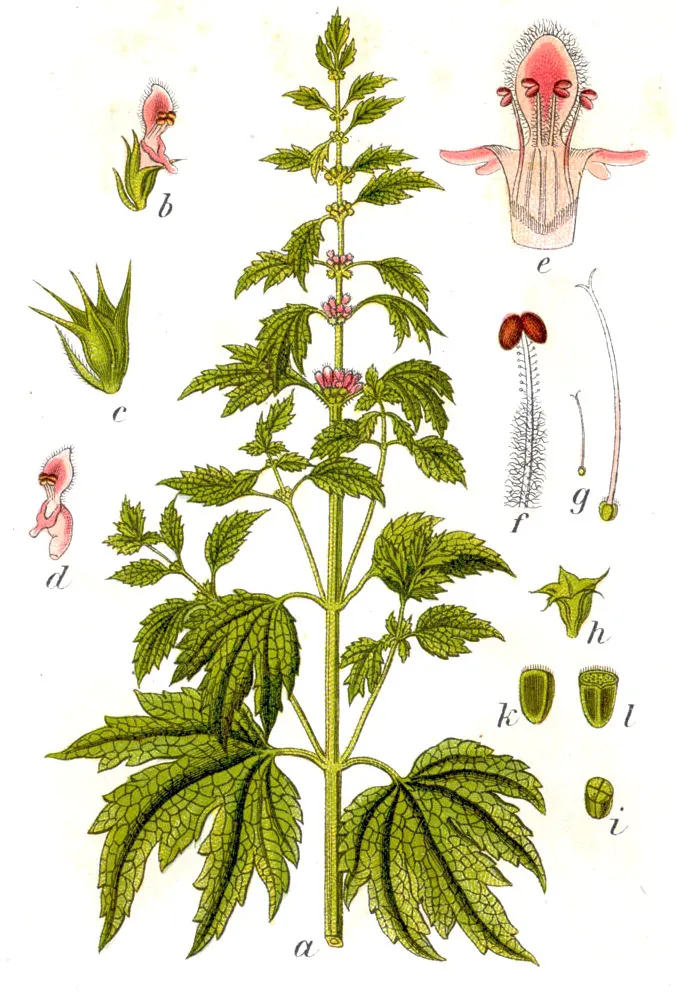
© Jacob Sturm, Deutschlands Flora in Abbildungen (1796) · Public domain · Commons
Motherwort
CautionEchtes Herzgespann · (Leonurus cardiaca)
Mint family (Lamiaceae)
Description
Motherwort grows as a hardy perennial from 30 to 120 centimetres tall, with a square stem, opposite palmately lobed leaves and dense false whorls of small, pale pink lipped flowers. Both its English name and the Latin epithet cardiaca point to its traditional use in relation to the heart. The flowering herb is gathered from June to August. It contains alkaloids such as stachydrine and leonurine, iridoid glycosides, flavonoids including rutin and hyperoside, and five to nine percent tannins. Taken as tea or tincture it is traditionally regarded as a calming remedy for nervous tension and nervous palpitations. One point is essential: heart symptoms belong first with a doctor, since palpitations can have serious causes. If complaints last longer than four weeks or worsen, medical advice is needed.
CONTRAINDICATED during pregnancy
Traditionally regarded as a uterine stimulant — do not use during pregnancy.
CONTRAINDICATED for children
Not for children and adolescents under 18 due to lack of data.
Calming tea for nervous tension and nervous palpitations (after a doctor has excluded serious causes).
Preparation & dosage
INFUSION: Pour 150 ml boiling water over 2–4 g of the dried flowering herb, cover and steep about 10 minutes, then strain. One cup three times daily (mean daily dose about 4.5 g of drug). To relieve symptoms of nervous tension and nervous heart complaints — only after serious conditions have been excluded by a doctor. If complaints persist for more than 4 weeks, consult a doctor.
- Dry amount
- 2–4 g
- Doses per day
- 3×
- Max duration
- 4 weeks
⚠ Age restriction: ≥ 18 years — Adults only — not for children and adolescents under 18 due to lack of data.
Sources: [1]
Concentrated calming form for travel use.
Preparation & dosage
TINCTURE (traditionally 1:5): 2–6 ml single dose, up to 3 times daily in a little water. A concentrated form for nervous tension. Due to the alcohol, not for pregnant or breastfeeding women, children, or people with liver disease.
- Liquid amount
- 2–6 ml
- Doses per day
- 3×
- Max duration
- 4 weeks
⚠ Age restriction: ≥ 18 years — Alcohol-containing tinctures only for adults from 18 years.
Sources: [1]
IMPORTANT: Never self-diagnose heart complaints or palpitations — serious cardiac conditions must first be excluded by a doctor. If complaints persist for more than 4 weeks or worsen, consult a doctor. Do not use during pregnancy (traditionally regarded as a uterine stimulant — hence the name "motherwort"). Not recommended during lactation or in children and adolescents under 18 due to lack of data. Consult a doctor when taking cardiac, sedative or blood-thinning medication concurrently.
⏱ Max continuous use: 4 weeks
Traditionally regarded as a uterine stimulant — do not use during pregnancy.
No data for breastfeeding — not recommended.
Not for children and adolescents under 18 due to lack of data.
Drug interactions
Herzmedikamente / Herzglykoside (z. B. Digoxin)
Theoretical additive effects on the heart are possible. Monitor and consult a doctor when used concurrently.
Beruhigungsmittel / zentral dämpfende Substanzen
The mild calming effect may theoretically add to that of sedatives.
Contraindications
- Pregnancy.
- Hypersensitivity to motherwort.
- Children and adolescents under 18 years.
Harvested part: flowering herb
- Time of day:
- In the late morning once the dew has dried, during full flowering.
- Drying:
- Harvest the upper flowering shoots and dry them airy, shaded and in a single layer.
- Storage:
- 12 months — Store dry in airtight, dark containers, use within a year.
- Alkaloide (Stachydrin, Leonurin, Betonicin)AlkaloidAerial parts
Characteristic compounds; stachydrine (a betaine) and leonurine are considered co-responsible for the calming, heart-related tradition.
- Iridoidglykoside (Leonurid, Ajugol, Galiridosid)GlycosideAerial parts
Bitter iridoids, typical of the genus.
- Flavonoide (Rutin, Hyperosid, Quercitrin)FlavonoidContent: ≥ 0,2 %Aerial parts
Antioxidant flavonoids; extracts are sometimes standardised to hyperoside.
- GerbstoffeTanninContent: 5–9 %Aerial parts
Mildly astringent accompanying compounds.
- Diterpen-Bitterstoffe (Leocardin)BitterAerial parts
Labdane diterpenes; contribute to the bitter taste.
- Phenolcarbonsäuren (Chlorogen-, Rosmarin-, Kaffeesäure)Phenolic acidAerial parts
Antioxidant hydroxycinnamic acids typical of the mint family.
- [1]MonographCommunity herbal monograph on Leonurus cardiaca L., herba (EMA/HMPC/127428/2010)(accessed: 2026-06-03)
- [2]BookNicholas Culpeper, The Complete Herbal (1653) — Motherwort(accessed: 2026-06-03)
- [3]WikipediaEchtes Herzgespann — Wikipedia (DE)(accessed: 2026-06-03)
Classical quotes
"There is no better herb to take melancholy vapours from the heart, to strengthen it, and make a merry, cheerful, blithe soul than this herb. Therefore the Latins called it Cardiaca. Besides, it makes women joyful mothers of children, and settles their wombs as they should be, therefore we call it Motherwort."
🤝 Permaculture Partners
In your garden, this plant acts as: