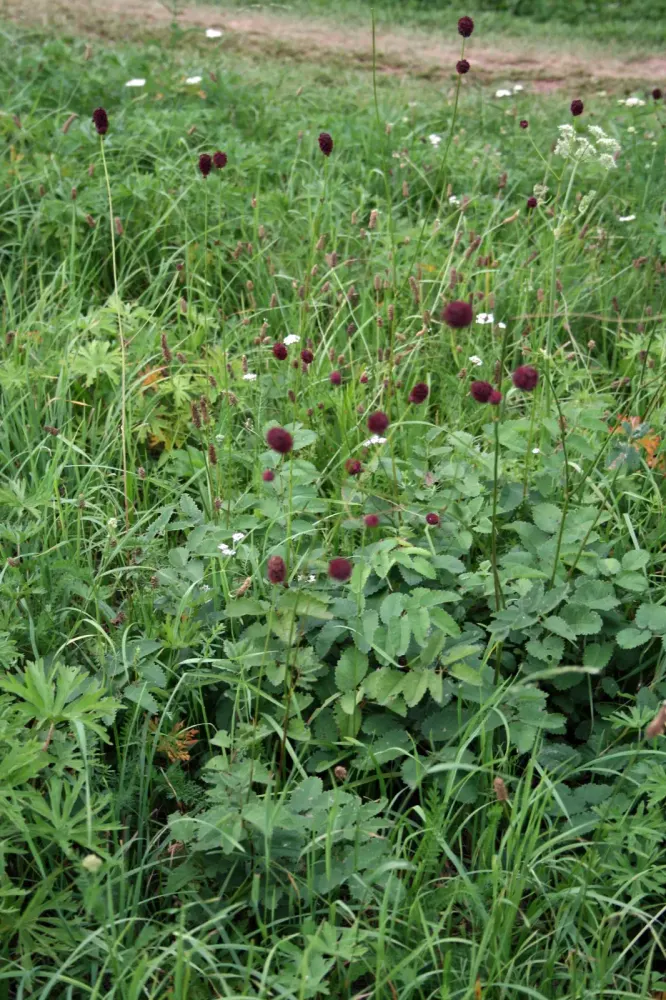
© Karelj · Public domain · Commons
Sanguisorba officinalis
Großer Wiesenknopf · (Sanguisorba officinalis)
Rose family (Rosaceae)
Description
Sanguisorba officinalis, commonly known as great burnet, is a plant in the family Rosaceae, subfamily Rosoideae. It is native throughout the cooler regions of the Northern Hemisphere in Europe, northern Asia, and northern North America.
- TeaRootInternalTraditional use
Tea infusion from dried great burnet root for diarrhea, dysentery, and mild peptic ulcers. The ellagitannins (sanguiin H-series) act astringently on the intestinal mucosa and inhibit inflammatory mediators.
Preparation & dosage
Boil 2–4 g dried, chopped root in 200 ml water and simmer for 10 minutes. Strain and drink warm, 3× daily.
- Dry amount
- 2–4 g
- Doses per day
- 3×
[#src_pfaf_sanguisorba] [#src_wiki_de_sanguisorba] [#src_ajcm_sanguisorba]
- CompressRootExternalTraditional use
Compresses with cooled great burnet root decoction for burns, wounds, boils, and inflamed skin areas. Chinese clinical research indicates the whole plant extract is more effective for burns than isolated tannins alone.
Preparation & dosage
- TinctureRootInternalTraditional use
Great burnet root tincture to support heavy menstrual bleeding (menorrhagia) and hemorrhoids. The triterpenoid glycoside fraction (ziyuglycoside I) shows the strongest hemostatic activity in laboratory studies.
Preparation & dosage
- TeaLeafInternalFolk medicine
Infusion from fresh or dried great burnet leaves as a tea substitute with mildly cooling properties. The leaves have a mild cucumber-like aroma and are considered cooling and febrifuge in folk medicine.
Preparation & dosage
Pour 200 ml boiling water over 1–3 g fresh or dried leaves, steep 5 minutes, strain and drink.
- Dry amount
- 1–3 g
- Doses per day
- 2×
- RawLeafInternalFolk medicine
Young leaves and flower buds of great burnet in spring are edible raw in salads or as a wild herb. The characteristic cucumber taste makes them a popular addition to spring salads and herb quark.
Preparation & dosage
- TeaRootInternalTraditional use
Great burnet root tea is considered diuretic and antiseptic in folk medicine. In TCM (Chinese name: Di Yu), the root is used to 'cool the blood', stop bleeding, and clear heat.
Preparation & dosage
Simmer 3–6 g dried root in 300 ml water for 15 minutes. Strain and drink warm, 2× daily.
- Dry amount
- 3–6 g
- Doses per day
- 2×