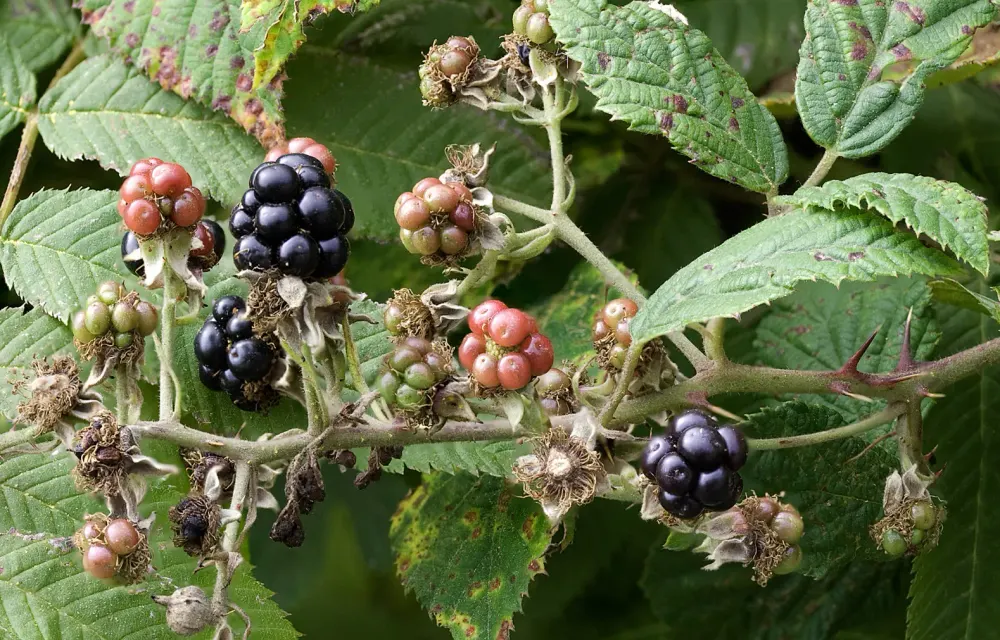
© Sven Teschke · CC BY-SA 3.0 de · Commons
Rubus fruticosus
Brombeeren · (Rubus fruticosus)
Rose family (Rosaceae)
Description
Rubus fruticosus L. is the ambiguous name of a European blackberry species in the genus Rubus. The name has been interpreted in several ways:The species represented by the type specimen of Rubus fruticosus L., which is also the type specimen of the genus Rubus.
- TeaLeafInternalCommission E
Blackberry leaf tea for non-specific, acute diarrhoeal diseases. The German Commission E issued a positive monograph for Rubi fruticosi folium: daily dose 4.5 g drug as infusion.
Preparation & dosage
Pour 200 ml of boiling water over 3–4.5 g of dried young leaves (harvested in the first half of May), steep 10 minutes, strain. Up to 3 cups daily.
- Dry amount
- 3–4.5 g
- Doses per day
- 3×
[#src_komm_e_rubus] [#src_wp_de_rubus] [#src_altmeyers_rubus]
- GargleLeafExternalCommission E
Cooled leaf infusion as mouthwash or gargle for mild inflammation of the oral and pharyngeal mucosa. Commission E indication (external use).
Preparation & dosage
Prepare infusion as for tea, cool to body temperature and gargle several times daily.
- Dry amount
- 3–5 g
- TeaLeafExternalFolk medicine
External use for chronic skin conditions and poorly healing wounds. The high ellagitannin content (up to 25 mg/g dry weight) is considered the basis for the astringent wound-healing effect.
- RawFruitInternalFolk medicine
Fresh blackberries as food are rich in cyanidin-3-O-glucoside (> 90% of anthocyanins), ellagic acid, quercetin and vitamin C. Traditionally eaten for exhaustion and as a natural tonic.
- CompressLeafExternalFolk medicine
Poultice of fresh or bruised blackberry leaves applied to eczema, abrasions and abscesses. Recorded in folk medicine; astringent tannins and antimicrobial flavonoids act synergistically.
- TeaLeafInternalFolk medicine
Leaf tea used in folk medicine as a mild diuretic and for bladder complaints. PFAF documents diuretic and depurative properties of leaves and root bark.