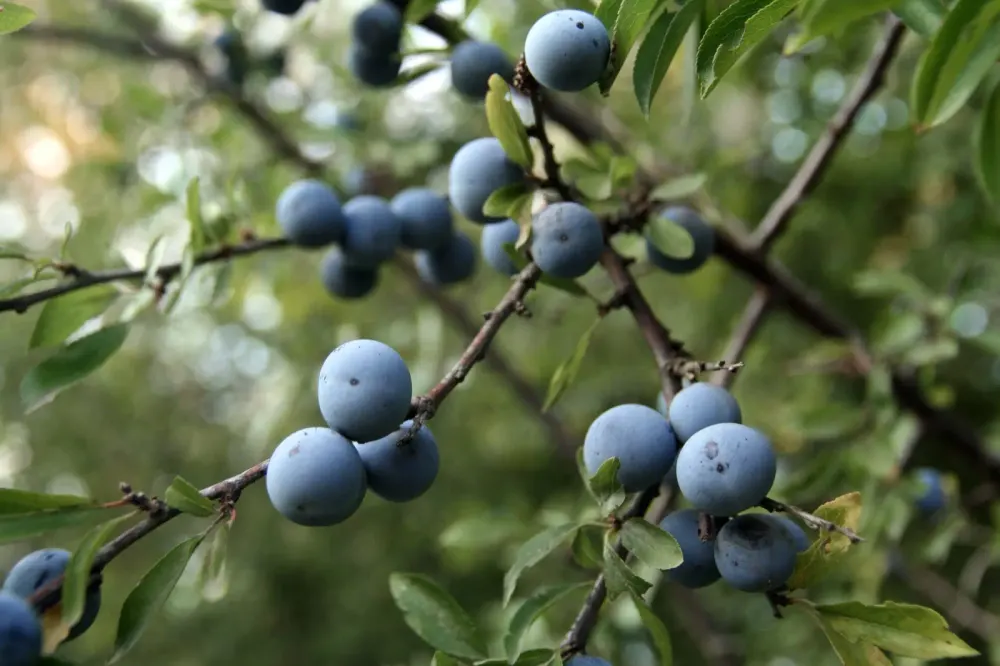
© Unknown (see Commons) · See Commons file page · Commons
Prunus spinosa
CautionSchlehdorn · (Prunus spinosa)
Rose family (Rosaceae)
Description
Prunus spinosa, called blackthorn or sloe, is a species of flowering plant in the rose family, Rosaceae. It is native to Europe and West Asia, and has been naturalized in parts of North America.
- TeaFruitExternalCommission E
Infusion of dried sloe fruits used as a mouthwash or gargle for mild inflammation of the oral and pharyngeal mucosa. The German Commission E issued a positive monograph for Pruni spinosae fructus for this external indication.
Preparation & dosage
Pour 200 ml boiling water over 2–4 g dried, stoned fruits, steep 15 minutes, strain. Cool and gargle several times daily.
- Dry amount
- 2–4 g
- TeaFlowerInternalFolk medicine
Flower infusion for digestive complaints, mild constipation and bladder-kidney support. Recorded in folk medicine for centuries; Commission E negative monograph due to insufficient efficacy evidence, no safety concerns identified.
Preparation & dosage
Pour 200 ml boiling water over 1–2 g of dried flowers (harvested just after opening), steep 10 minutes, strain.
- Dry amount
- 1–2 g
- Doses per day
- 2×
[#src_pfaf_prunus] [#src_wp_de_prunus] [#src_arzneipflanzen_prunus]
- RawFruitInternalFolk medicine
Sloes eaten raw after the first frost or processed as jam and juice. Frost (or freezing) reduces the tannin content from approx. 10 g/l to below 5 g/l and alleviates the extreme astringency. Traditionally used as a tonic after infectious illnesses.
- TinctureFruitInternalFolk medicine
Sloe liqueur or spirit (sloe gin) from ripe, frosted fruits; used in folk medicine as a digestive bitters and restorative after exhaustion. No therapeutic proof, but part of a long European tradition.
- TeaFlowerInternalFolk medicine
Flower infusion traditionally used as a diaphoretic and febrifuge for colds. PFAF documents diaphoretic and febrifuge properties of the flowers.
- TeaFlowerInternalFolk medicine
Flower infusion used in folk medicine as a mild diuretic for bladder and kidney complaints. PFAF describes the flowers as aperient, diuretic and depurative.