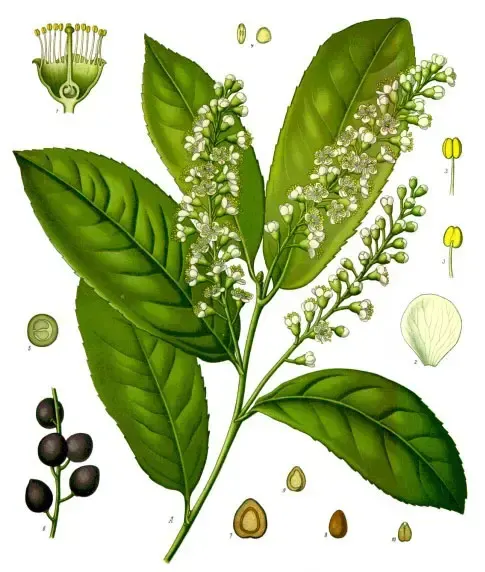
© Franz Eugen Köhler, Köhler's Medizinal-Pflanzen · Public domain · Commons
Prunus laurocerasus
Toxic🐾Lorbeerkirsche · (Prunus laurocerasus)
Rose family (Rosaceae)
Description
Prunus laurocerasus, also known as cherry laurel, common laurel and sometimes English laurel in North America, is an evergreen species of cherry (Prunus), native to regions bordering the Black Sea in southwestern Asia and southeastern Europe, from Albania and Bulgaria east through Turkey to the Caucasus Mountains and northern Iran.
External use only!
This plant must NOT be taken internally. Use only as compress, salve, or bath.
CONTRAINDICATED during pregnancy
Cyanide crosses the placental barrier; even small HCN amounts can cause fetal hypoxia. Any use of cherry laurel preparations below homeopathic D6 potency is absolutely contraindicated in pregnancy.
CONTRAINDICATED during breastfeeding
Cyanide and its metabolites (thiocyanate) pass into breast milk and can cause thyroid dysfunction and respiratory depression in the infant. Breastfeeding: contraindicated.
CONTRAINDICATED for children
Children are extremely sensitive to HCN due to lower body mass. The attractive black berries of this widely used garden hedge are a leading cause of plant poisoning in paediatrics. Education on plant identity and prohibition of consumption mandatory. In case of suspected ingestion of kernels or leaves, immediate medical consultation.
Critical drug interactions with:
Atemdepressiva (Opioide wie Morphin, Codein, Fentanyl) · Benzodiazepine und Z-Substanzen (Diazepam, Lorazepam, Zolpidem)
- CompressLeafExternalFolk medicine
Folk-medicinal use of cool poultices of crushed fresh leaves for skin rashes, insect bites and minor inflammations. The antiseptic effect was attributed to released HCN — obsolete today due to percutaneous absorption risk and unpredictable dose. Pure ethnographic documentation, no application recommendation.
[#src_pfaf_prunus_laurocerasus] [#src_grieve_prunus_laurocerasus]
- BathLeafExternalFolk medicine
Sporadically documented use in the 19th century of weak cherry laurel leaf infusions as an eye bath for conjunctival irritation. The application was already classified as risky in Victorian England and is strictly contraindicated today — eye contact with HCN-containing solutions causes corneal damage and systemic absorption via mucous membranes. Pure historical documentation.
- RawLeafExternalFolk medicine
Historical use of dried leaves for insect killing in collection containers (butterfly boxes, beetle collections) — released cyanide kills insects within minutes ('killing jar' of entomological practice). This use is not medicinal but documents HCN release in a practical application. Pure documentation, hazardous practice.
[#src_wp_en_prunus_laurocerasus] [#src_pfaf_prunus_laurocerasus]
Historical documentation only — do NOT use
These internal applications are historically documented. This plant is highly toxic — self-treatment can cause severe poisoning or death. For documentation only, explicitly NOT a recommendation.
- TinctureLeafInternalTraditional use
Historical pharmaceutical use of Aqua Laurocerasi (cherry laurel water) as sedative and antispasmodic remedy for dry irritating cough, whooping cough, asthma and stomach cramps. Distillation of fresh leaves releases hydrocyanic acid (HCN) via β-glucosidase, with concentrations of approximately 0.1 % in the distillate. Listed in the British and French Pharmacopoeias in the 19th century, became obsolete in the first half of the 20th century due to unpredictable HCN concentrations and numerous fatalities.
Preparation & dosage
[#src_grieve_prunus_laurocerasus] [#src_wp_cherrylaurelwater_prunus_laurocerasus]
- TinctureLeafInternalTraditional use
Use of Tinctura Laurocerasi (cherry laurel tincture) in the 18th and 19th centuries as antitussive and mild sedative — usually in doses of 5–10 drops, never higher. The effect rests on HCN-induced inhibition of respiratory centres. Strictly obsolete today: no therapeutic window since HCN content of fresh leaves varies strongly (season, light exposure, plant age) and can differ between batches by a factor of 10.
Preparation & dosage
[#src_grieve_prunus_laurocerasus] [#src_pfaf_prunus_laurocerasus]
- Essential oilLeafInternalFolk medicine
Food-historical use of a few drops of cherry laurel water as bitter almond flavour substitute in liqueurs, puddings and preserves (especially in Southern and Eastern Europe, 19th/early 20th century). Due to poisoning cases, use as a food flavouring is now strictly limited in the EU by Flavouring Regulation (EC) No 1334/2008 (max. 1 mg HCN/kg in foods). Domestic culinary use absolutely not recommended.
[#src_pfaf_prunus_laurocerasus] [#src_wp_cherrylaurelwater_prunus_laurocerasus]
- TinctureLeafInternalFolk medicine
Homeopathic use of Laurocerasus (mother tincture from fresh leaves, from D3) for shortness of breath, spasmodic cough, palpitations with cyanosis and nocturnal anxiety. Usually in potencies from D6 — these no longer contain pharmacologically active HCN amounts. Homeopathic finished products are licensed in Germany, France and Switzerland under medicinal-products law.
Preparation & dosage
[#src_wikidata_prunus_laurocerasus] [#src_grieve_prunus_laurocerasus]