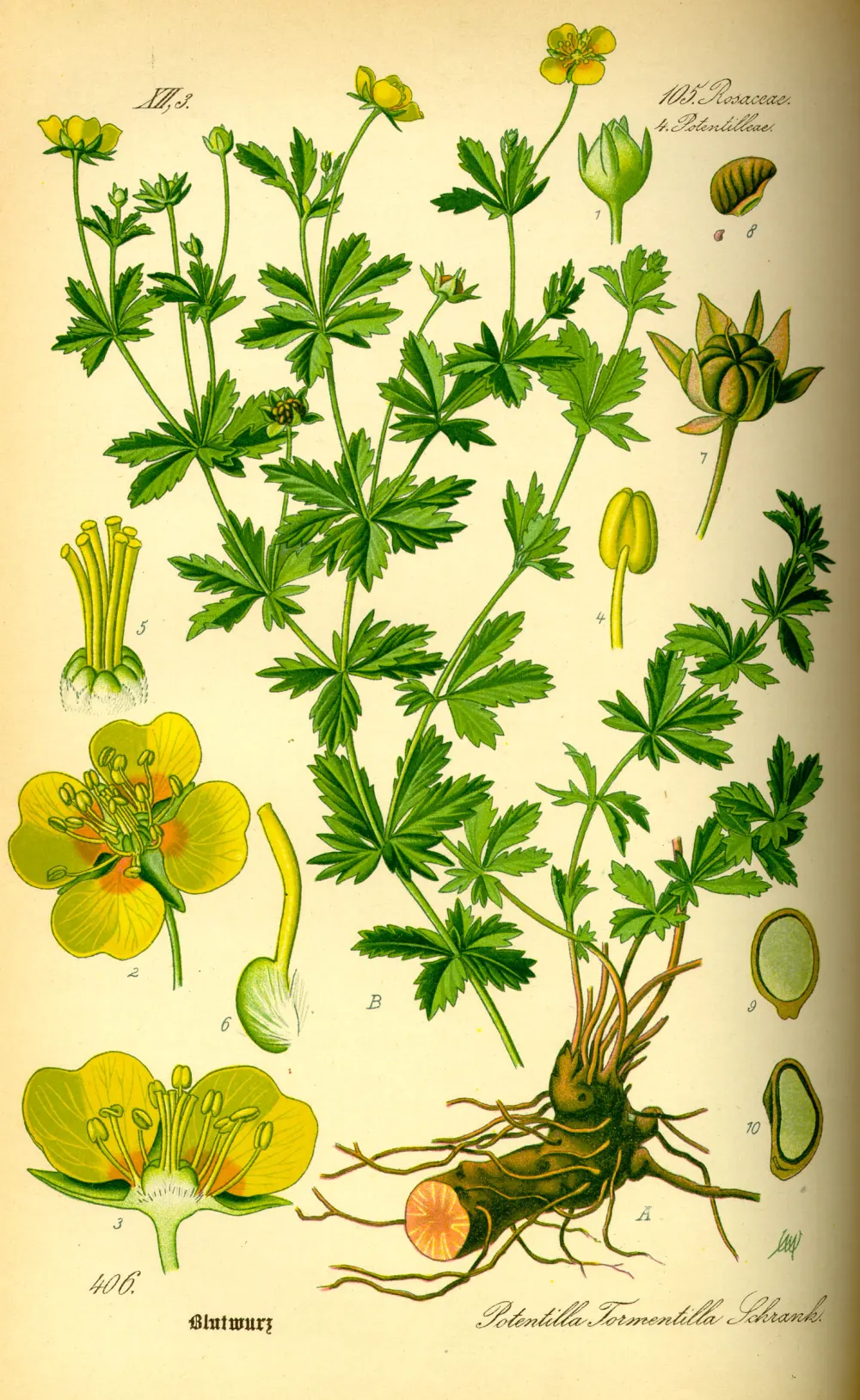
© Otto Wilhelm Thomé, Flora von Deutschland, Österreich und der Schweiz (1885) · Public domain · Commons
Tormentil
Blutwurz · (Potentilla erecta)
Rose family (Rosaceae)
Description
Cut into the knobby rhizome of tormentil and the surface turns blood red within minutes — the source of its German name, Blutwurz. The low perennial reaches only 10 to 30 centimetres and stands out for its three-part leaves and small yellow flowers which, unlike most of the rose family, usually carry just four petals. The rhizome, dug in autumn, is the part used. At 15 to 22 percent tannin it ranks among the strongest plant astringents in Central Europe, alongside the ellagitannin agrimoniin and triterpene saponins. Brewed as a tea it tightens the gut lining and is used for acute, mild diarrhoea; as a concentrated rinse it serves for sore gums and mild inflammation of the mouth and throat. With diarrhoea, adequate fluid intake matters. If it lasts more than three days, or if fever or bloody stools appear, the case belongs with a doctor.
CONTRAINDICATED for children
Use in children and adolescents under 18 not recommended.
Tannin-rich tea for acute mild diarrhoea — the tannins act astringently on the intestinal mucosa.
Preparation & dosage
DECOCTION: Briefly boil 1.4–3 g of comminuted rhizome in water and steep for 10 minutes, then strain; one cup several times a day (as a decoction max 6 g of drug per day, as an infusion up to 12 g). For acute, mild diarrhoea. If diarrhoea lasts more than 3 days or bloody stools occur, consult a doctor.
- Dry amount
- 1.4–3 g
- Doses per day
- 3×
- Max duration
- 1 weeks
⚠ Age restriction: ≥ 18 years — Use in children and adolescents under 18 not recommended (insufficient data).
Sources: [1]
Astringent rinse for minor inflammations of the mouth and throat — for example sore gums.
Preparation & dosage
RINSE/GARGLE: Prepare 1.3–2 g of rhizome per 100 ml water as an infusion or decoction, let cool; rinse the mouth or gargle several times a day. Do not swallow. For minor inflammations of the oral and throat mucosa. If complaints last more than 1 week, consult a doctor.
- Dry amount
- 1.3–2 g
- Doses per day
- 3×
- Max duration
- 1 weeks
⚠ Age restriction: ≥ 18 years — Use in children and adolescents under 18 not recommended.
Sources: [1]
Concentrated astringent form for travel use in mild diarrhoea.
Preparation & dosage
TINCTURE (1:5 in 45 % ethanol): 2–4 ml single dose, up to 3 times daily in a little water, for mild diarrhoea. Due to the alcohol, not for pregnant or breastfeeding women, children, or people with liver disease.
- Liquid amount
- 2–4 ml
- Doses per day
- 3×
- Max duration
- 1 weeks
⚠ Age restriction: ≥ 18 years — Alcohol-containing tinctures only for adults from 18 years.
Sources: [1]
With mild diarrhoea, ensure adequate fluid and salt intake. If diarrhoea lasts more than 3 days, or bloody stools or fever occur, consult a doctor; do not use mouth/throat rinses for more than 1 week without medical advice. The high tannin content may cause nausea or vomiting on a sensitive stomach. Tannins may delay absorption of concomitant medicines and of iron — keep a gap of at least 1 hour. Do not use in case of hypersensitivity to tormentil. Not recommended during pregnancy and lactation or in children and adolescents under 18 due to lack of data. ASPCA classification (accessed 2026-08-10): non-toxic to dogs and cats. The ASPCA classifies the whole genus this way.
⏱ Max continuous use: 1 weeks
Safety during pregnancy has not been established — not recommended due to lack of data.
Insufficient data for breastfeeding — not recommended.
Use in children and adolescents under 18 not recommended.
Drug interactions
Oral eingenommene Arzneimittel allgemein sowie Eisenpräparate
The high tannin content may delay intestinal absorption of concomitantly taken medicines and of iron. Therefore keep an interval of at least 1 hour.
Contraindications
- Hypersensitivity to tormentil (Potentilla erecta).
- Children and adolescents under 18 years.
Harvested part: rhizome (spring or autumn)
- Time of day:
- On a dry day in spring before sprouting, or in autumn.
- Drying:
- Dig up the rhizome, wash, cut into small pieces and dry airy in the shade over about two to three weeks.
- Storage:
- 24 months — Store dry and dark in airtight containers; keeps well thanks to the high tannin content.
- Gerbstoffe (Catechin-/kondensierte Gerbstoffe, „Tormentillrot")TanninContent: 15–22 %Rhizome
The main active group. Predominantly condensed catechin tannins and procyanidins; the pharmacopoeia requires at least 7 % tannins (as pyrogallol). They act astringently.
- Agrimoniin (dimeres Ellagitannin)TanninContent: ca. 1 %Rhizome
Main hydrolysable tannin; on hydrolysis it yields gallic and ellagic acid.
- Triterpensaponine (Tormentosid, Tormentill- und Chinovasäure)SaponinRhizome
Accompanying triterpenes of the rhizome.
- FlavonoideFlavonoidRhizome
Kaempferol and catechin units; antioxidant accompanying compounds.
- Phenolcarbonsäuren (Gallus-, Kaffee-, p-Cumarsäure)Phenolic acidRhizome
Contribute to the astringent and antioxidant overall effect.
- [1]MonographCommunity herbal monograph on Potentilla erecta (L.) Raeusch., rhizoma (EMA/HMPC/5513/2010)(accessed: 2026-06-03)
- [3]MonographASPCA Animal Poison Control — Cinquefoil (Potentilla spp.)(accessed: 2026-08-10)
- [2]WikipediaBlutwurz — Wikipedia (DE)(accessed: 2026-06-03)
🤝 Permaculture Partners
In your garden, this plant acts as: