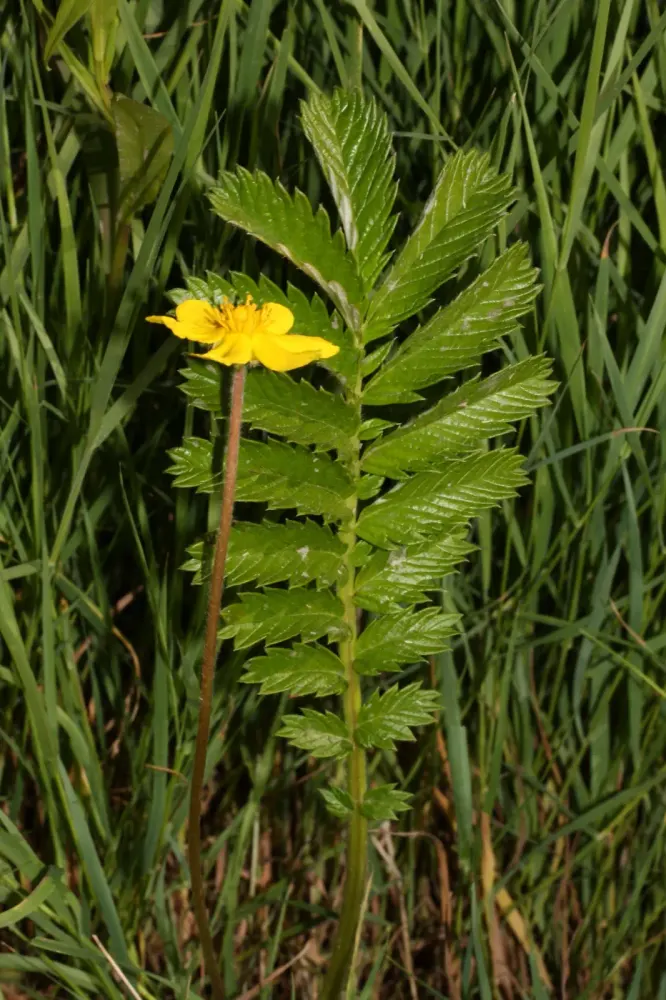
© Walter Siegmund (talk) · CC BY-SA 3.0 · Commons
Argentina anserina
Gemeines_Gänsefingerkraut · (Potentilla anserina)
Rose family (Rosaceae)
Description
Argentina anserina is a perennial flowering plant in the rose family, Rosaceae. It is known by the common names silverweed, common silverweed or silver cinquefoil. It is native throughout the temperate Northern Hemisphere, often on river shores and in grassy habitats such as meadows and road-sides.
- TeaAerial partsInternalCommission E
Infusion of the herb for mild, acute diarrhoea. The German Commission E recognised this indication for Potentillae anserinae herba. The astringent effect is due to the tannin content.
Preparation & dosage
Pour 250 ml boiling water over 2 g dried herb, steep 10 min, strain. Total daily amount 4–6 g crude drug.
- Dry amount
- 4–6 g
- Doses per day
- 3×
- TeaAerial partsInternalCommission E
For mild dysmenorrhoea (menstrual pain), the use of silverweed herb is recognised by the German Commission E. Animal studies show uterine muscle tone- and contraction-enhancing effects.
Preparation & dosage
- Dry amount
- 4–6 g
- Doses per day
- 3×
- GargleAerial partsExternalCommission E
Gargling with a more concentrated infusion for mild inflammation of the oral and pharyngeal mucosa, also recognised by the German Commission E for Potentillae anserinae herba.
Preparation & dosage
- TeaRootInternalTraditional use
The root contains higher tannin levels than the aerial herb and was traditionally used in stronger infusions for diarrhoea and bleeding. The root is considered the most tannin-rich plant part.
Preparation & dosage
- Dry amount
- 2–4 g
- Doses per day
- 2×
- CompressAerial partsExternalFolk medicine
Bruised or powdered herb was applied as a compress for ulcers and wounds. Folk medicine also used it as a local pain remedy for dental and joint complaints.
- RawRootInternalFolk medicine
The carbohydrate-rich roots were used as a food source in various cultures (North America, Tibet) and resemble parsnip in taste. They were especially harvested in spring and autumn.