© Unknown (see Commons) · Public domain · Commons
Lemon balm
CautionZitronenmelisse · (Melissa officinalis)
Mint family (Lamiaceae)
Description
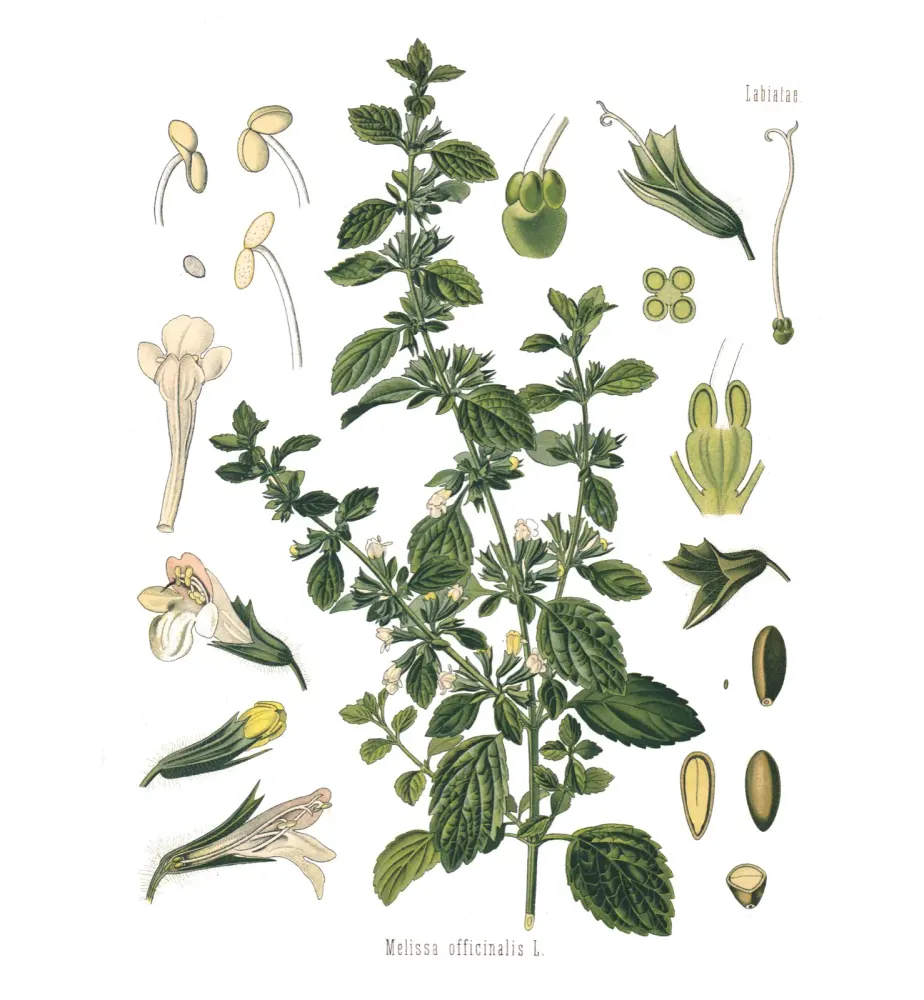
Rub a lemon balm leaf between your fingers and a fine citrus scent is released at once — it comes from an essential oil dominated by geranial and neral, present together with abundant rosmarinic acid in the leaves of this mint-family plant, best harvested before flowering. Folk medicine rightly calls it the "nerve herb": as tea it traditionally eases mild stress and inner restlessness and supports falling asleep, while a tincture is valued for its quick calming effect when travelling. It is also traditionally used for nervous digestive complaints such as bloating, and a lemon balm bath is a traditional way to unwind in the evening. To keep the volatile citral components from escaping, the infusion should always be steeped covered. Anyone with known sensitivity to the mint family should avoid it, and alcohol-based tinctures are unsuitable for pregnant or breastfeeding women, children, or people with liver disease. If complaints persist beyond two weeks, medical advice should be sought.
CONTRAINDICATED for children
Per EMA, not for children under 12 years.
Classic calming tea — relieves mild stress symptoms, inner restlessness, and aids sleep. Folk medicine rightly calls lemon balm the nerve herb.
Preparation & dosage
INFUSION: Pour 150 ml boiling water over 1.5–4.5 g dried lemon balm leaves, cover, steep for 10 minutes, then strain. Drink one cup 1–3 times a day; for inner restlessness or trouble falling asleep, drink the last cup about 30 minutes before bedtime. Covering while steeping is important so the essential oil does not evaporate.
- Dry amount
- 1.5–4.5 g
- Doses per day
- 3×
- Max duration
- 2 weeks
⚠ Age restriction: ≥ 12 years — Per EMA, only for adults and adolescents from 12 years onwards.
Sources: [1]
Tea for mild gastrointestinal complaints with a nervous component.
Preparation & dosage
INFUSION: Pour 150 ml boiling water over 1.5–4.5 g dried lemon balm leaves, cover, steep for 10 minutes, strain. Drink one cup 1–3 times a day between or after meals. Helps with bloating, fullness, and nervously irritated stomach.
- Dry amount
- 1.5–4.5 g
- Doses per day
- 3×
- Max duration
- 2 weeks
⚠ Age restriction: ≥ 12 years — Per EMA, only for adults and adolescents from 12 years onwards.
Sources: [1]
Concentrated form for travel use — acts quickly to calm inner tension.
Preparation & dosage
TINCTURE (1:5 in 45 % ethanol per EMA): 2–6 ml single dose, up to 3 times daily. Drop into a little water or onto a teaspoon of honey. Due to alcohol, not suitable for pregnant or breastfeeding women, children, people with liver disease.
- Liquid amount
- 2–6 ml
- Doses per day
- 3×
- Max duration
- 2 weeks
⚠ Age restriction: ≥ 18 years — Alcohol-containing tinctures only for adults from 18 years.
Sources: [1]
Relaxing evening bath in folk medicine — no EMA-listed indication, but traditionally popular.
Preparation & dosage
LEMON BALM BATH ADDITIVE: Briefly bring 50–100 g of dried lemon balm leaves to a boil in 2 litres of water, cover and steep for 15 minutes, strain, and add to a warm full bath (around 37 °C). Bathe for 15–20 minutes, pat dry gently afterwards.
- Dry amount
- 50–100 g
- Doses per day
- 1×
- Max duration
- 4 weeks
Sources: [1]
If symptoms persist for more than 2 weeks or worsen, consult a doctor. Always steep the tea covered, otherwise the active citral components escape. Do not use in case of known hypersensitivity to Lamiaceae. Tinctures contain alcohol — not suitable for pregnant or breastfeeding women, children, people with liver disease. ASPCA classification (accessed 2026-08-10): non-toxic to dogs and cats.
⏱ Max continuous use: 2 weeks
EMA notes that there is no sufficient data on reproductive and developmental toxicity — use during pregnancy is therefore not recommended.
Insufficient data on safety during breastfeeding — not recommended per EMA.
Per EMA, not for children under 12 years.
Drug interactions
Sedativa / Beruhigungsmittel (GABA-erge Wirkstoffe wie Benzodiazepine, Z-Substanzen, Barbiturate)
Theoretically, the mild sedative effect of lemon balm may add to that of sedatives and sleep medications. Monitor when used concurrently.
Schilddrüsenmedikamente (Levothyroxin, Thyreostatika)
In-vitro studies suggest that lemon balm extracts may inhibit TSH binding to thyroid receptors. With hypothyroidism on levothyroxine substitution, long-term use should be discussed with a doctor.
Contraindications
- Hypersensitivity to lemon balm or other plants of the mint family (Lamiaceae).
- Children under 12 years — not approved due to lack of data.
Harvested part: leaves (before flowering)
- Time of day:
- On a dry, sunny morning once the dew has evaporated, just before flowering.
- Drying:
- Dry the leaves quickly in the shade, airy and in a single layer, at maximum 35 °C. The essential oil is very volatile.
- Storage:
- 12 months — Store in airtight, dark jars — use within a year. If the dried herb hardly smells of lemon any more, it has lost its strength.
- Ätherisches Öl (Citral: Geranial + Neral, Citronellal)Essential oilContent: 0,02–0,3 %Leaf
Carries the characteristic lemon scent. Main components are citral isomers — mildly sedative, antispasmodic, antiviral. Very volatile.
- RosmarinsäurePhenolic acidContent: 1–6 %Leaf
Main water-soluble compound. Antioxidant, mildly anti-inflammatory and antiviral — extracts well into the infusion.
- Flavonoide (Luteolin- und Apigenin-Glykoside)FlavonoidLeaf
Contribute to the antioxidant and mildly calming overall effect.
- Gerbstoffe (Lamiaceen-Gerbstoffe)TanninContent: ca. 4 %Leaf
Mild astringent action on the gastrointestinal mucosa.
- Triterpensäuren (Urs- und Oleanolsäure)OtherLeaf
Mildly anti-inflammatory accompanying compounds.
- BitterstoffeBitterLeaf
Contribute to the mildly digestive effect.
- [1]MonographEMA/HMPC/196745/2012 — European Union herbal monograph on Melissa officinalis L., folium (Final, 14 May 2013)(accessed: 2026-05-18)
- [2]MonographASPCA Animal Poison Control — Lemon Balm (Melissa officinalis): Non-Toxic to Dogs, Non-Toxic to Cats, Non-Toxic to Horses(accessed: 2026-08-10)
Distribution in Europe
🪴 Grow at home
- ☀ Light
- partial shade
- 💧 Water
- every few days
- 🌱 Soil
- Standard herb compost
- 🪴 Pot
- 20 cm
- ⭐ Difficulty
- ★☆☆ beginner
- 🐾 Pets
- non-toxic — verified against the ASPCA list
Tips:
- Partial shade ideal — full sun yellows leaves.
- Aroma strongest before flowering.
- In pot only 2-3 years — then divide or re-sow.
Care tips are general indoor-gardening recommendations, not scientific sources.
🤝 Permaculture Partners
In your garden, this plant acts as: