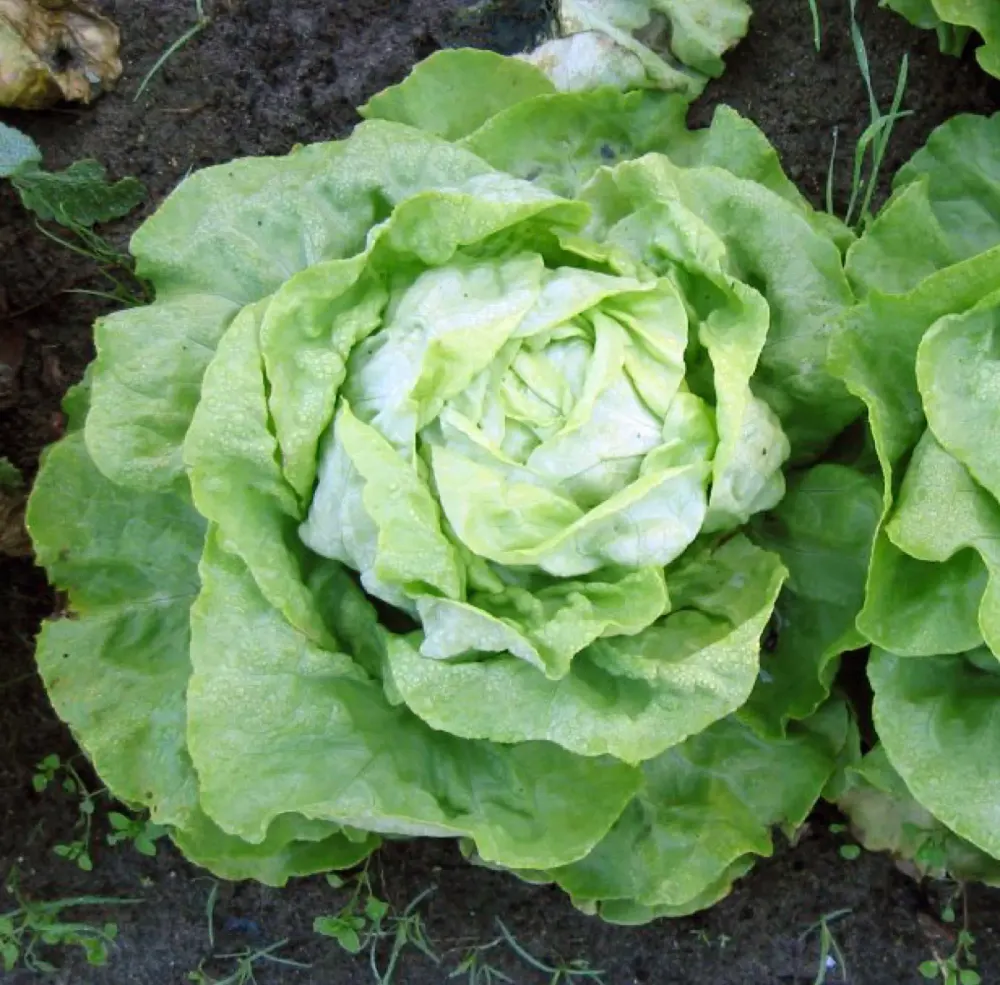
© Rasbak · CC BY-SA 3.0 · Commons
Lettuce
Kopfsalat · (Lactuca sativa var. capitata)
Daisy family (Asteraceae)
Description
Lettuce is an annual plant of the family Asteraceae mostly grown as a leaf vegetable. The leaves are most often used raw in green salads, although lettuce is also seen in other kinds of food, such as sandwiches, wraps and soups; it can also be grilled. Its stem and seeds are sometimes used; celtuce is one variety grown for its stems, which are eaten either raw or cooked.
- RawLeafInternalClinical trial
Lettuce is the world's most widely consumed raw vegetable. 100 g supplies approx. 102 µg vitamin K (about 85 % DV), 73 µg folate, 166 µg RAE vitamin A (from beta-carotene), 238 mg potassium and only 13 kcal — making it an ideal satiety vegetable with low energy density. The tender, water-rich leaves (95.5 % water) provide dietary fibre, support intestinal peristalsis and promote hydration. Consumed raw in salads, sandwiches, wraps or briefly braised — classic early-summer vegetable, often the first outdoor crop harvested in German-speaking regions.
[#src_usda_lettuce] [#src_wp_en_lettuce] [#src_wp_de_kopfsalat] [#src_nutritionvalue_lettuce]
- RawLeafInternalClinical trial
Lettuce and other Lactuca varieties with dark green leaves are significant sources of beta-carotene (provitamin A). 100 g of butterhead lettuce supplies approx. 166 µg RAE vitamin A — comparable to butterhead types (Boston, Bibb). Beta-carotene is an antioxidant compound and precursor of vitamin A, essential for visual function, immune defence and skin integrity. Dark green outer leaves contain 4–8× more beta-carotene than pale inner leaves — these should be eaten rather than discarded.
[#src_nutritionvalue_lettuce] [#src_wp_en_lettuce] [#src_usda_lettuce]
- RawLeafInternalFolk medicine
Lettuce contains small amounts of the sesquiterpene lactones lactucin and lactucopicrin in its milky sap — the same bitter compounds concentrated in the related wild lettuce (Lactuca virosa) as lactucarium. In European folk medicine of the 17th–19th centuries, eating a head lettuce before bedtime was regarded as a sleep-promoting home remedy. Animal studies confirm sedative and analgesic effects of lactucin and lactucopicrin; at normal salad consumption levels, concentrations are too low for a pharmacological effect.
[#src_wp_en_lactucarium] [#src_pfaf_lactuca] [#src_wp_en_lactucopicrin]
- RawLeafInternalFolk medicine
In traditional phytotherapy (PFAF, Grieve), Lactuca species are described as mildly diuretic, slightly antispasmodic and calming (nervine). The milky sap (lactucarium) from flowering plants was sold in pharmacies in the 19th century as a cough remedy and mild sedative. Cultivated lettuce has very low lactucarium content compared to Lactuca virosa; the recorded uses refer primarily to wild species and flowering plants.
- RawLeafInternalClinical trial
Lettuce is a relevant vitamin K source: 100 g of butterhead types supplies approx. 102 µg vitamin K1 — about 85 % of the daily requirement. Vitamin K is essential for blood coagulation (factors II, VII, IX, X) and bone mineralisation (osteocalcin activation). Dark-green lettuce varieties (unlike iceberg lettuce) supply significantly more vitamin K. Patients on anticoagulant therapy should keep their daily vitamin K intake consistently stable.
[#src_nutritionvalue_lettuce] [#src_usda_lettuce] [#src_wp_en_lettuce]
- RawLeafInternalTraditional use
The flowering or bolting of lettuce is evaluated positively in folk medicine: in Central European folk belief, the milky sap of the bolting plant was considered especially valuable (bitter, concentrated). In everyday cooking, bolting plants are however usually discarded. Horticulturally important: harvest lettuce before bolting in cool weather with even watering, as bitterness and toughness of leaves increase.
[#src_wp_en_lactucarium] [#src_pfaf_lactuca] [#src_wp_de_kopfsalat]
- RawSeedInternalFolk medicine
Lettuce seeds can be sprouted and eaten as sprouts — they are rich in proteins and contain germination-active enzymes. In the traditional cooking of the Middle East and Central Asia, lettuce seeds are occasionally pressed for oil (lettuce oil). The oil is edible, but not economically significant due to small seed size (PFAF). Consume seed sprouts 3–5 days after sprouting at room temperature, then refrigerate.
🤝 Permaculture Partners
In your garden, this plant acts as:
✨ Best symbiotic partners
- 🌿 Onion Classic companion-planting partner.
- 🌿 Chives Chives distract aphids and keep lettuce pests away.
- 🌿 Beetroot Classic companion-planting partner.
- 🌿 Cabbage Classic companion-planting partner.
- 🌿 Broccoli Classic companion-planting partner.
- 🌿 Cucumber Classic companion-planting partner.
- 🌿 Carrot Classic companion-planting partner.
- 🌿 Eruca sativa Classic companion-planting partner.
- 🌿 Fragaria vesca Lettuce as ground cover between strawberry rows.
- 🌿 Parsnip Classic companion-planting partner.
- 🌿 Pea Classic companion-planting partner.
- 🌿 Black_Spanish_radish Classic companion-planting partner.
- 🌿 Radish Classic: radishes fast, lettuce slow — perfect row companions.
- 🌿 Rhubarb Lettuce as ground cover beneath the large rhubarb leaves.
- 🌿 Spinach Classic companion-planting partner.
⚠️ Better not planted together
📦 Part of these planting sets:
Source: Gertrud Franck, Gesunder Garten durch Mischkultur (1980, eigene Kuration) | Helga und Margarete Langerhorst, Mein gesunder Naturgarten (eigene Kuration)