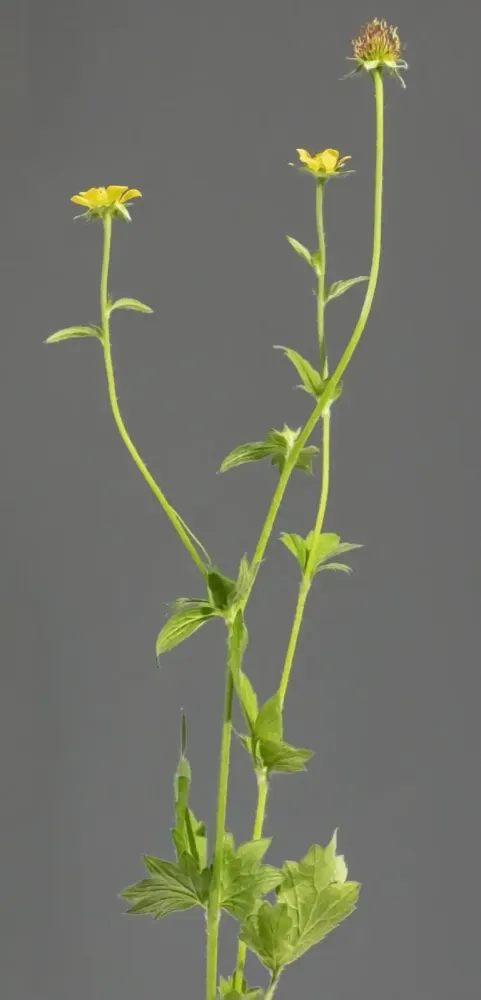
© Didier Descouens · CC BY-SA 4.0 · Commons
Geum urbanum
Echte Nelkenwurz · (Geum urbanum)
Rose family (Rosaceae)
Description
Rubbing the freshly dug root of wood avens releases a scent of cloves, owed to the aromatic compound eugenol it contains and the source of one of its common names. The root is harvested in autumn and, besides eugenol, is rich in gallotannins along with caffeic and chlorogenic acid. A decoction of the root is traditionally drunk for digestive complaints and used externally as a gargle for sore throat, while poultices have folk use on minor wounds as well. No side effects are known with ordinary use. Because the clove-like aroma fades progressively as the dried root is stored, it is best ground shortly before use to preserve its full potency.
Root infusion or decoction of dried wood avens rhizomes for diarrhoea, stomach cramps and digestive disorders. Classical folk-medicinal indication; tannins (approx. 9% according to PFAF) exert an astringent effect in the gut.
Preparation & dosage
Bring 2–4 g of dried, chopped root with 250 ml cold water to a brief boil and steep 15 minutes; strain. Up to 3 cups daily, freshly prepared (volatile eugenol is lost on prolonged storage).
- Dry amount
- 2–4 g
- Doses per day
- 3×
Cooled root decoction as mouthwash and gargle for dental and gum problems, aphthous ulcers, throat irritation and halitosis. The combination of tannins and eugenol acts antiseptic and astringent.
Preparation & dosage
Prepare decoction as for tea; cool to body temperature and rinse or gargle several times daily.
- Dry amount
- 3–5 g
Compresses soaked in root decoction for haemorrhoids, eczema and poorly healing wounds. Astringent gallotannins and ellagitannins constrict tissue and inhibit microorganisms.
Fresh root used as a spice – the clove-like eugenol aroma was historically popular as a beer flavouring (e.g. Augsburg ale). Also recorded as a seasoning for soups and broths.
Root infusion in folk medicine as a febrifuge and diaphoretic for infectious diseases. PFAF documents antipyretic and diaphoretic properties of the drug.
Sources: [1]
Foot baths with strong root decoction recorded in folk medicine for frostbite and chilblains. PFAF explicitly mentions this application.
Sources: [1]
No known side effects with normal use. Eugenol: the characteristic clove aroma is a quality marker – pronounced in fresh root, increasingly lost during storage of the dried drug. Grind the root ideally shortly before use.
Insufficient safety data for medicinal use during pregnancy.
No data on use during breastfeeding.
No data for children under 12 years; medicinal use should be avoided as a precaution.
Contraindications
- Known hypersensitivity to eugenol or Rosaceae.
Harvested part: root (autumn)
- Time of day:
- Morning on dry days; PFAF recommends spring harvest (March-April) for highest eugenol content.
- Drying:
- Wash roots immediately after harvest, slice and dry at 35–40 °C. Eugenol is volatile: dry only briefly and use soon; grind only shortly before use.
- Storage:
- 6 months — In airtight containers, cool and dark. Eugenol content decreases noticeably during storage.
- Time of day:
- Harvest young leaves in the morning; can be prepared like spinach or added to soups.
- Drying:
- Dry leaves at max. 40 °C or use fresh.
- Storage:
- 12 months
- EugenolEssential oilContent: 0.1-0.2 %Root
Main component of the fresh root essential oil; produces the characteristic clove scent. Released by enzymatic hydrolysis of the glycoside gein.
- Gein (Eugenyyl-vicianosid)GlycosideRoot
Precursor glycoside of eugenol; split into eugenol and the disaccharide vicianose by plant-own hydrolases upon cell disruption.
- GallotannineTanninContent: ca. 9 %Root
Main tannin group of the root; hydrolysable tannins with strongly astringent action on mucous membranes and wounds.
- EllagitannineTanninRoot
Hydrolysable tannins alongside gallotannins; antimicrobially active.
- KaffeesäurePhenolic acidRoot
Phenolic carboxylic acid; antioxidant and mildly anti-inflammatory.
- ChlorogensäurePhenolic acidRoot
Phenolic carboxylic acid; antioxidant; present in leaves and fruits as well.
- GallussäurePhenolic acidRoot
Free phenolic carboxylic acid; hydrolysis product of gallotannins; astringent and antimicrobial.
- [1]BookPlants For A Future – Geum urbanum(accessed: 2026-05-21)
- [2]WikipediaEchte Nelkenwurz (Wikipedia DE)(accessed: 2026-05-16)
- [3]WikipediaGeum urbanum (Wikipedia EN)(accessed: 2026-05-21)