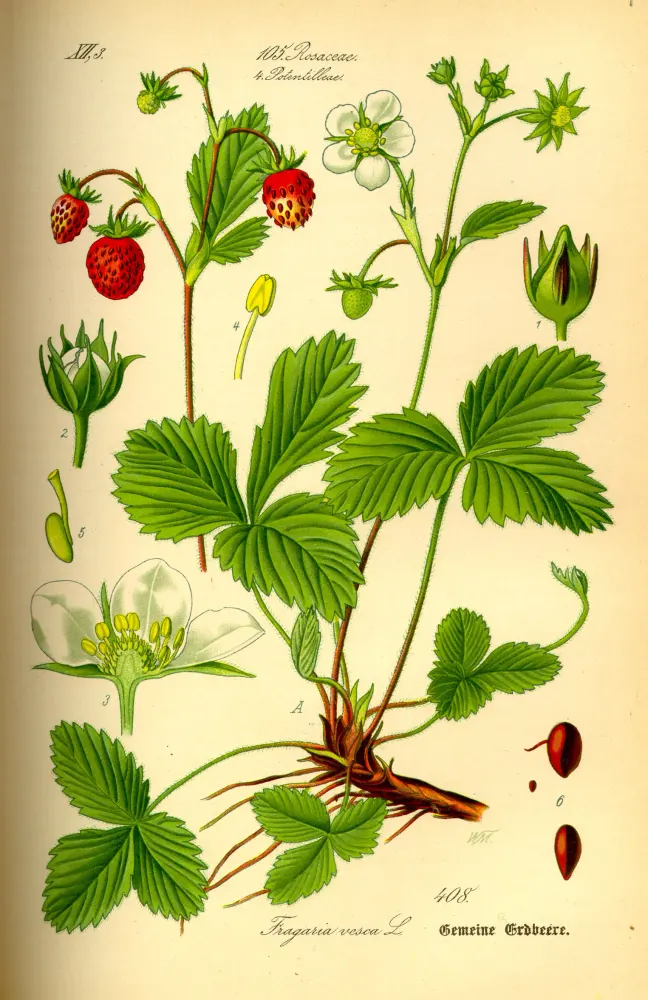
© Unknown (see Commons) · Public domain · Commons
Fragaria vesca
Wald-Erdbeere · (Fragaria vesca)
Rose family (Rosaceae)
Description
Fragaria vesca, commonly called the woodland strawberry, Alpine strawberry, wild strawberry, Carpathian strawberry or European strawberry, is a perennial herbaceous plant in the rose family that grows naturally throughout much of the Northern Hemisphere, and that produces edible fruits.
- TeaLeafInternalTraditional use
Infusion of dried wild strawberry leaves for diarrhoea, gastric complaints, and loss of appetite. The ellagitannins and tannins (up to 12 % in older leaves) have an astringent effect on the intestinal mucosa.
Preparation & dosage
Pour 250 ml boiling water over 3–5 g dried leaves, steep 10 minutes, strain. Up to 3 cups daily.
- Dry amount
- 3–5 g
- Doses per day
- 3×
[#src_wp_de_fragaria] [#src_dr_hauschka_fragaria] [#src_wp_en_fragaria]
- GargleLeafExternalFolk medicine
Concentrated leaf infusion as a gargle for inflammation of the oral mucosa, gingivitis, and throat inflammation. The astringent tannins cause the mucous membranes to contract.
Preparation & dosage
5–8 g leaves with 200 ml boiling water, steep 15 min. Gargle several times daily; do not swallow.
- Dry amount
- 5–8 g
- RawFruitInternalFolk medicine
Ripe wild strawberries are rich in vitamin C, anthocyanins, and ellagic acid. Eaten fresh they provide antioxidant compounds and support immune function. More intense flavour than cultivated strawberries.
- TinctureLeafInternalFolk medicine
Tincture of wild strawberry leaves (1:5, 40–60 % ethanol) as a concentrated form for astringent and diuretic use. Traditionally also used for gout and rheumatism.
- TeaLeafInternalFolk medicine
In folk medicine, leaves combined with vine leaves were used as a liver tea. Dr. Hauschka describes the leaves as supportive for liver and gallbladder. Evidence limited to traditional use.
- RawFruitExternalFolk medicine
Mashed ripe fruits were traditionally applied as a face mask for skin blemishes. Ellagic acid inhibits melanin formation in vitro; extracts from fruits and leaves are therefore used in cosmetics.
Distribution in Europe
🤝 Permaculture Partners
In your garden, this plant acts as:
✨ Best symbiotic partners
- 🌿 Leek Leek deters strawberry pests.
- 🌿 Garlic Garlic deters strawberry fungi (grey mould).
- 🌿 Chives Chives protect strawberry from fungi (grey mould).
- 🌿 Allium ursinum Classic companion-planting partner.
- 🌿 Borage Borage attracts pollinators to strawberry blossoms and strengthens the plant.
- 🌿 Calendula officinalis Classic companion-planting partner.
- 🌿 Hyssopus officinalis Classic companion-planting partner.
- 🌿 Lettuce Lettuce as ground cover between strawberry rows.
- 🌿 Lettuce Classic companion-planting partner.
- 🌿 Parsley Classic companion-planting partner.
- 🌿 Spinach Spinach as ground cover provides nitrogen for strawberry roots.
- 🌿 Tagetes patula Marigold deters root nematodes around strawberries.
- 🌿 Thymus vulgaris Thyme as ground cover deters slugs.
⚠️ Better not planted together
- 🥬 Cabbage Cabbage and strawberry compete for nutrients and water.
- 🥬 Broccoli Classic companion-planting partner.
📦 Part of these planting sets:
Source: Helga und Margarete Langerhorst, Mein gesunder Naturgarten (eigene Kuration)