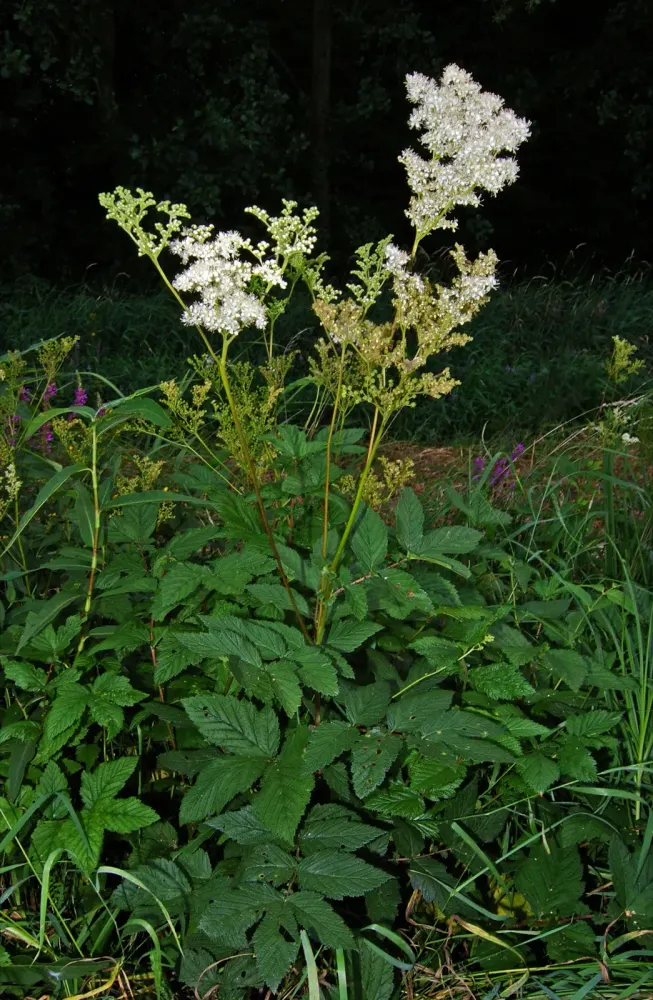
© Christian Fischer · CC BY-SA 3.0 · Commons
Filipendula ulmaria
CautionEchtes Mädesüß · (Filipendula ulmaria)
Rose family (Rosaceae)
Description
Filipendula ulmaria, commonly known as meadowsweet or mead wort, is a perennial herbaceous plant in the family Rosaceae that grows in damp meadows. It is native throughout most of Europe and Western Asia. It has been introduced and naturalised in North America.
CONTRAINDICATED during pregnancy
Meadowsweet is contraindicated in pregnancy. Salicylates cross the placenta and are associated with increased risk of fetal cardiac defects (premature closure of the ductus arteriosus), growth retardation, prolonged labour and bleeding time, and postpartum haemorrhagic complications. External use (bath, compress) should also be avoided in pregnancy. EMA and ESCOP explicitly advise against meadowsweet preparations throughout pregnancy.
CONTRAINDICATED during breastfeeding
Meadowsweet is contraindicated during lactation. Salicylates pass into breast milk and may cause bleeding tendency, Reye syndrome risk, and gastric irritation in the infant. EMA/ESCOP recommend completely avoiding meadowsweet preparations during breastfeeding.
CONTRAINDICATED for children
Meadowsweet preparations (tea, tincture, bath) are CONTRAINDICATED in children/adolescents under 12 with febrile viral infections (cold, flu, chickenpox) — Reye syndrome risk from salicylates. In children over 12 and adolescents without acute viral infection, meadowsweet tea may be used cautiously; Kommission E monograph applies from age 12. Parents should always consult a doctor or pharmacist before use in children.
Critical drug interactions with:
Antikoagulanzien und Thrombozytenaggregationshemmer (Warfarin, Phenprocoumon, Heparin, Clopidogrel, ASS) · Nichtsteroidale Antirheumatika / NSAIDs (Ibuprofen, Diclofenac, Naproxen, Indometacin) · Methotrexat
- TeaFlowerInternalCommission E
Flower infusion for feverish colds and influenza-like illness — Kommission E positive monograph based on natural salicylate compounds.
Preparation & dosage
FLOWER INFUSION (Kommission E): 2–3 g dried meadowsweet flowers in 250 ml boiling water, covered, steep 10 min, strain. 3–4× daily, warm, combined with adequate fluid intake during feverish colds. Daily dose 6–9 g. Kommission E rates use in common colds as positive. Effect attributed to natural salicylate compounds (spiraeosides, salicylaldehyde) — weaker than synthetic ASA but gentler. Do NOT use with known salicylate hypersensitivity, ASA/NSAID-induced asthma. Not for children under 12 with fever (Reye syndrome risk). Duration: max. 2 weeks without medical supervision.
- Dry amount
- 2–3 g
- Doses per day
- 3×
- Max duration
- 2 weeks
⚠ Age restriction: ≥ 12 years — Not for children under 12 with fever — Reye syndrome risk from salicylates. Kommission E monograph applies to adults and adolescents from age 12.
[#src_kommission_e_filipendula] [#src_ema_filipendula_flos] [#src_escop_filipendulae_flos] [#src_wichtl_filipendula]
- TeaAerial partsInternalTraditional use
Traditional herb tea from flowering meadowsweet for digestive complaints and mild joint discomfort — EMA traditional use.
Preparation & dosage
HERB TEA (Herba Filipendulae ulmariae): 4–6 g dried flowering meadowsweet herb (leaves + flowers) in 500 ml boiling water, covered, steep 12–15 min, strain. Divide daily dose into 3 cups after meals. Traditional use (EMA traditional) for GI complaints (nausea, mild cramps, acid belching) and adjunctively for mild joint complaints. Astringent tannins (ellagitannins) calm the gastric mucosa; salicylates contribute anti-inflammatory activity. CAUTION: meadowsweet contains salicylates — do not use with gastric ulcers or erosive gastritis, as salicylates may irritate mucosa. Not simultaneously with warfarin or anticoagulants. Max. 4 weeks without physician.
- Dry amount
- 4–6 g
- Doses per day
- 3×
- Max duration
- 4 weeks
⚠ Age restriction: ≥ 12 years — From age 12. Contraindicated in children under 12 due to Reye syndrome risk.
[#src_ema_filipendula_flos] [#src_escop_filipendulae_flos] [#src_wichtl_filipendula] [#src_pfaf_filipendula]
- TinctureAerial partsInternalTraditional use
Traditional meadowsweet herb tincture as mild analgesic and antipyretic — alternative to tea when ethanol is acceptable.
Preparation & dosage
TINCTURE (DAC, 1:5 in 25–45 % ethanol): 2–4 ml (~40–80 drops) 3× daily, stirred into water, after meals. Daily dose 6–12 ml tincture. Traditionally used as antirheumatic and analgesic for mild joint and muscle pain, and for fever reduction. Ethanol-based preparation extracts salicylate glycosides and phenolic compounds (spiraeosid, rutin) more efficiently than plain water. Not for children, not in pregnancy/lactation. Avoid concurrent anticoagulant use (warfarin, phenprocoumon).
- Liquid amount
- 2–4 ml
- Doses per day
- 3×
- Max duration
- 3 weeks
⚠ Age restriction: ≥ 18 years — Adults only. Ethanol content and salicylates exclude children.
[#src_escop_filipendulae_flos] [#src_wichtl_filipendula] [#src_madaus_filipendula]
- BathAerial partsExternalFolk medicine
Folk meadowsweet herbal bath for rheumatic complaints and muscle soreness — aromatic and warming.
Preparation & dosage
HERBAL BATH / PARTIAL BATH: 100–150 g dried meadowsweet herb (or fresh flowers and leaves) in 3 litres boiling water, covered, steep 20 min, strain, add decoction to bath water (36–38 °C). Full bath 15–20 min, partial bath (hands, feet, knees) 10–15 min. Folk use for rheumatic joint complaints, muscle soreness, gout, and as a relaxing aromatic bath. Aromatic flower scent (salicylaldehyde, methyl salicylate) contributes to wellbeing. CAUTION: salicylates may be absorbed transdermally — avoid with known salicylate hypersensitivity or open skin wounds. Avoid full baths in hypertension, heart failure, or varicose veins (consult doctor).
- Dry amount
- 100–150 g
[#src_pfaf_filipendula] [#src_madaus_filipendula] [#src_wp_de_filipendula]
- TeaFlowerInternalFolk medicine
Gentle flower infusion used in folk medicine as irrigation therapy for UTIs, for heartburn, and as a diaphoretic.
Preparation & dosage
GENTLE FLOWER INFUSION (folk): 1–2 tsp dried meadowsweet flowers in 200 ml hot (not boiling, ~85 °C) water, steep 6–8 min — shorter steeping for a mild, aromatic-almond flavour. Strain, light honey possible. 1–2 cups daily. Folk use as a mild diuretic adjunct for mild UTIs (irrigation therapy with plenty of water), for heartburn, and as a mild diaphoretic. The salicylaldehyde scent of the flowers is the most characteristic identifying feature. No long-term self-treatment of UTIs without medical evaluation.
- Dry amount
- 1–2 g
- Doses per day
- 2×
- Max duration
- 2 weeks
[#src_pfaf_filipendula] [#src_madaus_filipendula] [#src_wp_en_filipendula]
- CompressAerial partsExternalFolk medicine
Folk meadowsweet herb compresses for gout, rheumatism, bruises, and insect stings.
Preparation & dosage
COMPRESS / POULTICE: 10–15 g dried meadowsweet herb (leaves + flowers) in 300 ml boiling water, covered 15 min, strain. Cool to body temperature (~37 °C). Soak clean linen or cotton cloth in infusion, wring out, apply to painful area (joint, muscles) for 20–30 min. Folk use for gout, rheumatism, bruises, and minor wounds. Applied cool also for insect bites and mild sunburn. Tannins act astringent and mildly antiseptic; salicylates contribute to local relief. Not on open wounds or inflamed weeping skin.
- Dry amount
- 10–15 g
[#src_pfaf_filipendula] [#src_wp_de_filipendula] [#src_madaus_filipendula]
- SpiceFlowerInternalFolk medicine
Culinary use of meadowsweet flowers as an aromatic plant — beverages, desserts, jams; historically for mead and ale flavouring.
Preparation & dosage
CULINARY AND BEVERAGES: Fresh meadowsweet flowers have an intense almond-salicylaldehyde aroma — ideal for flavouring. Uses: (1) add fresh plucked flowers to white wine or apple juice, cold-infuse 2–4 h → aromatic summer drink; (2) briefly heat flowers in cream (do not boil), strain → panna cotta base; (3) dry flowers as a spice in jams, jellies and compotes; (4) fresh flowers as edible decoration on desserts and salads; (5) layer flowers with sugar in a jar → meadowsweet sugar (1–2 weeks in fridge); (6) historically used to flavour mead (hence the name 'meadowsweet') and ale. Use sparingly — intense flavour. Persons with salicylate sensitivity should avoid.
[#src_pfaf_filipendula] [#src_wp_en_filipendula] [#src_wp_de_filipendula]