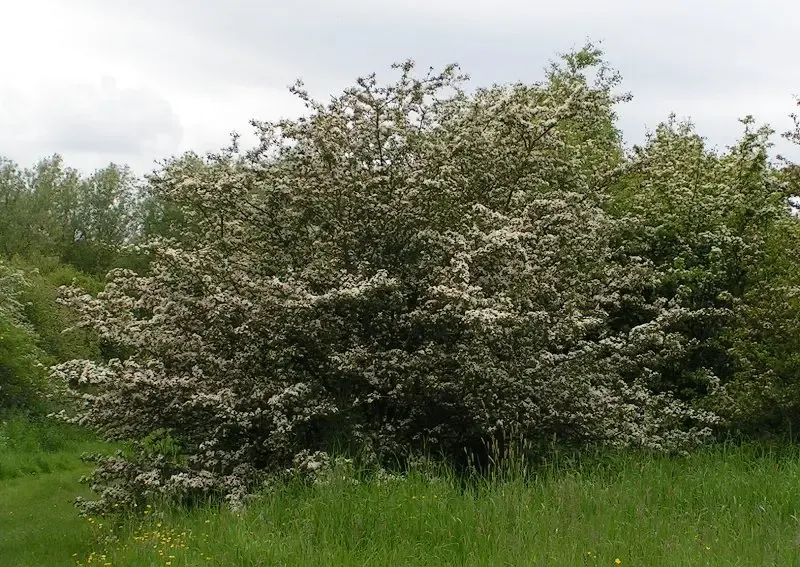
© Unknown (see Commons) · CC BY-SA 3.0 · Commons
Crataegus monogyna
CautionEingriffeliger Weißdorn · (Crataegus monogyna)
Rose family (Rosaceae)
Description
Crataegus monogyna, known as common hawthorn, whitethorn, one-seed hawthorn, or single-seeded hawthorn, is a species of flowering plant in the rose family, Rosaceae. It grows to about 10 metres tall, producing hermaphrodite flowers in late spring. The berry-like pomes contain a stone-encased seed.
- TinctureAerial partsInternalEMA well-established
Standardised dry extract (well-established use) for supportive treatment of mild heart failure NYHA II — leading preparation WS 1442.
Preparation & dosage
STANDARDISED DRY EXTRACT (EMA well-established use): Standardised dry extracts of hawthorn leaf with flower (e.g. WS 1442, LI 132), DER 4–7:1, ethanol 45 % m/m or methanol 70 % V/V, standardised to 18.75 % oligomeric procyanidins. Daily dose 160–900 mg, split into 2–3 single doses with meals. Indication: supportive treatment of declining cardiac performance corresponding to NYHA stage II (mild exertional dyspnoea, chest pressure, fatigue). Effect onset after 4–6 weeks — no acute action. Do not self-medicate confirmed heart failure; hawthorn is adjunctive. Worsening symptoms, oedema, dyspnoea at rest or chest pain require immediate medical attention.
- Liquid amount
- 5–10 ml
- Doses per day
- 3×
- Max duration
- 6 weeks
⚠ Age restriction: ≥ 18 years — Per EMA, adults only — insufficient data for children/adolescents under 18.
[#src_ema_crataegi_folium_cum_flore] [#src_escop_crataegi_folium_cum_flore] [#src_kommission_e_crataegi]
- TeaAerial partsInternalTraditional use
Traditional infusion of leaf with flower for nervous mild cardiac complaints (NYHA II supportive) after medical evaluation.
Preparation & dosage
INFUSION: 1–1.5 g of finely cut hawthorn leaf with flower in 150–250 ml boiling water, covered, steep 10–15 min, strain. 2–3× daily fresh, between meals. Daily dose ~3–4.5 g. Traditional use (EMA traditional) for mild nervous cardiac complaints (palpitations, chest pressure) after exclusion of serious causes. Slow acting — patience for 2–4 weeks. Beyond 6 weeks without improvement, consult doctor.
- Dry amount
- 1–1.5 g
- Doses per day
- 3×
- Max duration
- 6 weeks
⚠ Age restriction: ≥ 18 years — Per EMA, adults only.
[#src_ema_crataegi_folium_cum_flore] [#src_kommission_e_crataegi] [#src_escop_crataegi_folium_cum_flore]
- TinctureAerial partsInternalTraditional use
Traditional tincture for mild nervous cardiac complaints — alternative to tea when ethanol is acceptable.
Preparation & dosage
TINCTURE (DER 1:5 in 45–70 % ethanol): 1–2 ml (~20–40 drops) 3× daily, diluted in water, before or between meals. Effect after 2–4 weeks of continuous use. If complaints persist beyond 6 weeks, consult a doctor. Traditional use for mild nervous cardiac complaints (palpitations, restlessness), not for acute treatment.
- Liquid amount
- 1–2 ml
- Doses per day
- 3×
- Max duration
- 6 weeks
⚠ Age restriction: ≥ 18 years — Adults only. Due to ethanol content not for alcohol dependence, liver disease, or epilepsy.
[#src_ema_crataegi_folium_cum_flore] [#src_escop_crataegi_folium_cum_flore]
- TeaFlowerInternalFolk medicine
Folk calming and sleep tea from hawthorn flowers — mild nervine, often blended with lemon balm or valerian.
Preparation & dosage
FOLK EVENING TEA: 1–2 tsp dried hawthorn flowers (optionally with lemon balm or valerian) in 250 ml hot water, covered, steep 8–10 min, strain. 1 cup late afternoon and 1 cup ~30 min before bedtime. Folk use for mild calming with restlessness and nervous trouble falling asleep. NOT a pharmacological sedative — mild adjunct. For chronic sleep problems, seek medical evaluation.
- Dry amount
- 1–2 g
- Doses per day
- 2×
- Max duration
- 4 weeks
- TeaFruitInternalFolk medicine
Folk berry decoction for menopausal complaints, mild restlessness and sleep issues — WHO lists Fructus Crataegi as a traditional cardiovascular remedy.
Preparation & dosage
BERRY TEA: 2–3 tsp dried, lightly crushed hawthorn berries in 250 ml cold water, bring to boil, simmer 10–15 min (decoction), strain. 1–2 cups daily. Folk use for menopausal complaints (hot flushes, restlessness, climacteric palpitations) and mild sleep support. Milder action than leaf-flower preparation — berries differ in compound profile (more procyanidins, fewer flavonoids). Adjunctive use only.
- Dry amount
- 2–3 g
- Doses per day
- 2×
- Max duration
- 6 weeks
[#src_who_fructus_crataegi] [#src_madaus_1938] [#src_pfaf_crataegus_monogyna]
- SpiceFruitInternalFolk medicine
Edible berry — jam, jelly, liqueur, flour substitute; traditional famine food and sweet-tart wild fruit.
Preparation & dosage
KITCHEN: Fully ripe deep-red hawthorn berries (Sept–Oct, sweetest after first frost) are edible — mealy, mildly sweet-tart. Uses: cooked into jam, jelly or fruit butter (remove stones or press through sieve — the hard stone is inedible), added to apple sauce, infused as hawthorn liqueur (with sugar and spirit, 6–8 weeks), dried and ground as flour substitute (up to ~25 %). Traditional farm/famine food, roasted as coffee substitute in hard times.