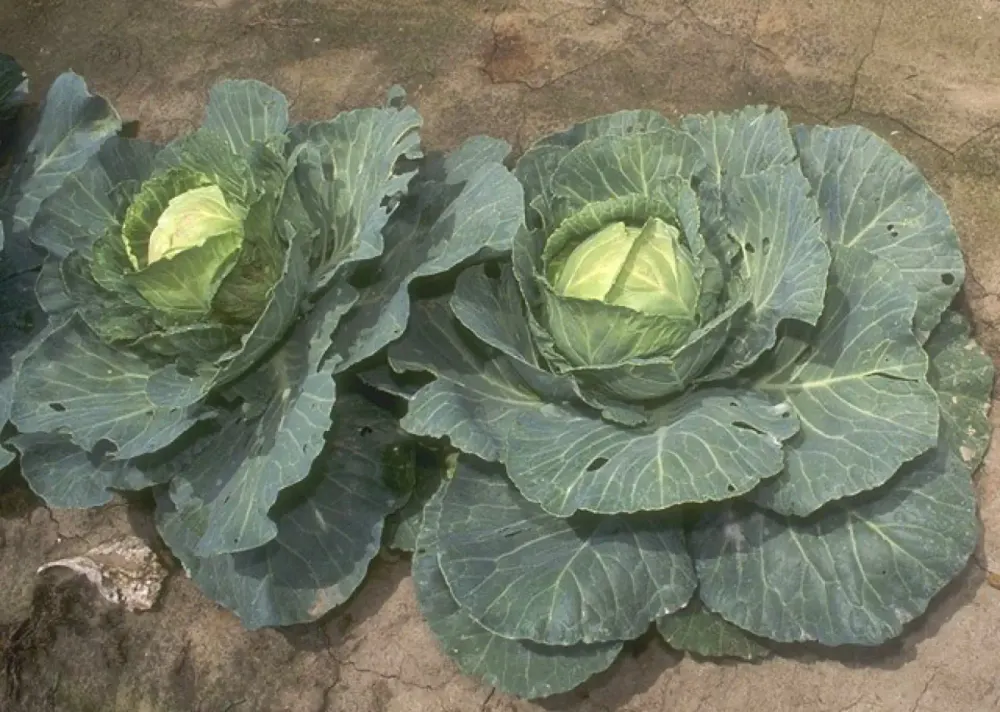
© Bill Tarpenning · Public domain · Commons
Cabbage
Weißkohl · (Brassica oleracea convar. capitata var. alba)
Cabbage family (Brassicaceae)
Description
Cabbage, comprising several cultivars of Brassica oleracea, is a leafy green, red (purple), or white biennial plant grown as an annual vegetable crop for its dense-leaved heads. It is descended from the wild cabbage, and belongs to the "cole crops" or brassicas, meaning it is closely related to broccoli and cauliflower ; Brussels sprouts ; and Savoy cabbage.
- RawLeafInternalTraditional use
Raw white cabbage as food — rich in vitamin C (approx. 36–54 mg/100 g fresh), vitamin K, folate and glucosinolates. Traditionally served as coleslaw (Krautsalat), finely sliced or grated, with a vinegar-oil dressing. High water content, crisp texture. Regular consumption provides antioxidant protection; glucosinolates (glucobrassicin, sinigrin) are converted by the enzyme myrosinase during chewing into isothiocyanates, which epidemiological studies associate with a lower risk of certain cancers. For maximum vitamin C retention, eat raw or briefly cooked.
[#src_usda_fdc_cabbage] [#src_wp_en_cabbage] [#src_wp_de_weisskohl]
- RawLeafInternalTraditional use
Sauerkraut — white cabbage fermented by lactic acid fermentation. Traditional preservation method in Central and Eastern Europe: finely sliced cabbage is pounded with salt (approx. 1.5–2 % of cabbage weight) until juice is released, then fermented anaerobically (2–4 weeks at room temperature). Fermentation significantly increases vitamin C bioavailability; traditionally used to prevent scurvy on long sea voyages (Captain Cook's fleet). Lactic acid bacteria (Lactobacillus plantarum, Leuconostoc mesenteroides) act as probiotics and can beneficially influence gut flora. Sauerkraut is more digestible than fresh cabbage and less flatulent.
[#src_wp_en_cabbage] [#src_wp_de_weisskohl] [#src_pfaf_brassica]
- RawLeafInternalTraditional use
Fresh white cabbage juice (approx. 200–500 ml daily) — folk medicine tradition for adjunctive support of gastric and duodenal ulcers. Contains S-methylmethionine (formerly called 'vitamin U', no longer classified as a vitamin), a sulfur-containing amino acid derivative compound to which mucosa-protective properties are attributed. The tradition traces back to observations by Dr Garnett Cheney (Stanford, 1940s–1950s), who documented healing outcomes with raw cabbage juice in ulcer patients. More modern studies are limited and variable in quality; not recommended as a substitute for medically prescribed ulcer therapy (proton pump inhibitors, H. pylori eradication). Folk use in Germany, Austria, Eastern Europe.
[#src_pfaf_brassica] [#src_wp_en_cabbage] [#src_wikidata_brassica]
- CompressLeafExternalClinical trial
Cabbage leaf compress (cold wrap) for mastitis (breast engorgement / lactation mastitis): fresh, chilled white cabbage leaves (remove outer leaves, wash inner ones, optionally score the central rib flat) are applied to the affected breast for 20–30 minutes or until warmed, 2–3 times daily. Several randomised controlled trials and systematic reviews (e.g. Snowden et al. 2001, Boi et al. 2012) show significant pain reduction and improved breastfeeding capacity compared to warm compresses or control. Mechanism unclear — hypotheses: cooling effect, pressure relief, isothiocyanates or sinapic acid with anti-inflammatory properties. The cabbage leaf wrap is an accepted complementary measure but does not replace medical treatment for infective mastitis.
- CompressLeafExternalFolk medicine
Cabbage leaf compress for joint pain and arthritis: traditional folk medicine in Germany, Austria and Switzerland. Fresh white cabbage leaves (gently warmed or cold, by preference) are applied to the affected joint (knee, ankle), secured with a cloth, and left overnight or for several hours. Also used in folk medicine for phlebitis and leg ulcers. Clinical evidence for the joint indication is weaker than for mastitis; some smaller studies and case reports suggest pain relief. Accepted as a low-risk adjunct for mild joint complaints; does not replace rheumatological or orthopaedic treatment.
- RawLeafInternalFolk medicine
White cabbage as a kitchen vegetable — cooked: blanched, braised, steamed or in soups and stews (e.g. cabbage soup, bigos, borscht). Prolonged cooking with the lid on produces hydrogen sulfide, creating the characteristic overcooked cabbage smell; brief blanching or steaming reduces this. Regionally typical: cabbage rolls (leaves as wrap for minced meat filling), noodles with cabbage, braised sauerkraut as a side dish. White cabbage provides dietary fibre (2–2.5 g/100 g), potassium and B-vitamins; vitamin C is partially lost during cooking. Frost-tolerant storage vegetable, traditionally kept in supply through winter.
[#src_usda_fdc_cabbage] [#src_wp_de_weisskohl] [#src_pfaf_brassica]
- SpiceLeafInternalFolk medicine
White cabbage in fermented products beyond sauerkraut: kimchi (Korean fermentation with chilli, garlic, ginger), tsukemono (Japanese salt-pickle variation), and traditional brine pickles. Fermentation increases content of short-chain fatty acids (butyrate) and B vitamins (B12 in some variants through bacterial synthesis). Discussed in folk tradition and in modern nutritional medicine as part of a gut-healthy diet; probiotic effect dependent on non-pasteurised preparation.
🤝 Permaculture Partners
In your garden, this plant acts as:
✨ Best symbiotic partners
- 🌿 Apium graveolens Celery deters cabbage white butterfly (classic DACH rule).
- 🌿 Celeriac Classic companion-planting partner.
- 🌿 Beetroot Classic companion-planting partner.
- 🌿 Lettuce Classic companion-planting partner.
- 🌿 Lettuce Classic companion-planting partner.
- 🌿 Rhubarb Rhubarb leaves shade the soil, cabbage benefits from the retained moisture.
- 🌿 Spinach Spinach roots produce saponins — cabbage grows stronger.
- 🌿 Tagetes patula Classic companion-planting partner.
⚠️ Better not planted together
- 🥬 Fragaria vesca Cabbage and strawberry compete for nutrients and water.
- 🥬 Tomato Tomato and cabbage compete heavily for nitrogen.
📦 Part of these planting sets:
Source: Gertrud Franck, Gesunder Garten durch Mischkultur (1980, eigene Kuration) | Helga und Margarete Langerhorst, Mein gesunder Naturgarten (eigene Kuration)