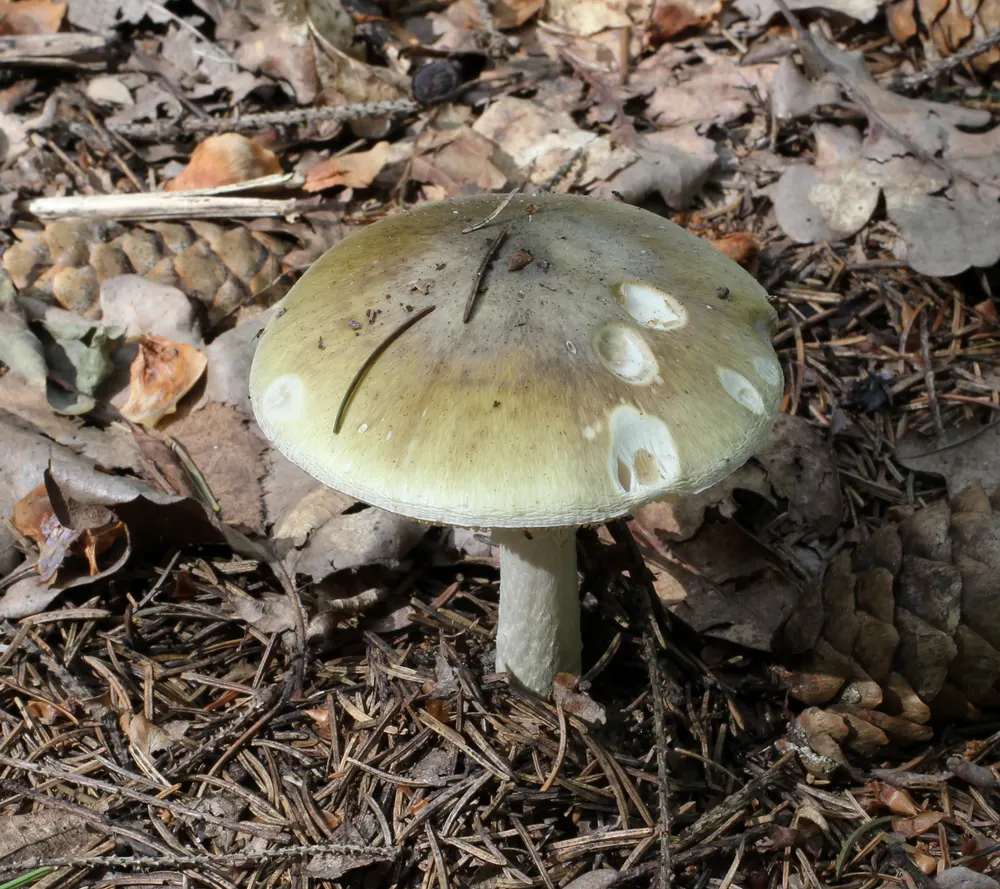
© George Chernilevsky (Wikimedia Commons) · Public Domain · Commons
Death cap
Toxic🐾Grüner Knollenblätterpilz · (Amanita phalloides)
Amanita family (Amanitaceae)
Description
The death cap is the fungus responsible for most fatal mushroom poisonings worldwide. Its cap is usually yellowish to olive-green, the gills and spore print are white, and the stem bears a membranous ring with a sac-like bulb (volva) at the base. It grows from summer through autumn, mainly in deciduous woodland in symbiosis with oaks and beeches. It is dangerously easy to confuse with edible mushrooms such as button mushrooms (white gills rather than pink-brown) or some Russula species. A single fruiting body can be lethal to an adult.
🌿 Risk of confusion — read before wild-harvesting!
DEADLY POISONOUS. A single mushroom can be fatal; if ingestion is suspected, seek emergency and poison-control help immediately.
Historical documentation only — do NOT use
These internal applications are historically documented. This plant is highly toxic — self-treatment can cause severe poisoning or death. For documentation only, explicitly NOT a recommendation.
- RawWhole plantInternalFolk medicine
No culinary or medicinal value — responsible for most fatal mushroom poisonings. Documentary note only, explicitly not a use.