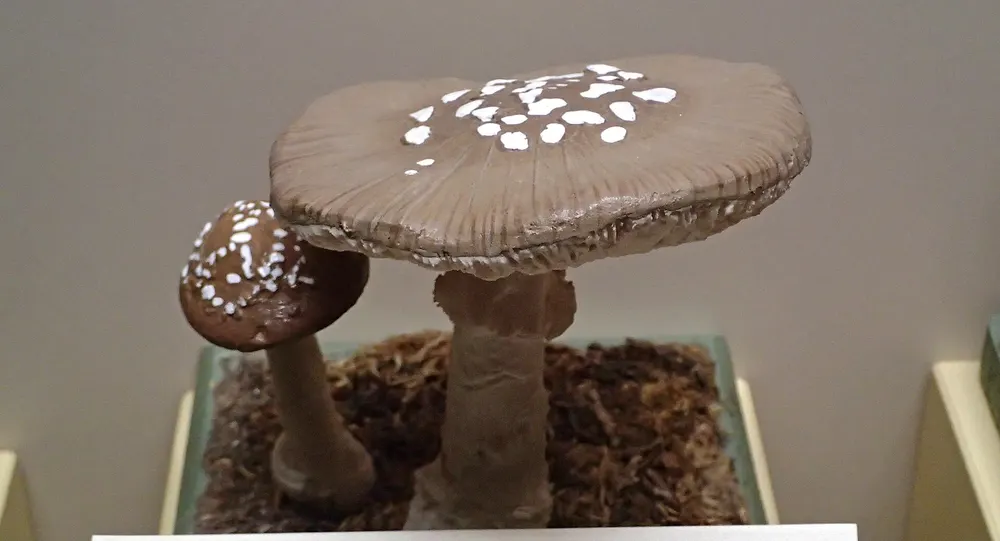
© James St. John · CC BY 2.0 · Commons
Panther cap
Toxic🐾Pantherpilz · (Amanita pantherina)
Amanita family (Amanitaceae)
Description
The panther cap (Amanita pantherina) is an ectomycorrhizal gilled mushroom in the family Amanitaceae, associated with deciduous and coniferous trees across the Northern Hemisphere. Its 4-12 cm cap is hazel to dark brown and evenly dotted with pure-white, concentrically arranged veil flakes; distinctive features are the sharply rimmed bulb margin, the white skirt-like ring, and the white gills. It contains the neuroactive isoxazole compounds ibotenic acid and muscimol and is considered more toxic than the fly agaric (A. muscaria). Historically it has been discussed alongside other ibotenic-acid-bearing Amanita species in the ethnomycological study of intoxicating mushrooms of northern Eurasia; mycologically it is best known as a dangerous look-alike of the edible blusher (A. rubescens) and the grey spotted amanita. Confusion can lead to severe and, in rare cases, fatal poisoning (pantherina syndrome).
🌿 Risk of confusion — read before wild-harvesting!
POISONOUS, more so than the fly agaric and potentially fatal. Contains ibotenic acid and muscimol; poisoning (pantherina syndrome) causes nausea, vomiting, dilated pupils, confusion, agitation or intoxication, seizures within a few minutes to about two hours (rarely longer) and can progress to coma and respiratory arrest. High risk of confusion with the edible blusher (A.
Historical documentation only — do NOT use
These internal applications are historically documented. This plant is highly toxic — self-treatment can cause severe poisoning or death. For documentation only, explicitly NOT a recommendation.
- RawWhole plantInternalFolk medicine
Historical-ethnomycological context: the panther cap is grouped with the fly agaric among the ibotenic-acid/muscimol-bearing Amanita species studied in research on the intoxicating mushrooms of northern Eurasia (e.g. Siberian shamanism, where the fly agaric in particular played a role). This is purely historical-documentary context and NOT a usage guide; the mushroom is poisonous.
- RawWhole plantInternalTraditional use
Pharmacological context: the constituents ibotenic acid (a glutamate/NMDA receptor agonist) and muscimol (a potent GABA-A receptor agonist) have long been studied in basic neuropharmacology; ibotenic acid is used in the laboratory to produce targeted lesions of nervous tissue. This describes the mechanisms and research use of the isolated compounds, not consumption of the mushroom.