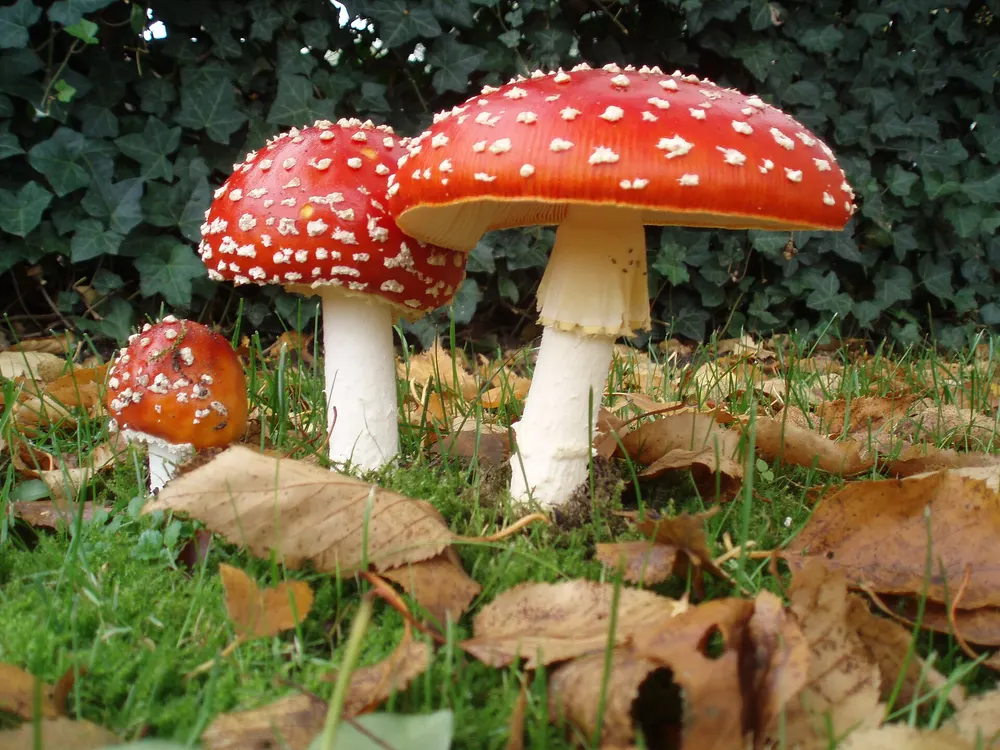
© Onderwijsgek (Wikimedia Commons) · CC BY-SA 3.0 NL · Commons
Fly agaric
Toxic🐾Fliegenpilz · (Amanita muscaria)
Amanita family (Amanitaceae)
Description
The fly agaric (Amanita muscaria), with its bright red, white-spotted cap, is perhaps the most iconic mushroom of Northern Hemisphere forests, forming ectomycorrhizal symbioses chiefly with birch and spruce. Its common and Latin names derive from its historical use as a fly killer: crumbled into milk it attracted and stupefied flies. Pharmacologically it contains the psychoactive compounds ibotenic acid and muscimol (a GABA-A agonist), with only trace amounts of the toxic muscarine. Ethnomycologically it is documented as an inebriant of Siberian shamans and is the subject of contested theories linking it to Vedic soma and Viking berserkers. It is regarded as a poisonous mushroom with unpredictable, delirium-inducing, sedative effects.
🌿 Risk of confusion — read before wild-harvesting!
The fly agaric contains ibotenic acid and muscimol and produces pantherina syndrome: confusion, speech disturbance, ataxia, dilated pupils, motor restlessness, hallucinations, seizures and deep sedative sleep (onset ½–3 h after ingestion, recovery usually 12–24 h). High risk of confusion with the potentially lethal panther cap (Amanita pantherina) and, when young, with other Amanita species.
- RawWhole plantExternalFolk medicine
Historically, the crumbled cap was steeped in milk or sugar water to attract and stupefy flies, giving rise to the name fly agaric. Purely historical/documentary note.
Historical documentation only — do NOT use
These internal applications are historically documented. This plant is highly toxic — self-treatment can cause severe poisoning or death. For documentation only, explicitly NOT a recommendation.
- RawWhole plantInternalTraditional use
Ethnomycologically documented as an inebriant and entheogen among Siberian peoples (e.g. Mansi, Khanty, Koryak, Kamchadal) in shamanic contexts. Historical context only — NOT a consumption or dosing guide; the mushroom is poisonous.