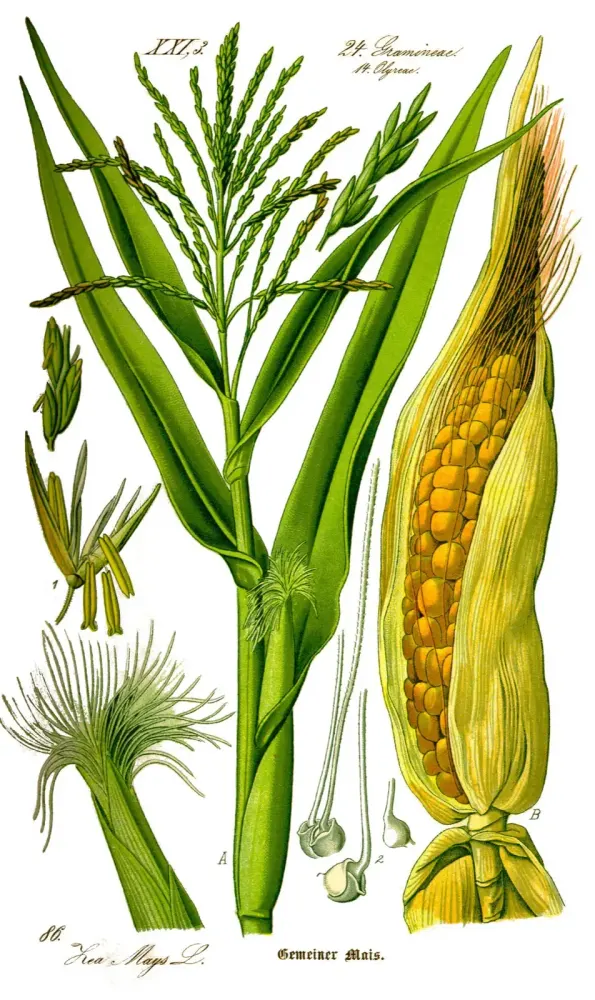
© User:Kilom691 · Public domain · Commons
Maize
CautionMais · (Zea mays)
Grass family (Poaceae)
Description
Maize, also known as corn in North American English, is a tall stout grass that produces cereal grain. The leafy stalk of the plant gives rise to male inflorescences or tassels which produce pollen, and female inflorescences called ears. The ears yield grain, known as kernels or seeds.
- RawFruitInternalClinical trial
Maize is the most widely cultivated grain worldwide after wheat and rice, and an important staple food. Sweet corn is cooked, steamed or grilled on the cob and contains approx. 19 g carbohydrates, 3 g protein and 1 g fat per 100 g (86 kcal). It provides B vitamins (thiamin B1, niacin B3, pantothenic acid B5, folate), the carotenoids zeaxanthin and lutein, and potassium. Maize products (polenta, tortillas, cornmeal, corn oil, cornstarch) are indispensable in many world regions.
- TeaFlowerInternalTraditional use
Corn silk (Stigmata maydis) — the filiform styles of the female maize flowers — is used worldwide in folk medicine as a diuretic tea. Traditional application for urinary tract infections (cystitis), irritable bladder, urinary stones and difficult urination. Preparation: 1–2 teaspoons fresh or dried corn silk per 250 ml hot water, steep 10–15 minutes, 2–3 cups daily. Fresh corn silk is more effective than dried (PFAF: loss of diuretic effect upon storage). The EMA HMPC monograph (EMA/HMPC/509424/2023) remains in draft stage as of 2026.
[#src_pfaf_zea_mays] [#src_wp_en_corn_silk] [#src_ema_zea_mays_draft]
- RawFruitInternalTraditional use
Nixtamalisation — soaking and cooking maize in an alkaline lime solution (calcium hydroxide) — was developed by Mesoamerican cultures over 3,000 years ago and makes the niacin (vitamin B3) in maize bioavailable to the human body. Without nixtamalisation, maize-dominant diets can lead to pellagra (niacin deficiency disease). Tortillas, tamales and arepas are made with nixtamalised maize. This traditional practice is a historical example of nutritionally optimised food preparation.
- RawFruitInternalClinical trial
Maize contains the carotenoids zeaxanthin and lutein — both play an important role in macular pigmentation of the retina and protection against age-related macular degeneration (AMD) and cataracts. Yellow maize varieties are one of the few cereals providing meaningful amounts of these xanthophylls. Zeaxanthin accumulates in the yellow spot (macula lutea) of the retina. Epidemiological studies document an association between lutein/zeaxanthin intake and reduced AMD risk.
- SpiceFruitInternalTraditional use
Cornstarch (Amylum maydis, Maizena) is used worldwide as a thickener for sauces, soups, puddings and gluten-free baking. In traditional housekeeping a lightly thickened cornstarch solution is also regarded as a mild mucosal protectant for gastrointestinal irritation (similar to potato starch). Gluten-free — important for coeliac disease. Corn oil (cold-pressed or refined) is rich in linoleic acid and vitamin E.
- CompressFlowerExternalFolk medicine
In Native American folk medicine (including Zuni, Hopi) ground and moistened maize kernels were applied as poultices for ulcers, swellings and rheumatic pain. PFAF documents this application. Clinical evidence is entirely lacking; the use is ethnobotanically interesting as evidence of the versatile pre-Columbian use of maize.
- RawFruitInternalTraditional use
Corn germ oil (corn oil) is extracted from the maize germ by cold-pressing or refining and is rich in linoleic acid (omega-6, approx. 50–55 %), oleic acid (approx. 25–30 %) and vitamin E (tocopherols). It has a relatively high smoke point (approx. 230 °C refined) and is suitable for frying and deep-frying. Cold-pressed corn oil is suitable as a salad oil. Historically corn oil was extracted from maize germs by indigenous Mesoamerican peoples.
🤝 Permaculture Partners
In your garden, this plant acts as:
✨ Best symbiotic partners
- 🌿 Cucumber Maize serves as climbing frame for cucumber (Three Sisters analogue).
- 🌿 Cucurbita pepo Squash shades the maize bed and retains moisture.
- 🌿 Zucchini Classic companion-planting partner.
- 🌿 Phaseolus vulgaris Bush bean fixes nitrogen for hungry maize.
- 🌿 Phaseolus vulgaris Maize provides a living climbing frame for the pole bean.
- 🌿 Tropaeolum majus Nasturtium as aphid trap protects maize.
📦 Part of these planting sets:
Source: Helga und Margarete Langerhorst, Mein gesunder Naturgarten (eigene Kuration) | Klassische Mischkultur-Tradition (Three Sisters, Bauernregel)