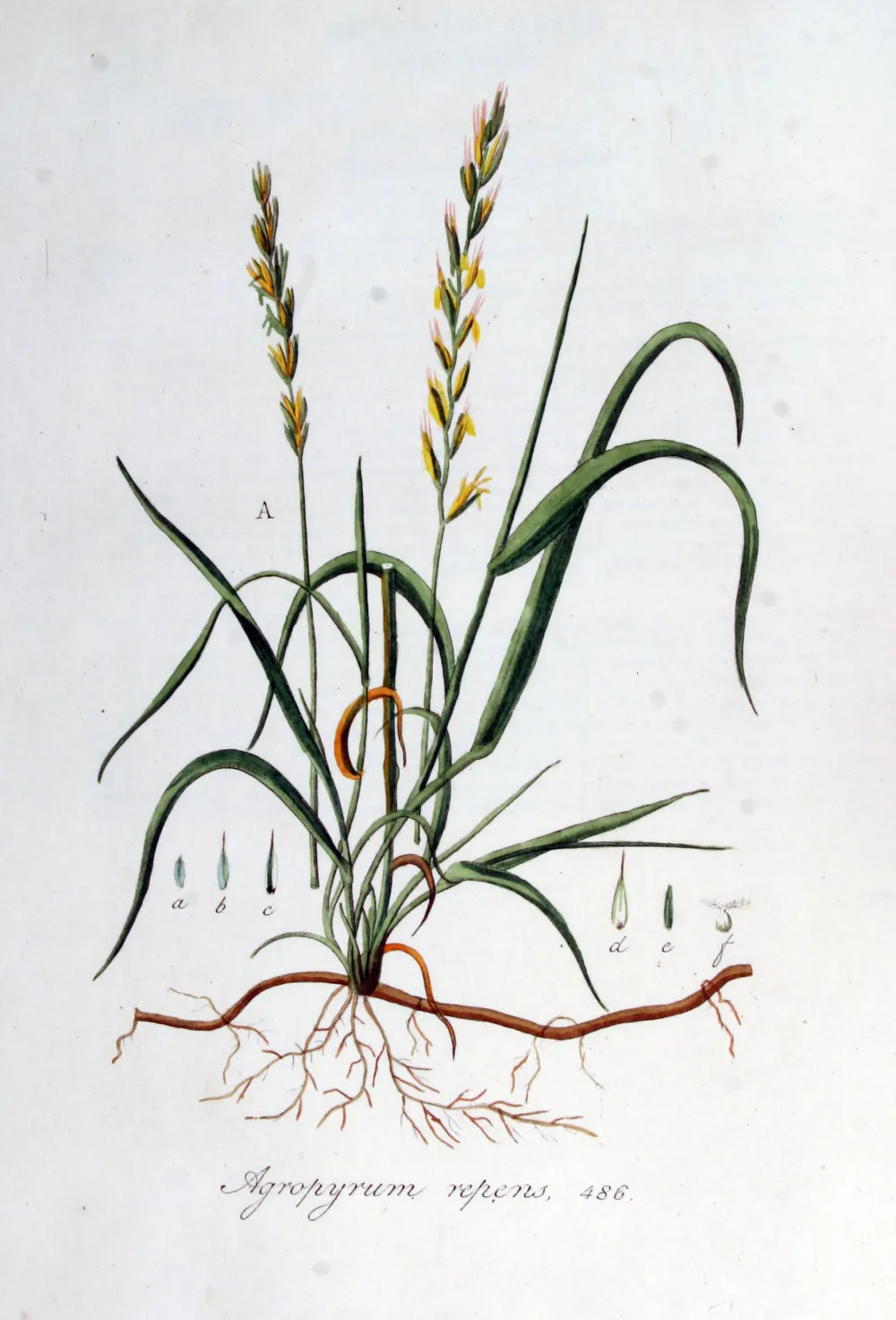
© Jan Kops, Flora Batava, Volume 7 (Deel 7), 1846 · Public domain (PD-old-expired) · Commons
Couch grass
Kriechende Quecke · (Elymus repens)
Grass family (Poaceae)
Description
Couch grass (also called twitch or quackgrass; synonyms Agropyron repens and Elytrigia repens) is a perennial grass reaching 50 to 150 centimetres in height. With the help of long, white, underground runners (rhizomes) it rapidly forms dense stands; the sharp-tipped runners can even penetrate wood and asphalt. This vigorous growth makes it a notorious garden and field weed, since a new plant grows from every severed rhizome fragment. The medicinal part is exclusively the washed, dried rhizome (Graminis rhizoma), used as a mild, traditional remedy for flushing the urinary tract. The commercial material consists of shiny, yellowish-brown, hollow, longitudinally furrowed rhizome and stem pieces with a bland, slightly sweet taste.
Traditional herbal medicine for flushing the urinary tract as supportive treatment of minor urinary complaints and to help prevent kidney gravel. Its use is based exclusively on long-standing experience; the rhizome is attributed a diuretic (urine-increasing) and mildly antimicrobial action.
Preparation & dosage
Pour about 250 ml of boiling water over 3 to 6 g of comminuted couch grass rhizome, steep for 10 minutes and strain. Drink as an infusion or decoction two to four times daily (daily dose 6 to 24 g). Drink plenty of fluid during use so that the flushing effect can occur. If symptoms persist for more than one week, consult a doctor.
- Dry amount
- 3–6 g
- Doses per day
- 3×
⚠ Age restriction: ≥ 12 years — For use in adults and adolescents from 12 years of age. There are insufficient data for children under 12 years; use is not recommended.
Do not use for flushing in the presence of fluid retention (oedema) due to impaired heart or kidney function. Always drink plenty of fluid during use. If fever, pain or spasms on urination, blood in the urine, or symptoms lasting more than one week occur, consult a doctor. Use only rhizome from clean, uncontaminated soil, because the root system can take up pollutants from the ground. Because of a lack of data, do not use during pregnancy or breastfeeding, or in children under 12 years.
Safety during pregnancy has not been established; in the absence of sufficient data, use is not recommended.
Safety during breastfeeding has not been established; in the absence of sufficient data, use is not recommended.
There are insufficient data for children under 12 years; use is not recommended. In adolescents from 12 years of age flushing therapy is considered acceptable according to the monograph.
Drug interactions
Diuretika / Diuretics
The official monograph reports no known interactions. As the rhizome is attributed a diuretic action, a possible additive effect on urine volume and fluid balance should be monitored as a precaution when diuretic medicines are taken concurrently.
Contraindications
- Oedema (fluid retention) due to impaired cardiac or renal function.
- Conditions requiring a restricted fluid intake.
- Hypersensitivity (allergy) to grasses.
Harvested part: Rhizome (underground rootstock)
- Time of day:
- Best dug in spring before shooting or in autumn after the foliage has yellowed.
- Drying:
- Wash the rhizome thoroughly, remove soil and roots, cut into pieces and dry airy in the shade or at no more than 40 °C. Use only material from clean soil.
- TriticinPolysaccharideContent: ca. 12 %Rhizome
Leading constituent; an inulin-like fructan polysaccharide (about 30 fructose units) that readily hydrolyses in hot water.
- Zuckeralkohole (Mannit, Inosit)OtherContent: Mannit 2-3 %Rhizome
Mannitol and inositol; mannitol is thought to form partly on boiling and contributes to the slightly sweet taste.
- Schleimstoffe (Mucilago)MucilageRhizome
Demulcent mucilage that supports the traditionally soothing effect on the urinary tract.
- Ätherisches Öl (mit Agropyren)Essential oilContent: ca. 0,017 %Rhizome
Present only in small amounts. Agropyrene, once described as a characteristic component, was not confirmed in later studies; the oil contains carvacrol, thymol and carvone among others.
- Kieselsäure / SilikateMineralContent: 0,34-0,43 % SiRhizome
Soluble silicic acid; an infusion of 3 g rhizome in 200 ml water provides about 2.6 mg of assimilable silicon (equivalent to about 5.6 mg SiO₂).
- KaliumMineralRhizome
Potassium salts contribute to the mild diuretic (flushing) effect.
- Tricin (Flavon)FlavonoidRhizome
Flavone (5,7,4'-trihydroxy-3',5'-dimethoxyflavone); a companion compound with antioxidant properties.
- Phenolsäuren (u.a. p-Cumarsäure, Vanillinsäure)Phenolic acidRhizome
Free and bound phenolic acids such as p-coumaric, vanillic and chlorogenic acid.
- [1]MonographEuropean Union herbal monograph on Agropyron repens (L.) P. Beauv., rhizoma (EMA/HMPC/113794/2021)(accessed: 2026-07-02)
- [2]MonographAssessment report on Agropyron repens (L.) P. Beauv., rhizoma (EMA/HMPC/113793/2021), Final Revision 1, 30 March 2022(accessed: 2026-07-02)
- [3]MonographGraminis Rhizoma (Couch Grass Rhizome) - ESCOP monograph(accessed: 2026-07-02)
- [7]MonographMetabolic Profile of Agropyron repens (L.) P. Beauv. Rhizome Herbal Tea by HPLC-PDA-ESI-MS/MS Analysis (Molecules 2022, PMC9370816)(accessed: 2026-07-02)
- [4]WikipediaKriechende Quecke - Wikipedia (deutsch)(accessed: 2026-07-02)
- [5]WikipediaElymus repens - Wikipedia (English)(accessed: 2026-07-02)
- [8]CommonsAgropyrum repens - Flora Batava, Volume 7 (Jan Kops) - Wikimedia Commons(accessed: 2026-07-02)
- [6]WikidataElymus repens (Q158940) - Wikidata(accessed: 2026-07-02)
🤝 Permaculture Partners
In your garden, this plant acts as: