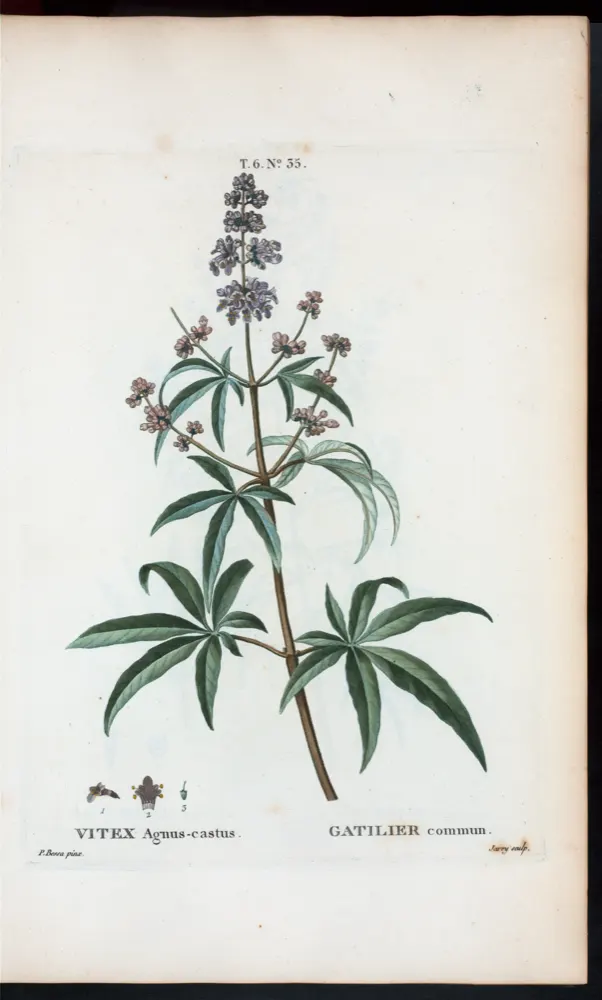
© Nouveau Duhamel / Traité des arbres (figures nach P.-J. Redouté & P. Bessa, 1801); NYPL-Scan · Public domain · Commons
Chaste tree
CautionMönchspfeffer · (Vitex agnus-castus)
Mint family (Lamiaceae)
Description
The chaste tree (Vitex agnus-castus), also called monk's pepper, is a deciduous, aromatically scented shrub of the Mediterranean and western Asia, growing 1–5 m tall and favouring riverbanks. Its palmately divided leaves and long slender wands recall willow and hemp. From summer into autumn it bears terminal spike-like panicles of small blue-violet flowers, which ripen into peppercorn-sized reddish-black drupes with a sharp, peppery taste — the medicinal drug (Agni casti fructus). The genus is now placed in the mint family (formerly the verbena family).
CONTRAINDICATED during pregnancy
No indication during pregnancy; hormonal action — use not recommended.
CONTRAINDICATED during breastfeeding
May affect lactation; a risk to the suckling child cannot be excluded — do not use.
CONTRAINDICATED for children
No indication; not for children and adolescents under 18 years.
Standardised extract for premenstrual syndrome (well-established use) — only after consulting a doctor.
Preparation & dosage
STANDARDISED DRY EXTRACT (clinically supported): Chaste tree does not work as a tea but as a standardised dry extract. For the treatment of premenstrual syndrome only one specific extract is supported: dry extract DER 6–12:1 (ethanol 60 % m/m), 20 mg once daily, as a licensed medicinal product. For an optimal effect, continued use over three months is recommended; if symptoms persist afterwards, consult a doctor. Traditionally also as a powder (2 × 400 mg/day) or tincture (1:5, ethanol 68–70 %, 165 mg/day). Because of the hormonal action, discuss dosing and use with a doctor.
⚠ Age restriction: ≥ 18 years — Adult women only — not for children and adolescents under 18 years.
Sources: [1]
IMPORTANT: Chaste tree acts on the hormonal system (dopaminergic, prolactin-lowering and possibly oestrogenic effects) — therefore use only after consulting a doctor and not long-term on your own. Do not use during pregnancy or lactation (it may affect milk flow and hormonal processes). Not for children and adolescents under 18. With oestrogen-dependent tumours, pituitary disorders, or when taking dopaminergic medicines, hormonal contraceptives or hormone therapy, consult a doctor before use. In prolactin-secreting pituitary tumours, chaste tree may mask symptoms.
No indication during pregnancy; hormonal action — use not recommended.
May affect lactation; a risk to the suckling child cannot be excluded — do not use.
No indication; not for children and adolescents under 18 years.
Drug interactions
Dopamin-Agonisten und -Antagonisten
Because of chaste tree's dopaminergic action, interactions cannot be excluded.
Östrogene, Antiöstrogene und hormonelle Verhütungsmittel
Because of a possible oestrogenic effect, interactions with hormonal preparations cannot be excluded — consult a doctor first.
Contraindications
- Hypersensitivity to chaste tree.
- Pregnancy and lactation.
- Children and adolescents under 18 years.
Harvested part: ripe fruit
- Time of day:
- In autumn, when the fruits are reddish-black and hard.
- Drying:
- Air-dry the ripe fruits at moderate warmth (≤ 40 °C) until hard and peppercorn-like. For a medicinal effect the standardised extract is required, however — home harvest is suitable only for culinary/folk use.
- Storage:
- 24 months — Store dry, light-protected and airtight in dark containers.
- Iridoidglykoside (Agnusid)GlycosideFruit
Marker compound of the fruit; used to standardise the extracts.
- AucubinGlycosideFruit
Second principal iridoid glycoside.
- Flavonoide (Casticin, Vitexin, Orientin)FlavonoidFruit
Casticin is a characteristic methoxylated flavonoid of the fruit.
- Diterpene (Clerodadienole, z. B. Rotundifuran)OtherFruit
Dopaminergic labdane diterpenes — regarded as carriers of the prolactin-lowering effect.
- Ätherisches Öl (Cineol, Sabinen, Limonen)Essential oilContent: 0,5–2 %Fruit
Gives the fruit its peppery aroma.
- [1]MonographEuropean Union herbal monograph on Vitex agnus-castus L., fructus (EMA/HMPC/606742/2017)(accessed: 2026-06-10)
- [2]MonographKeuschlamm — Vitex agnus-castus L., Forschergruppe Klostermedizin (historische Monographie, Dioskurides-Beleg)(accessed: 2026-06-10)
- [3]WikipediaMönchspfeffer — Wikipedia (DE)(accessed: 2026-06-10)
Classical quotes
"It is called chaste because the women, at the Thesmophoria — the yearly festivals in honour of Demeter, goddess of fertility — used it as their bedding in order to preserve their chastity."
🤝 Permaculture Partners
In your garden, this plant acts as: