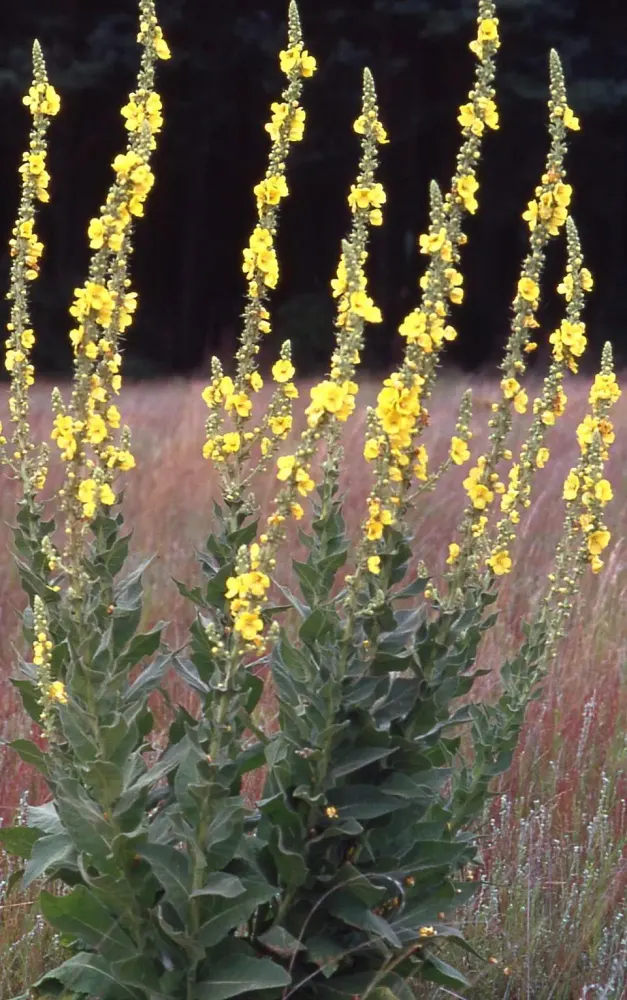
© Christian Fischer · CC BY-SA 3.0 · Commons
Verbascum densiflorum
Großblütige Königskerze · (Verbascum densiflorum)
Figwort family (Scrophulariaceae)
Description
Along roadsides and sunny gravel banks, the flowering spike of great mullein can reach two metres, studded with golden blossoms that each open for a single day in July and August. Only the freshly opened flower corollas are collected, prized for their mucilage (xylo-glucuronoarabinogalactans) and triterpene saponins, alongside iridoid and phenylethanoid glycosides such as verbascoside. The Kommission E monograph rates mullein flower positively for common colds and catarrh of the respiratory tract, with mucilage thought to coat irritated mucous membranes while saponins are traditionally linked to loosening secretions. One caveat matters: every infusion must be carefully filtered, since the flowers' microscopic star-shaped hairs can otherwise irritate the mouth and throat.
Traditional cough tea for dry irritant cough and catarrh of the respiratory tract (EMA traditional use). Mucilage forms a protective film on irritated mucous membranes; saponins promote secretion liquefaction.
Preparation & dosage
INFUSION: 1.5–2 g dried mullein flowers in 150 ml freshly boiled water, covered, steep 10 min. MANDATORY STEP: ALWAYS filter through muslin, coffee filter or fine cloth — microscopic star-hairs irritate mucous membranes and worsen cough. Drink warm, in small sips, 2–3× daily. Daily dose 3–4.5 g. Classic chest tea blends combine mullein flowers with ribwort plantain, mallow flowers, marshmallow root, thyme and liquorice root. Per EMA HMPC: max 1 week self-medication; persistent symptoms with fever, purulent sputum or dyspnoea require medical attention.
- Dry amount
- 1.5–2 g
- Doses per day
- 3×
- Max duration
- 1 weeks
⚠ Age restriction: ≥ 12 years — Per EMA HMPC monograph: from 12 years. For children under 12: medical consultation required.
Mullein flower gargle for mild pharyngeal irritation and sore throat — demulcent mucilage coats and soothes irritated membranes.
Preparation & dosage
GARGLE: Prepare infusion as for cough tea (1.5–2 g, 150 ml, 10 min), ALWAYS filter through muslin or coffee filter. Cool to lukewarm. Gargle 30–60 seconds 2–3× daily; do not swallow (optional). Supports mild sore throat and pharyngeal irritation.
- Dry amount
- 1.5–2 g
- Doses per day
- 3×
- Max duration
- 1 weeks
⚠ Age restriction: ≥ 12 years — From 12 years (EMA).
Folk steam inhalation with mullein flowers for head colds and respiratory irritation — warmth and mucilage moisten irritated airways.
Preparation & dosage
STEAM INHALATION: 2–3 g dried flowers (or 1 handful fresh) in 500 ml boiling water, steep 2–3 min. Place bowl on table, drape towel over head and bowl. Inhale in short breaths 5–10 min, eyes closed. Not for asthma or sensitive airways without medical advice. Folk use for head colds, sinus congestion and irritant cough.
- Dry amount
- 2–3 g
- Doses per day
- 2×
- Max duration
- 1 weeks
Mullein flowers carry a positive Kommission E monograph for the treatment of common cold and catarrh of the respiratory tract — demulcent mucilage and secretolytic saponins as primary mechanism.
Preparation & dosage
CHEST TEA per Kommission E (positive assessment 1985, published BAnz 1994): 1.5–2 g Verbasci Flos (mullein flowers, DAB/Ph. Eur.) in 150 ml boiling water, covered 10–15 min, ALWAYS filter through muslin/coffee filter. Daily dose 3–4 g in 3 divided doses. Indication per Kommission E: common cold and catarrh of the respiratory tract. Suitable for established blends (e.g. Species pectorales / chest tea). Up to 2 weeks use. Worsen or fever: see a doctor.
- Dry amount
- 1.5–2 g
- Doses per day
- 3×
- Max duration
- 2 weeks
⚠ Age restriction: ≥ 12 years — Kommission E without age restriction; EMA from 12 years.
Alcoholic tincture of mullein flowers as alternative to tea for irritant cough — practical when tea preparation and filtering are not feasible.
Preparation & dosage
TINCTURE (DER 1:5 in 25–45 % ethanol): 1–2 ml (~20–40 drops) 3× daily, diluted in water. No filtering needed (star-hairs do not suspend in alcohol extracts as in aqueous infusions). Traditional use for irritant cough and catarrh when tea is impractical. Adults and adolescents from 12 years only (ethanol content). Max 1 week; no improvement → see doctor.
- Liquid amount
- 1–2 ml
- Doses per day
- 3×
- Max duration
- 1 weeks
⚠ Age restriction: ≥ 12 years — From 12 years — ethanol content precludes use in younger children.
Folk leaf tea for cough and bronchial catarrh — less demulcent than flowers but rich in iridoid glycosides with anti-inflammatory properties.
Preparation & dosage
LEAF INFUSION (folk): 1.5–2 g dried, finely cut leaves (preferably young basal leaves, 1st year) in 250 ml boiling water, covered 10 min, MANDATORY filter through muslin (leaves also bear star-hairs). 2× daily. Folk use in German and English herbal tradition for cough, bronchial catarrh and hoarseness. Some sources also cite use for joint and muscle pain as a diaphoretic. Evidence weaker than for flowers — flowers (Verbasci Flos) are the EMA/Kommission E-authorised drug.
- Dry amount
- 1.5–2 g
- Doses per day
- 2×
- Max duration
- 2 weeks
Folk leaf poultice for joint inflammation and skin irritation — external application of mullein leaves as a traditional home remedy across central and western Europe.
Preparation & dosage
COMPRESS / POULTICE: Soften fresh or re-hydrated dried leaves briefly in steam or scalding water, cool slightly, apply to affected area (joints, swellings, irritated skin), fix with cloth. Leave 20–30 min. 1–2× daily. Folk use for joint inflammation, abscesses, skin irritation and swollen tissue. The leaf felt (star-hairs) is laid flat by steam. Caution on open wounds or severely inflamed skin — patch test first.
Classic chest tea blend with mullein flowers as main component — synergistic profile of mucilage, saponins and flavonoids from multiple herbs.
Preparation & dosage
CHEST TEA BLEND: Mullein flowers (Verbasci Flos) are an excellent base for cough tea blends. Established combination (Species pectorales): mullein flowers 30 g + marshmallow leaves or root 30 g + mallow flowers 20 g + liquorice root 20 g. Per cup: 2 g blend in 150 ml boiling water, 10 min, ALWAYS filter through muslin. 3× daily warm. Synergistic: all ingredients' mucilage complement each other; liquorice adds glycyrrhizin saponins (mild secretolytic); mallow adds demulcent support. Per EMA, Verbasci Flos may be used as monodrug or in such established blends.
- Dry amount
- 1.5–2 g
- Doses per day
- 3×
- Max duration
- 1 weeks
⚠ Age restriction: ≥ 12 years — From 12 years. Avoid large amounts of liquorice in hypertension.
MANDATORY FILTERING: Mullein flowers and leaves bear microscopic star-shaped hairs (trichomes) that cause irritation, burning and paradoxical cough reflex on direct mucosal contact. ALWAYS filter every infusion through muslin, coffee filter or fine cloth — no exceptions. This precaution is central to the EMA monograph. Additionally: limit self-medication to 1 week; fever, dyspnoea, bloody or purulent sputum, or worsening after 1 week require immediate medical attention. Mucilage may delay absorption of concurrently taken oral medicines — allow 30–60 min separation. Avoid if hypersensitive to Scrophulariaceae.
⏱ Max continuous use: 1 weeks
Per EMA HMPC, not recommended during pregnancy due to insufficient safety data. Culinary amounts (occasional small cup) are likely harmless, but consult a doctor especially in the first trimester.
Per EMA HMPC, not recommended during lactation due to insufficient data. No known transfer into breast milk, but caution is advised.
EMA HMPC: Verbasci Flos may be used from 12 years. For children under 12, clinical data are insufficient — medical consultation required. Mandatory filtering applies strictly to all ages. Children under 2: no use without medical recommendation.
Drug interactions
Orale Arzneimittel (allgemein — alle Gruppen)
The high-molecular-weight mucilage of mullein flowers may form a protective coating on the gastrointestinal mucosa, thereby delaying or reducing absorption of concurrently administered oral medicines. This applies in principle to all orally taken drugs. Allow at least 30–60 minutes between intake of mullein preparations and other medicines.
Antidiabetika (orale Hypoglykämika, Insulin)
Iridoid glycosides (aucubin, catalpol) from Verbascum species showed weak hypoglycaemic properties in in vitro studies. Clinical relevance in humans is not established; monitor blood glucose more closely when using with oral antidiabetics or insulin.
Contraindications
- Hypersensitivity to mullein (Verbascum spp.) or other Scrophulariaceae.
- Children under 12 years (per EMA HMPC — lack of safety data).
- Unfiltered tea or infusion — star-hairs irritate mucous membranes (not contraindicated for the drug, but unfiltered preparation is a preparation-related contraindication).
Harvested part: flowers
- Time of day:
- On a dry, sunny morning between 9 and 12, after the morning dew has completely evaporated. Individual flowers open for one day only — check daily and pluck freshly opened corollas. The spike flowers from bottom to top; re-harvest the same plant daily after the first picking of the lowest flowers.
- Drying:
- Pluck only the golden-yellow corollas without calyx, stamens or stem. Dry in a single layer on clean paper or screens in warm shade at 30–40 °C. Flowers must dry quickly (within 24–48 h) to retain the golden colour — browning indicates insufficient drying or moisture. IMPORTANT: Do not inhale star-hairs during harvest — collect outdoors, hold breath or wear light protection; star-hairs irritate airways if directly inhaled.
- Storage:
- 12 months — Airtight in dark glass jars or tins, dry, cool (below 25 °C), protected from light. Use within 12 months — potency drops quickly thereafter (mucilage degrades, flowers discolour). Risk of mould in humid conditions; store with desiccant/silica gel.
- Time of day:
- In the first year the plant grows as a leaf rosette (no flowers) — this is the optimal time for leaf harvest. Collect young basal leaves in spring and early summer (May–July) in dry weather, before flower stems appear in year two. Alternatively: lowest leaves of second-year plants before flowering. Avoid late afternoon — evening dew increases mould risk during drying.
- Drying:
- Spread young, undamaged leaves (no spots or insect damage) individually at 35–45 °C in shade or dehydrator. Leaves are harder to dry than flowers due to the dense felt (star-hairs) — ensure good air circulation; separate thin from thick leaves. ALWAYS wear gloves when handling — star-hairs can irritate skin. Crumble dried leaves coarsely and store in airtight containers.
- Storage:
- 12 months — Airtight, dark, dry (below 25 °C). Use within 12 months. Check for mould after 2–3 weeks — leaves absorb moisture readily.
- Schleimstoffe — Xylo-Glucuronarabinogalaktane (Polysaccharide)MucilageContent: 3-4 %Flower
Quantitatively dominant active group in the flowers. High-molecular-weight polysaccharides of xylose, glucuronic acid, arabinose and galactose. Form colloidal gels in aqueous infusion that coat irritated oro-pharyngeal and airway mucosa, protecting against mechanical and chemical irritation (demulcent action). This mechanism is the pharmacological basis of the EMA and Kommission E authorisation.
- Triterpensaponine — Verbascosaponin und weitereSaponinContent: 0.5-2 %Flower
Steroid-saponin-type compounds, predominantly verbascosaponin. Responsible for secretolytic and mild expectorant action — reduce surface tension of bronchial secretion, facilitating mucociliary clearance. Act synergistically with mucilage. At excessive concentrations may cause gastric irritation (observe maximum daily dose).
- Iridoidglykoside — Aucubin, Catalpol, HarpagosidGlycosideContent: 0.3-1 %Flower
Characteristic lead compounds of the genus Verbascum and family Scrophulariaceae. Aucubin and catalpol are antioxidant, hepatoprotective and showed anti-inflammatory properties in vitro (cyclooxygenase and NF-κB inhibition). Harpagoside is primarily known from devil's claw but also present in Verbascum. Contribute to the overall anti-inflammatory activity of the drug.
- Phenylethanoidglykoside — Verbascosid (Acteoside)GlycosideContent: 0.1-1 %Flower
Verbascosid (also acteoside or verbascoside) is a phenylethanoid glycoside whose name derives from Verbascum species. Strongly antioxidant (DPPH assay), anti-inflammatory (5-LOX and COX inhibition), mildly antimicrobial and immunomodulating. Intensively studied in recent pharmacological research; clinical significance in the context of tea use remains to be established.
- Flavonoide — Apigenin, Luteolin, Rutin, HesperidinFlavonoidContent: 0.5-1 %Flower
Flavones (apigenin, luteolin) and flavonol glycosides (rutin, hesperidin). Antioxidant, capillary-protective, mildly anti-inflammatory. Apigenin shows spasmolytic properties on bronchial smooth muscle in vitro — possibly contributing to relief of bronchospasm in irritant cough, but not clinically established.
- Invertzucker (Glucose, Fructose)OtherContent: 11 %Flower
Relatively high sugar content responsible for the pleasantly mild, slightly sweet taste of mullein flowers, improving compliance (palatability/acceptance) of the tea in adolescents. No pharmacological contribution to the main action.
- Phenolcarbonsäuren — Kaffeesäure, Chlorogensäure, ProtocatechusäurePhenolic acidContent: 0.2-0.5 %Flower
Hydroxycinnamic acid derivatives (caffeic acid, chlorogenic acid) and hydroxybenzoic acid derivatives (protocatechuic acid). Antioxidant and mildly antimicrobial; complement the antioxidant potential of iridoid and phenylethanoid glycosides. Chlorogenic acid showed mild antiviral properties in studies.
- Ätherisches Öl (Spuren)Essential oilContent: 0.02-0.05 %Flower
Trace amounts of volatile constituents (incl. α-terpineol, linalool, benzaldehyde). Responsible for the characteristically mild honey-sweet scent of fresh flowers. Pharmacologically irrelevant at these quantities; no contribution to the main therapeutic action.
- [1]MonographEMA/HMPC/611537/2016 — European Union herbal monograph on Verbascum thapsus L., V. densiflorum Bertol., V. phlomoides L., flos (Final, 22 June 2018)(accessed: 2026-05-21)
- [2]MonographKommission E — Verbasci flos (Königskerzenblüten), Monographie (positiv), BAnz Nr. 43, 2. März 1989, zuletzt geändert BAnz 1994(accessed: 2026-05-21)
- [3]MonographESCOP Monographs — Verbasci Flos (Mullein Flower), 2nd edition 2003 (incl. supplement)(accessed: 2026-05-21)
- [6]MonographPlants For A Future (PFAF) — Verbascum densiflorum database entry(accessed: 2026-05-21)
- [4]BookWichtl, Max (Hrsg.) — Teedrogen und Phytopharmaka, 5. Auflage, Wissenschaftliche Verlagsgesellschaft Stuttgart 2008; Eintrag: Verbasci Flos(accessed: 2026-05-21)
- [5]BookMadaus, Gerhard — Lehrbuch der biologischen Heilmittel, Band II: Verbascum thapsiforme / densiflorum, 1938 (Public Domain)(accessed: 2026-05-21)
- [7]BookHenriette's Herbal Homepage — Verbascum: Eclectic and historical entries (public domain)(accessed: 2026-05-21)
- [8]WikipediaGroßblütige Königskerze (Wikipedia DE)(accessed: 2026-05-21)