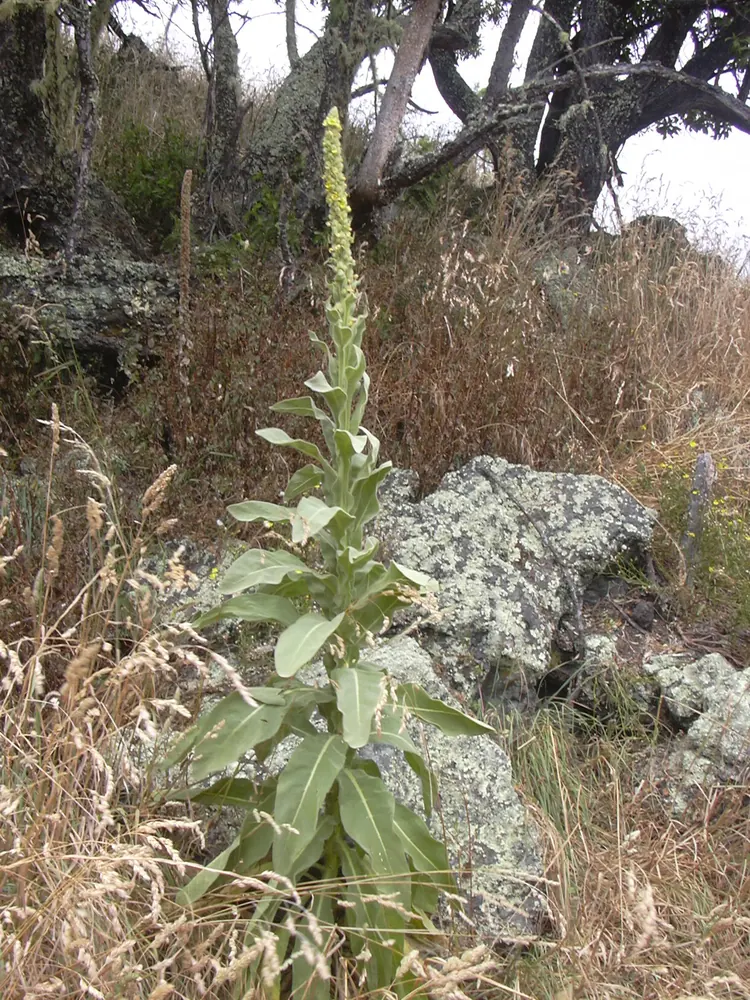
© Forest & Kim Starr · CC BY 3.0 · Commons
Great mullein, Common mullein
Kleinblütige Königskerze · (Verbascum thapsus L.)
Figwort family (Scrophulariaceae)
Description
Great mullein (Verbascum thapsus) is a biennial plant densely covered with felt-like hairs, forming a basal leaf rosette in its first year and an erect, usually unbranched flowering spike one to two metres tall in its second year. The small yellow flowers are tightly packed into a long, candle-like raceme and open in succession from June to September. All parts of the plant are clothed in star-shaped hairs, giving it a silvery, woolly appearance. It is native to Europe, North Africa and Asia and prefers dry, sunny ruderal sites, roadsides and waste ground. Medicinally it is the dried flowers (Verbasci flos) that are used, which, together with those of V. densiflorum and V. phlomoides, serve as a remedy for cough and catarrh.
CONTRAINDICATED for children
Use in children and adolescents under 12 years is not recommended owing to a lack of data (EMA).
- TeaFlowerInternalTraditional use
The classic application of mullein flowers: the mucilage they contain forms a soothing film over irritated mucous membranes, while saponins ease expectoration. The EMA classifies this use as a traditional use for the relief of sore throat associated with dry cough and cold.
Preparation & dosage
Pour about 150 ml of boiling water over 1.5-2 g of dried mullein flowers, cover and steep for 10-15 minutes, then strain through a fine cloth or coffee filter to remove the fine irritant flower hairs. Drink freshly prepared and warm 3 times daily. Consult a doctor if symptoms worsen or persist longer than one week.
- Dry amount
- 1.5–2 g
- Doses per day
- 3×
- Max duration
- 1 weeks
⚠ Age restriction: ≥ 12 years — Per EMA only for adults and adolescents over 12 years.
- GargleFlowerExternalTraditional use
In folk practice and within the traditional indication, the mucilage-rich flower infusion is used as a gargle for a scratchy throat and hoarseness to soothe the irritated pharyngeal mucosa.
Preparation & dosage
Allow an infusion of mullein flowers prepared as for tea and well strained (1.5-2 g per 150 ml) to cool to lukewarm and gargle with it several times a day. Strain carefully through cloth or filter so that no irritant flower hairs remain.
[#src_commission_e] [#src_escop] [#src_arzneipflanzenlexikon]
- TeaFlowerInternalCommission E
Commission E issued a positive monograph for mullein flowers in 1990 for catarrhs of the respiratory tract. The mucilage acts as a demulcent and the saponins as a mild expectorant, hence the traditional use in mild catarrhal complaints with cough.
Preparation & dosage
Prepare as the cough tea: pour 150 ml hot water over 1.5-2 g dried flowers, steep for 10 minutes, strain through a fine cloth and drink warm several times a day.
- Dry amount
- 1.5–2 g
- Doses per day
- 3×
- Max duration
- 1 weeks
⚠ Age restriction: ≥ 12 years — Only for adults and adolescents over 12 years.
- InhalationFlowerExternalFolk medicine
In folk medicine mullein flowers are used as a warm, moist steam inhalation for catarrhal complaints of the upper respiratory tract. This application is not covered by monographs and rests on traditional experiential knowledge.
Preparation & dosage
Pour hot water over a handful of dried mullein flowers and carefully inhale the rising steam. A folk application; use caution with irritated airways and avoid steam that is too hot.
- SalveFlowerExternalFolk medicine
Mullein flower oil macerated in oil is a well-known folk household remedy formerly used for earache and irritated skin. There is no robust clinical evidence; the use is purely traditional and not covered by EMA or Commission E.
Preparation & dosage
Fresh mullein flowers are traditionally macerated in olive oil for several weeks in a warm place (flower oil). The strained oil is applied externally to irritated skin in folk use. IMPORTANT: for earache do not instil oil into the ear canal if the eardrum may be perforated or there is discharge; medical assessment is required.
- CompressFlowerExternalFolk medicine
Mucilage-containing mullein flowers are used in folk practice as a moist compress to soothe minor skin irritation. The demulcent action of the mucilage provides the rationale; clinical studies are lacking.
Preparation & dosage
Allow a strong, well-strained flower infusion to cool, soak a clean cloth in it and apply as a moist compress to the affected skin. Folk application without clinical evidence.
🤝 Permaculture Partners
In your garden, this plant acts as: