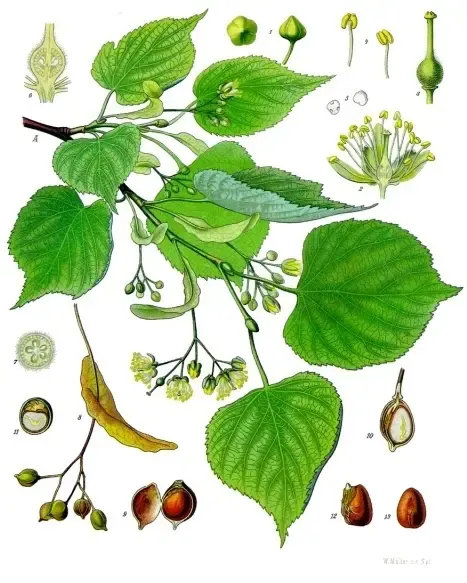
© Franz Eugen Köhler, Köhler's Medizinal-Pflanzen · Public domain · Commons
Tilia cordata
Winterlinde · (Tilia cordata)
Mallow family (Malvaceae)
Description
Drunk as hot as possible, ideally shortly before bed: that's how the flowers of this lime tree, botanically part of the mallow family, become a classic diaphoretic tea for the onset of a cold – a sweating action the EMA officially confirms. The drug owes its effect mainly to mucilage (arabinogalactans), which coats irritated throat mucosa and eases dry cough and throat scratchiness, supported by flavonoids such as tiliroside and quercetin glycosides. The characteristic honey-sweet essential oil containing farnesol also makes the flowers a popular addition to relaxing baths for nervous restlessness and sleep difficulties, while a tincture is traditionally taken for nervous palpitations. The flowers are considered very well tolerated and approved as tea from age four; in acute heart failure, however, the sweating effect should only be used after medical consultation. Tradition holds that very old stock, stored beyond two years, should no longer be used.
Traditional diaphoretic tea at the first signs of a cold. Mucilage and flavonoids act together; the sweating effect depends on drinking the tea hot and keeping warm.
Preparation & dosage
DIAPHORETIC TEA: 1.5–1.8 g + 150 ml boiling water, steep 5–10 min covered, strain. Drink as hot as possible, 2–4 cups/day, one before bed. Wrap warm afterwards. Up to ~6 g/day.
- Dry amount
- 1.5–1.8 g
- Doses per day
- 4×
- Max duration
- 1 weeks
⚠ Age restriction: ≥ 4 years — Per EMA from 4 years.
Soothing tea for dry irritative cough and throat irritation. Arabinogalactans coat irritated mucosa; flavonoids provide mild anti-inflammatory support.
Preparation & dosage
SOOTHING TEA: 1.5–1.8 g + 150 ml boiling water, steep 5–10 min covered. Drink warm in small sips 2–3× daily. Honey enhances the mucous film effect.
- Dry amount
- 1.5–1.8 g
- Doses per day
- 3×
- Max duration
- 1 weeks
⚠ Age restriction: ≥ 4 years — From 4 years.
Traditional relaxing bath for nervous restlessness and sleep problems. Essential oil (farnesol) and flavonoids act mildly sedative through the skin.
Preparation & dosage
RELAXING BATH: 20–50 g + 1–2 L boiling water, steep 15 min, add to bath at 37 °C. 15–20 min, ideally before bed. Pat dry and rest warm.
- Dry amount
- 20–50 g
- Doses per day
- 1×
- Max duration
- 2 weeks
⚠ Age restriction: ≥ 12 years — Full baths from 12 years.
Traditional tincture for nervous palpitations, mildly elevated blood pressure and anxiety. Tilia extracts show GABA-ergic and benzodiazepine-agonist activity in vitro.
Preparation & dosage
TINCTURE (1:5 in 25% ethanol): 1–2 ml 3× daily in water. Traditional for nervous palpitations, blood pressure dysregulation and inner restlessness. Pharmacy preparation recommended.
- Liquid amount
- 1–2 ml
- Doses per day
- 3×
Folk use for stress-related digestive complaints and GI cramps. The antispasmodic effect of flavonoids relaxes smooth muscle of the GI tract.
Preparation & dosage
AFTER-MEAL TEA: 1.5–2 g + 200 ml boiling water, steep 10 min. Drink warm after meals for stress-related digestive complaints.
- Dry amount
- 1.5–2 g
- Doses per day
- 2×
Folk steam inhalation for nasal congestion and sore throat. The essential oil (farnesol, eugenol) soothes mucosa and is mildly antiseptic.
Preparation & dosage
STEAM INHALATION: 10–20 g + 1 L boiling water. Drape towel over head, inhale 5–10 min. For nasal congestion and sore throat. Caution: hot steam — maintain safe distance.
- Dry amount
- 10–20 g
Linden flowers considered very well tolerated. Seek medical attention if symptoms persist beyond 1 week, or with high fever, dyspnoea, purulent sputum or severe sore throat. Diaphoretic tea not in acute cardiac insufficiency without medical advice. Very old linden flowers reportedly develop narcotic properties — use freshly dried material only. Allergic reactions rarely possible.
⏱ Max continuous use: 1 weeks
Insufficient safety data for pregnancy. Not recommended as medicinal tea as a precaution; occasional use as mild beverage tolerable with midwife/doctor consultation.
Insufficient data on safety during lactation.
Per EMA tea from 4 years. Medical advice for persistent symptoms in children under 12. Full baths from 12 years only.
Contraindications
- Hypersensitivity to linden flowers or other Tiliaceae.
- Children under 4 years (tea).
- Acute cardiac insufficiency: diaphoretic tea burdens the circulation — only with medical advice.
Harvested part: flowers (midsummer)
- Time of day:
- On sunny, dry mornings once dew has dried — ideally between 9 and 12 o'clock.
- Drying:
- Harvest whole flower clusters WITH tongue-shaped bracts (official Tiliae flos requires them). Spread immediately single-layer in shade. Dry quickly at 25–35 °C. Never in direct sun — active compounds degrade. Dry when flower stems snap on bending.
- Storage:
- 12 months — Airtight in dark glass or paper bags, cool and dry. Use within 12 months — essential oil evaporates over time.
- Schleimstoffe (Arabinogalaktane)MucilageContent: ~10 %Flower
Acidic arabinogalactans. Form protective film on irritated mucosa (throat, bronchi). Main basis of antitussive and demulcent action. Optimally soluble only with hot water.
- TilirosidFlavonoidFlower
Characteristic flavonoid glycoside (kaempferol-3-O-[6''-p-coumaroyl]-β-D-glucoside). Quality marker for Tiliae flos. Mildly antioxidant and anti-inflammatory.
- Quercetin-Glykoside (Quercitrin, Isoquercitrin, Hyperosid, Rutin)FlavonoidFlower
Antioxidant, vessel-stabilising. Contribute to mild antispasmodic action. Isoquercitrin identified in T. cordata flowers.
- Kaempferol-Glykoside (Astragalin)FlavonoidFlower
Astragalin and other kaempferol derivatives. Mildly antioxidant. Astragalin also involved in tiliroside biosynthesis.
- Phenolsäuren (Chlorogensäure, p-Cumarsäure, Kaffeesäure)Phenolic acidFlower
Antioxidant. p-Coumaric acid linked to mild diaphoretic and antispasmodic effects.
- Ätherisches Öl (Farnesol, Citral, Eugenol, Limonene)Essential oilContent: 0,02–0,1 %Flower
Characteristic honey-sweet floral scent primarily from farnesol. Other components: citral, citronellal, eugenol, limonene, α-pinene, nerol, terpineol. Mildly sedative and antiseptic.
- Kondensierte Gerbstoffe (Proanthocyanidine, Procyanidine)TanninContent: ~2 %Flower
Catechin and proanthocyanidin type. Mildly astringent and antimicrobial. Contribute to mucosa-toning effect.
- SaponineSaponinFlower
Present in small amounts. May contribute to mucosa-irritating effect at high doses.
- [1]MonographEMA/HMPC/337066/2011 — European Union herbal monograph on Tilia cordata Miller, T. platyphyllos Scop., T. x vulgaris Heyne or their mixtures, flos (Final, 10 July 2012)(accessed: 2026-05-18)
- [5]MonographLinden — Uses, Benefits & Dosage (Drugs.com Natural Products)(accessed: 2026-05-21)
- [6]MonographTilia: A Comprehensive Overview of Pharmaceutical Applications (PTcell, Ogbonna/Kelvas)(accessed: 2026-05-21)
- [4]BookPlants For A Future — Tilia cordata(accessed: 2026-05-21)
- [2]WikipediaWinterlinde (Wikipedia DE)(accessed: 2026-05-21)
- [3]WikipediaTilia (Wikipedia EN)(accessed: 2026-05-21)