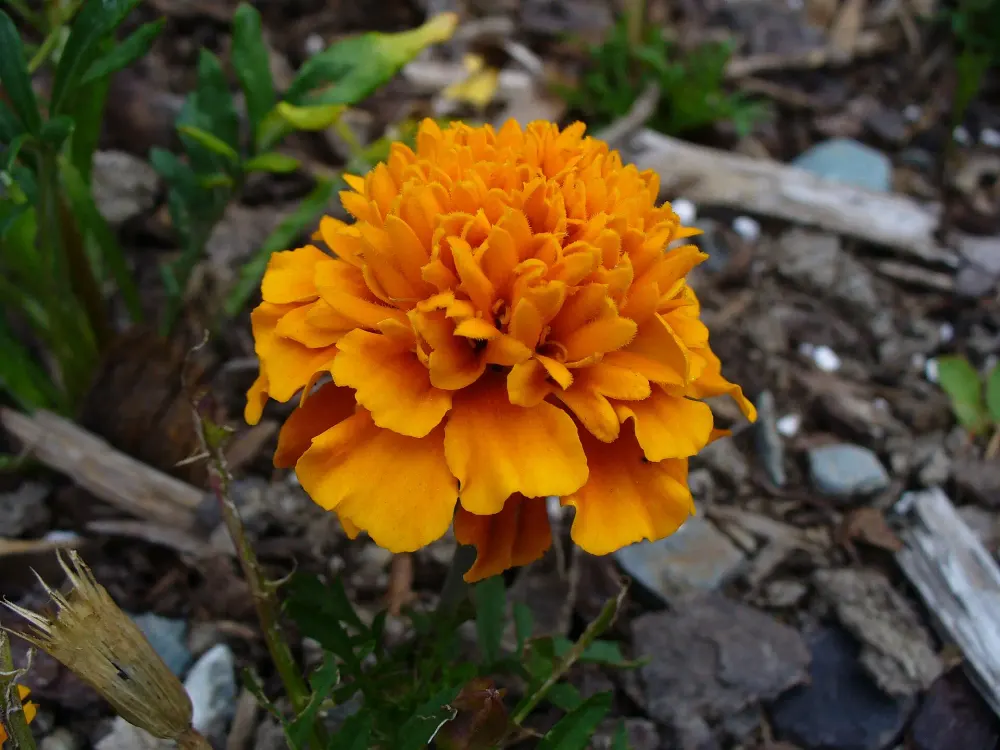
© Neelix at English Wikipedia · Public domain · Commons
Tagetes patula
Caution🐾Tagetes · (Tagetes patula)
Daisy family (Asteraceae)
Description
Tagetes patula, the French marigold, is a species of flowering plant in the family Asteraceae, native to Mexico and Guatemala with several naturalised populations in many other countries. It is widely cultivated as an easily grown bedding plant with hundreds of cultivars, which often have bright yellow to orange flowers.
- RawWhole plantExternalTraditional use
Classic companion-planting and green-manure use of French marigold: roots release phototoxic thiophene derivatives that suppress root-knot and lesion nematodes — long-standing horticultural practice repeatedly confirmed since the 1970s.
Preparation & dosage
COMPANION PLANTING / GREEN MANURE against nematodes: Sow Tagetes patula as a companion between tomatoes, potatoes, strawberries or beans — spacing 25–30 cm. Root exudates (α-terthienyl and other thiophene derivatives, plus polyacetylenes) inhibit migrating root-lesion nematodes (especially Pratylenchus penetrans and Meloidogyne spp.). Effect appears after 2–4 months — leave plants for the whole season for sustained soil clearance, then cut above ground and work residues into the soil (green manure). Solid pre-cropping (sole stand) in an infested bed is more effective than scattered individuals.
[#src_wp_en_tagetes_patula] [#src_molecules_tagetes_2018] [#src_planta_thiophenes_tagetes]
- TeaFlowerInternalFolk medicine
Traditional Mexican infusion of dried florets — reported for stomach cramps, flatulence and menstrual complaints. Not established outside Mexican folk medicine; no EMA or Kommission E assessment.
Preparation & dosage
FOLK INFUSION (Mexican tradition): Pour 200 ml boiling water over 1–2 g dried T. patula florets (stems removed), cover and steep 5–10 min, strain. 1–2 cups daily for mild stomach cramps, flatulence or menstrual complaints. Use SHORT-TERM only — max 1 week; consult a doctor for persistent symptoms. NOT in pregnancy (described as emmenagogue/uterotonic in folk use). Avoid with Asteraceae allergy. Taste reminiscent of tarragon (from the essential oil).
- Dry amount
- 1–2 g
- Doses per day
- 2×
- Max duration
- 1 weeks
⚠ Age restriction: ≥ 12 years — Internal use not for small children — folk preparation without pharmacopoeial dossier.
- CompressFlowerExternalFolk medicine
Folk skin compress (Mexico, Andean countries): for mild skin irritation, superficial wounds, traditionally also against scabies and skin parasites. Note phototoxicity from α-terthienyl.
Preparation & dosage
INFUSION compress: Pour 250 ml hot water over 3–5 g dried florets, steep 10 min, strain, cool to skin temperature. Soak a clean cotton or linen cloth and apply for 20–30 min to irritated or mildly inflamed skin. 1–2× daily. DO NOT apply before direct sun exposure — thiophene derivatives (α-terthienyl) are phototoxic and may cause erythema, blistering or burning in combination with UV-A.
- Dry amount
- 3–5 g
- Doses per day
- 2×
- Max duration
- 1 weeks
⚠ Age restriction: ≥ 12 years — Due to phototoxicity and lack of paediatric data, only from 12 years; always covered from sunlight.
[#src_unam_apmtm_cempasuchil] [#src_wp_en_tagetes_patula] [#src_obelis_sccs_tagetes_phototox]
- BathFlowerExternalFolk medicine
Traditional partial bath for skin fungus and callus problems — antifungal action of the essential oil (α-terthienyl is active against dermatophytes) shown in vitro, not clinically standardised.
Preparation & dosage
HAND/FOOT BATH: Pour 2 L boiling water over 30–50 g dried T. patula florets and herb, steep 15 min, strain, add to lukewarm bath (hand or foot). Bathe 10–15 min. Avoid direct sun for at least 6 hours after bathing (phototoxicity). Traditionally used in Mexico for foot fungus, corns and tired legs.
- Dry amount
- 30–50 g
- Doses per day
- 1×
- Max duration
- 1 weeks
⚠ Age restriction: ≥ 12 years — Not for young children due to phototoxicity.
[#src_unam_apmtm_cempasuchil] [#src_alpha_terthienyl_antifungal]
- SpiceFlowerInternalTraditional use
Culinary use (Georgia, Imereti region): dried ground ray florets are a traditional yellow spice — known as 'imeruli shaphrani' or Imeretian saffron. Also used industrially to colour egg yolks and poultry feed.
Preparation & dosage
DRIED PETALS AS SPICE: Harvest fully opened flower heads, air-dry, pluck off the ray florets, grind to powder in a mortar. In Georgia known as 'imeruli shaphrani' ('Imeretian saffron') and part of the Khmeli Suneli blend — pairs with chicken, rice and walnut dishes. A knife-tip per portion. Provides intense golden-yellow colour and a mild earthy-aromatic taste. Culinary use, not medicinal.
- Essential oilFlowerExternalTraditional use
Tagetes essential oil: spot-applied, strongly diluted on calluses, corns or fungal nails. Phototoxic via α-terthienyl and α-bithienyl — strict sun avoidance after use required.
Preparation & dosage
TAGETES OIL (strongly diluted): 1 drop of Tagetes oil (T. patula or T. minuta) in 20 ml carrier oil (almond, jojoba) — about 0.1–0.25 % dilution. IMPORTANT: SCCS opinion sets max. 0.01 % Tagetes oil in leave-on cosmetics (excluding sunscreen), and α-terthienyl content of the oil must not exceed 0.35 %. Higher home-made concentrations are only acceptable for rinse-off use (short contact, then washed off) or for spot application followed by sun avoidance (24–48 h). NEVER apply on large areas before sun exposure — phototoxicity (erythema, blistering) otherwise. Classically dabbed on corns, calluses and toenail fungus.
⚠ Age restriction: ≥ 18 years — Adults only — narrow safety window because of phototoxicity.
[#src_obelis_sccs_tagetes_phototox] [#src_alpha_terthienyl_antifungal] [#src_molecules_tagetes_2018]
Distribution in Europe
🪴 Grow at home
- ☀ Light
- full sun
- 💧 Water
- every few days
- 🌱 Soil
- Standard potting compost
- 🪴 Pot
- 18 cm
- ⭐ Difficulty
- ★☆☆ beginner
- 🐾 Pets
- pet-safe
Tips:
- Classic companion plant for tomatoes — repels nematodes.
- Deadhead regularly for long flowering.
- Self-seeding — collect seeds or let it spread.
Care tips are general indoor-gardening recommendations, not scientific sources.
🤝 Permaculture Partners
In your garden, this plant acts as:
✨ Best symbiotic partners
- 🌿 Onion Marigold deters onion fly.
- 🌿 Garlic Classic companion-planting partner.
- 🌿 Cabbage Classic companion-planting partner.
- 🌿 Calendula officinalis Classic companion-planting partner.
- 🌿 Capsicum annuum Marigold deters nematodes and aphids.
- 🌿 Capsicum chinense Classic companion-planting partner.
- 🌿 Cucurbita pepo Classic companion-planting partner.
- 🌿 Carrot Classic companion-planting partner.
- 🌿 Fragaria vesca Marigold deters root nematodes around strawberries.
- 🌿 Basil Classic companion-planting partner.
- 🌿 Tomato Marigold roots deter nematodes in the tomato bed.
- 🌿 Eggplant Classic companion-planting partner.
- 🌿 Potato Marigold deters nematodes that attack potato tubers.
- 🌿 Thymus vulgaris Classic companion-planting partner.
- 🌿 Tropaeolum majus Both deter soil pests and are edible.
📦 Part of these planting sets:
Source: Helga und Margarete Langerhorst, Mein gesunder Naturgarten (eigene Kuration) | Klassische Mischkultur-Tradition (Three Sisters, Bauernregel)