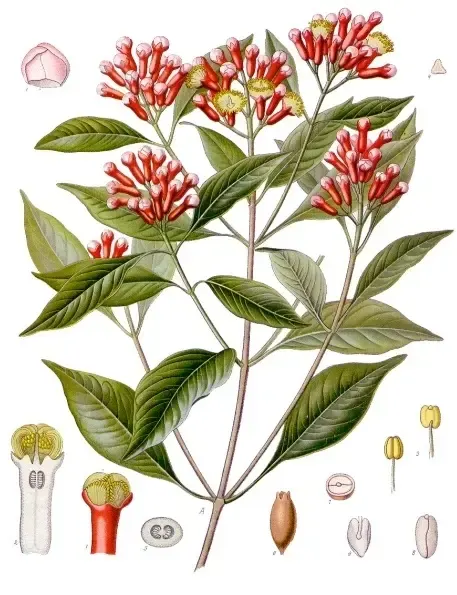
© Franz Eugen Köhler, Köhler's Medizinal-Pflanzen · Public domain · Commons
Clove
CautionGewürznelkenbaum · (Syzygium aromaticum)
Myrtle family (Myrtaceae)
Description
Cloves are the aromatic flower buds of a tree in the family Myrtaceae, Syzygium aromaticum. They are native to the Maluku Islands, or Moluccas, in Indonesia, and are commonly used as a spice, flavoring, or fragrance in consumer products, such as toothpaste, soaps, or cosmetics. Cloves are available throughout the year owing to different harvest seasons across various countries.
- Essential oilFlowerExternalCommission E
Clove oil (1–2 drops on a cotton swab) acts as a local analgesic and antiseptic for toothache. The main active compound eugenol inhibits pain receptors and shows antimicrobial activity against oral pathogens. Apply externally to the affected gum or tooth only — do not apply undiluted to mucous membranes.
Preparation & dosage
Dilute 1–2 drops of clove oil with carrier oil (e.g. olive oil) 1:1; apply with cotton swab. Do not swallow. Not for children under 12 years.
⚠ Age restriction: ≥ 12 years — Do not use undiluted clove oil in children under 12 years.
[#src_komm_e_syzygium] [#src_ema_syzygium_oil] [#src_arzneipflanzenlexikon_syzygium]
- GargleFlowerExternalCommission E
A 1–5% mouthwash with clove oil (in water or alcohol) acts antiseptically and anti-inflammatorily in mild inflammation of the oral and pharyngeal mucosa. Rinse several times daily; spit out solution afterwards. Eugenol inhibits plaque biofilm formation.
Preparation & dosage
Dissolve 1–5 drops clove oil in 100 ml lukewarm water or a mouthwash base. Rinse 30 seconds several times daily and spit out.
[#src_komm_e_syzygium] [#src_ema_syzygium_oil] [#src_pharmawiki_syzygium]
- SpiceFlowerInternalTraditional use
As a culinary spice (whole or ground), cloves promote digestion, act carminatively (anti-flatulence), and stimulate gastric secretion. Traditionally used for nausea, bloating, and digestive weakness. Used in desserts, meat dishes, mulled wine, and chai.
Preparation & dosage
1–3 whole cloves or a pinch of powder per dish or drink. Culinary amounts used daily are considered safe.
[#src_pfaf_syzygium] [#src_arzneipflanzenlexikon_syzygium] [#src_frontiers_syzygium]
- TeaFlowerInternalTraditional use
Clove tea (2–3 whole cloves per 250 ml hot water, steeped 10 min) acts warming, expectorant, and mildly antiseptic in colds with cough and digestive complaints. Traditional use in Ayurvedic and traditional Chinese medicine.
Preparation & dosage
Lightly crush 2–3 whole cloves and pour 250 ml boiling water over them. Steep 10 minutes, strain. Up to 3 cups daily.
- Dry amount
- 0.5–1 g
- Doses per day
- 3×
- Essential oilFlowerExternalFolk medicine
Diluted clove oil (3–5% in carrier oil) is used in folk medicine to relieve muscle and joint pain through massage. β-caryophyllene, the second most abundant active compound alongside eugenol, shows local anaesthetic and anti-inflammatory properties.
Preparation & dosage
Dilute 3–5 drops clove oil in 10 ml carrier oil (jojoba, almond). Gently massage into affected area. Do not apply to open wounds.
[#src_pfaf_syzygium] [#src_pmc_syzygium_batiha] [#src_frontiers_syzygium]
- SpiceFlowerInternalTraditional use
Cloves rank among the most antioxidant-rich foods. In addition to essential oil, the flower buds contain flavonoids (quercetin, kaempferol), phenolic acids, and oleanolic acid. As a spice in usual amounts, cloves contribute to an antioxidant-rich diet.
Preparation & dosage
Use as a spice in daily cooking (whole cloves, ground, or food-grade essential oil).