Donum ∞ Dei
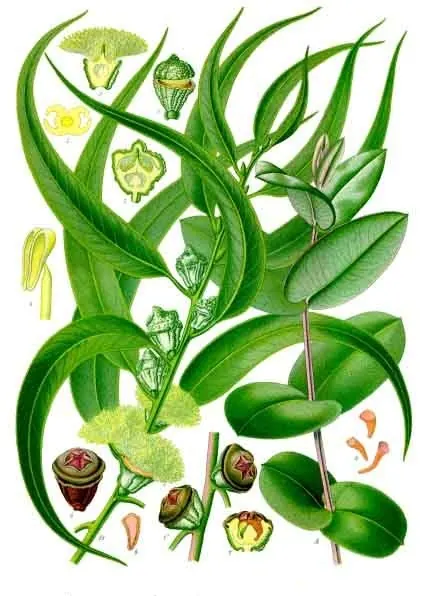
Botanical plate of Eucalyptus globulus (blue gum), Köhler 1897

© Franz Eugen Köhler, Köhler's Medizinal-Pflanzen (1897) · Public domain · Commons

Blue gum eucalyptus

Caution🐾

Blauer Eukalyptus · (Eucalyptus globulus)

Myrtle family (Myrtaceae)

Description

The blue gum eucalyptus is a fast-growing evergreen tree of the myrtle family. It comes from Tasmania and south-eastern Australia and is now grown around the Mediterranean, in Portugal, California and South America; in good sites it exceeds fifty metres. Striking is how its foliage changes over its life: young shoots carry stalkless, blue-green waxy leaves that give the tree its name, while older ones bear long, sickle-shaped hanging leaves. The bark peels away in strips, exposing the smooth pale surface beneath. Medicinally, the leaves and the essential oil distilled from them are used; its main component is 1,8-cineole (eucalyptol) — the same compound that gives cardamom its cool note. The European Medicines Agency lists eucalyptus oil as a traditional herbal medicinal product for cough associated with the common cold and for localised muscle pain. Eucalyptus essential oil must not be applied to the face or nose of infants and small children — it can trigger a spasm of the glottis.

  • InhalationLeafInternalTraditional use

    Traditionally used to relieve cough associated with colds and as an inhalation or bath additive to help clear the upper airways; registered in the EU as a traditional herbal medicinal product. For inhalation, rubs and baths the EMA permits use from four years of age, for oral use only from twelve. If a cough lasts longer than a week it needs medical assessment.

    Preparation & dosage

    Add a few drops of oil to a bowl of hot, no longer boiling water and breathe in the steam with closed eyes. Not over boiling water — scalding is the most common accident with this.

    Doses per day
    3×

    Age restriction: ≥ 4 years — Not at all under 30 months because of the risk of glottal spasm, and even after that never on the face.

    Sources: [1] [2]

  • Essential oilLeafInternalClinical trial

    For the constituent 1,8-cineole, some clinical studies exist on respiratory complaints such as bronchitis and rhinosinusitis. What was studied is the isolated pure compound in enteric-coated capsules, not the oil from the bottle — so the results do not carry over to every form of use.

    Sources: [2] [3]

  • SalveLeafExternalTraditional use

    Alongside cough, the EMA also lists localised muscle pain as a traditional use — as a diluted rub. On the skin the oil produces a sensation of cold and then of warmth. If the pain has not improved after one to two weeks it needs to be looked at.

    Sources: [1]

More from this family · Myrtle family

DEENFRESBG