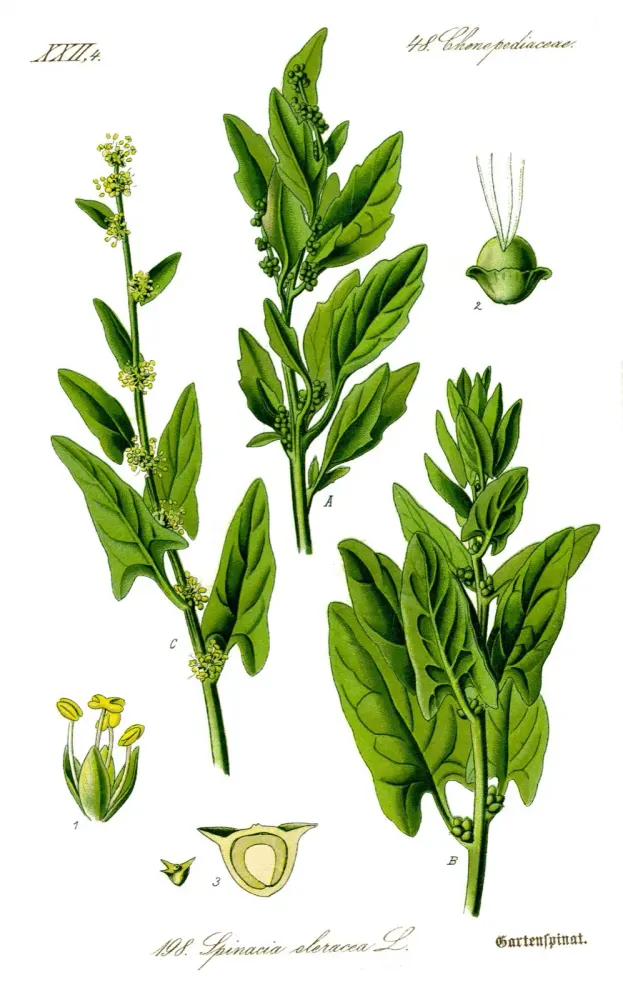
© Otto Wilhelm Thom&eacute · Public domain · Commons
Spinach
CautionSpinat · (Spinacia oleracea)
Amaranth family (Amaranthaceae)
Description
Spinach is a leafy green flowering plant native to Central and Western Asia. It is of the order Caryophyllales, family Amaranthaceae, subfamily Chenopodioideae. Its leaves are a common vegetable consumed either fresh, cooked or after storage.
- RawLeafInternalTraditional use
Young spinach leaves eaten raw in salad — rich in vitamin C, folate and lutein; iron and calcium bioavailability limited by oxalates.
Preparation & dosage
RAW SALAD: Young, tender spinach leaves (harvested before flowering) washed thoroughly and used as a salad base or addition. Raw spinach retains more vitamin C than cooked, but iron and calcium bioavailability is considerably reduced due to the high oxalate content — oxalates bind minerals in the gut. Safe for people without kidney problems. A dressing with lemon juice or vinegar increases vitamin C intake and can marginally improve iron absorption.
[#src_usda_spinach] [#src_wp_en_spinach] [#src_wp_de_spinach]
- RawLeafInternalTraditional use
Steamed spinach as a classic leaf vegetable — blanching reduces oxalates; never reheat repeatedly (nitrite formation risk).
Preparation & dosage
STEAMED LEAF VEGETABLE: Briefly steam spinach in a little water or butter over medium heat (2–4 minutes) and serve immediately. Blanching in boiling water (1–2 min) and discarding cooking water reduces oxalate content by approx. 30–50 %, somewhat improving calcium and iron bioavailability, but causes losses in heat-sensitive vitamins (vitamin C, folate). Pairing with a vitamin C source (lemon) can enhance non-haem iron absorption. IMPORTANT: Do not reheat spinach multiple times — reheating can convert nitrates to nitrites.
[#src_usda_spinach] [#src_efsa_nitrate] [#src_wp_en_spinach]
- RawLeafInternalFolk medicine
Spinach in smoothies — a modern folk practice for easy nutrient intake; flavour masked by fruit.
Preparation & dosage
SMOOTHIE / GREEN JUICE: A handful of fresh spinach leaves (approx. 30–50 g) blended with fruits (banana, apple, berries) and liquid (water, oat milk). The flavour is largely masked by the fruit. A common modern folk practice for easy intake of folate, lutein, zeaxanthin and vitamin K. No traditional or evidence-based indication — purely a nutritional application.
- RawLeafInternalFolk medicine
Iron source — spinach contains iron, but bioavailability is severely limited by oxalates; the 'Popeye myth' greatly exaggerates its significance.
Preparation & dosage
IRON SOURCE — MYTH AND REALITY: The folk belief that spinach is an exceptional iron source (the 'Popeye myth') is only partially accurate. Spinach contains approx. 2.7 mg iron per 100 g fresh weight — respectable for a vegetable. However, it is exclusively non-haem iron, with an absorption rate of only 1–7 % depending on the meal, compared to 15–35 % for haem iron from meat. Spinach's high oxalic acid content (approx. 700–900 mg/100 g) forms poorly soluble iron oxalates, further inhibiting uptake. The historical myth likely originates from a decimal error in a German study from 1870 that led to a tenfold overestimation of the iron content. Spinach is a valuable food — but not an exceptional iron source.
[#src_usda_spinach] [#src_wp_en_spinach] [#src_wp_de_spinach]
- RawLeafInternalFolk medicine
Folate source — spinach is one of the best plant folate sources; especially relevant in pregnancy (neural tube defect prevention), though heat-sensitive.
Preparation & dosage
FOLATE SOURCE: Spinach is one of the best dietary sources of folate (vitamin B9) with approx. 194 µg per 100 g fresh weight (approx. 49 % of the daily reference value). Folate is essential for cell division and DNA synthesis, particularly important in early pregnancy for neural tube defect prevention. Pregnant women and those planning pregnancy should additionally supplement, as dietary folate alone is often insufficient and absorption variability is high. Folate is heat-sensitive — blanching reduces content by 30–50 %.
- RawLeafInternalClinical trial
Lutein and zeaxanthin source for eye health support — clinically substantiated (AREDS2) for reduced AMD risk; fat substantially improves bioavailability.
Preparation & dosage
LUTEIN AND ZEAXANTHIN (EYE HEALTH): Spinach contains approx. 12 mg lutein + zeaxanthin per 100 g fresh weight — one of the richest sources of these xanthophyll carotenoids. Lutein and zeaxanthin accumulate in the macular pigment of the eye, filtering high-energy blue light. Multiple clinical studies and meta-analyses show that regular intake (approx. 6 mg/day lutein) significantly reduces the risk of age-related macular degeneration (AMD) (AREDS2 study). IMPORTANT for bioavailability: lutein is fat-soluble — always combine spinach with a fat source (oil, butter, nuts) as fat increases carotenoid absorption 4–6-fold. Cooking increases lutein bioavailability from spinach.
- RawLeafInternalTraditional use
Vitamin K source (approx. 400 % daily value per 100 g) — for coagulation and bone health; consistent, not avoided intake for those on vitamin K antagonists.
Preparation & dosage
VITAMIN K SOURCE: Spinach is exceptionally rich in vitamin K1 (phylloquinone) at approx. 483 µg per 100 g fresh weight — roughly 400 % of the daily reference value. Vitamin K is essential for blood coagulation and bone health. For healthy people without anticoagulant therapy, the high vitamin K content is nutritionally desirable. For those taking vitamin K antagonists (warfarin, phenprocoumon), consistent — not avoided — intake is key: sudden large amounts of spinach can destabilise INR values. Planned, regular amounts are well compatible with anticoagulant dosing.
🤝 Permaculture Partners
In your garden, this plant acts as:
✨ Best symbiotic partners
- 🌿 Onion Classic companion-planting partner.
- 🌿 Cabbage Spinach roots produce saponins — cabbage grows stronger.
- 🌿 Brussels sprout Classic companion-planting partner.
- 🌿 Fragaria vesca Spinach as ground cover provides nitrogen for strawberry roots.
- 🌿 Lettuce Classic companion-planting partner.
- 🌿 Pea Classic companion-planting partner.
- 🌿 Potato Spinach as undersowing provides nitrogen and shades soil.
📦 Part of these planting sets:
Source: Helga und Margarete Langerhorst, Mein gesunder Naturgarten (eigene Kuration)