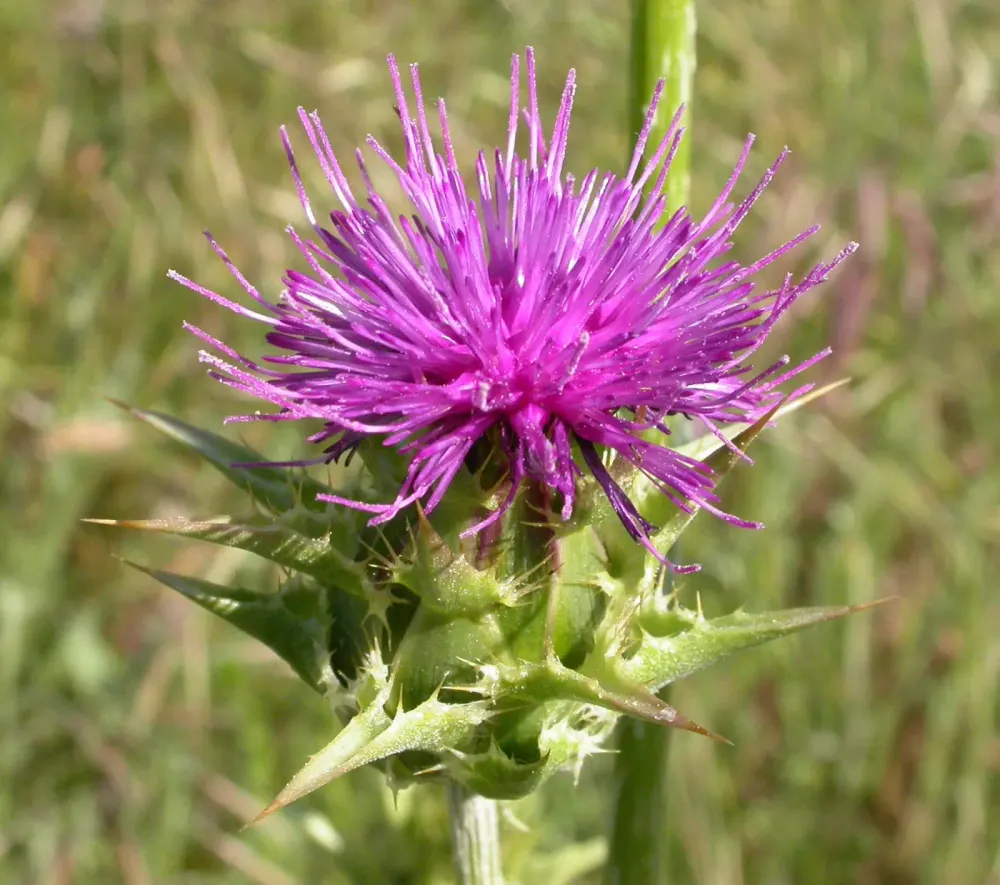
© Copyright by Curtis Clark, licensed as noted · CC BY-SA 2.5 · Commons
Silybum marianum
Mariendistel · (Silybum marianum)
Daisy family (Asteraceae)
Description
Silybum marianum is a species of thistle. It has various common names including milk thistle, blessed milkthistle, Marian thistle, Mary thistle, Saint Mary's thistle, Mediterranean milk thistle, variegated thistle and Scotch thistle. This species is an annual or biennial plant of the family Asteraceae.
CONTRAINDICATED for children
EMA monograph: not for children/adolescents under 18 — insufficient safety and efficacy data. Liver disease in children requires paediatric diagnosis and treatment.
- TinctureFruitInternalCommission E
Standardised silymarin dry extract (positively assessed by Commission E) for supportive treatment of toxic liver damage and chronic inflammatory liver disease — leading preparation Legalon.
Preparation & dosage
STANDARDISED DRY EXTRACT — EMA well-established use: Standardised preparations of milk thistle fruit (Silybi mariani fructus), dry extracts as capsules or coated tablets, DER 36–44:1, standardised to 30–65 % silymarin (as silibinin). Examples: Legalon 70/140 mg, Silymarin Stada. EMA dosage: 70–420 mg silymarin daily in 2–3 divided doses, with meals. Well-established indication: supportive treatment of toxic liver damage and chronic inflammatory liver diseases including cirrhosis. Onset 2–4 weeks; consult doctor for acute complaints. Do not self-treat jaundice or ascites — these need immediate medical assessment.
- Dry amount
- 0.3–0.6 g
- Doses per day
- 3×
- Max duration
- 8 weeks
⚠ Age restriction: ≥ 18 years — Per EMA monograph, adults 18+ only — insufficient safety data for children and adolescents.
[#src_ema_silybi_mariani_fructus_we] [#src_escop_silybi_fructus] [#src_kommission_e_cardui]
- TinctureFruitInternalTraditional use
Traditional use of powdered milk thistle fruit for dyspeptic complaints (bloating, flatulence) — classified by EMA as traditional use.
Preparation & dosage
TRADITIONAL USE — powdered fruit or standardised preparations: Powdered fruit 300–600 mg per dose, 2–3× daily with meals. Per EMA monograph (traditional use): supportive treatment of dyspeptic complaints (bloating, flatulence, mild digestive discomfort). Prefer standardised preparations over raw powder for bioavailability. No improvement after 4 weeks: consult doctor.
- Dry amount
- 0.3–0.6 g
- Doses per day
- 3×
- Max duration
- 4 weeks
⚠ Age restriction: ≥ 18 years — Adults 18+ only.
[#src_ema_silybi_mariani_fructus_we] [#src_kommission_e_cardui] [#src_escop_silybi_fructus]
- TeaFruitInternalFolk medicine
Folk tea from freshly crushed fruits for general liver support — silymarin poorly water-soluble, but digestive companions dissolve effectively.
Preparation & dosage
FOLK INFUSION: 3–5 g freshly crushed milk thistle fruits (rough crush in mortar — do NOT grind fine) in 200 ml boiling water, covered, steep 10–15 min, strain. 3× daily before meals. NOTE: Silymarin is very poorly water-soluble (~0.04 mg/ml). Tea delivers only a fraction of the effective dose of standardised extracts — used in folk medicine for general liver support but not a substitute for clinical extracts. Bitter compounds and mucilage dissolve in the infusion and support digestion.
- Dry amount
- 3–5 g
- Doses per day
- 3×
- Max duration
- 4 weeks
[#src_wichtl_teedrogen] [#src_pfaf_silybum] [#src_wp_de_mariendistel]
- TinctureFruitInternalClinical trial
Clinical use of i.v. silibinin hemisuccinate (Legalon SIL) in acute death cap mushroom poisoning — highest clinical evidence for liver-protective effect in amatoxin hepatotoxicity.
Preparation & dosage
INTRAVENOUS USE IN HOSPITAL ONLY — Silibinin hemisuccinate (Legalon SIL): For acute amatoxin poisoning (death cap mushroom, Amanita phalloides), the isolated compound silibinin hemisuccinate is given as IV infusion. Dose: 20 mg/kg/day as continuous infusion, started as early as possible. This is NOT for self-treatment — suspected mushroom poisoning: call poison control immediately and go to A&E. Mechanism: inhibition of amatoxin hepatocyte uptake via OATP1B1/1B3. Also described for hepatotoxic drug injury management in clinical settings.
- Dry amount
- 0.35–0.7 g
- Doses per day
- 3×
- Max duration
- 26 weeks
[#src_silibinin_iv_rambaldi] [#src_escop_silybi_fructus] [#src_ema_silybi_mariani_fructus_we]
- RawLeafInternalFolk medicine
Young leaves (despiked), peeled stems and immature flower heads are edible — traditional vegetable in Mediterranean regions; nutritionally valuable for proteins, fat and flavonoids.
Preparation & dosage
EDIBLE PLANT — leaves and stems: Young rosette leaves (pre-flowering, March–April), remove spines (cut with scissors), eat raw as salad or briefly blanched (2–3 min) as vegetable. Taste mild, slightly bitter. Peel stems before flowering (like rhubarb) and cook as vegetable or candy. Immature flower heads prepared like artichokes. Traditional food plant in Mediterranean countries.
- TinctureFruitInternalCommission E
Positively assessed by Kommission E for liver toxicity, chronic hepatitis and cirrhosis (200–400 mg silymarin/day) — one of the best-documented herbal liver indications in Germany.
Preparation & dosage
KOMMISSION E RECOMMENDATION — daily dose 200–400 mg silymarin (as silibinin) in standardised preparations. Positive Kommission E vote (1986, revised 1992) for toxic liver damage and supportive treatment of chronic hepatitis and cirrhosis. Single dose 140 mg silymarin 2–3× daily as capsule. Tincture (DAB, 1:5 in 45–60 % ethanol) matches fruit dosing but contains less bioavailable silymarin than dry extract — prefer capsules. Severe liver disease: medical treatment mandatory.
- Dry amount
- 0.35–0.7 g
- Doses per day
- 3×
- Max duration
- 8 weeks
[#src_kommission_e_cardui] [#src_escop_silybi_fructus] [#src_wichtl_teedrogen]
- TeaAerial partsInternalFolk medicine
Folk leaf tea for digestive complaints and bile flow stimulation — low silymarin content; primary action through bitter compounds.
Preparation & dosage
LEAF TEA (folk): 2–3 tsp dried, coarsely cut milk thistle leaves (remove spines before drying) in 250 ml boiling water, covered, steep 8–10 min, strain finely. 1–2× daily between meals. Bitter and tannin compounds stimulate bile flow and digestive secretions. Silymarin content in leaves is very low — leaf preparations support digestion generally, not liver therapy. PFAF documents folk use of leaves for liver and gallbladder complaints in Mediterranean traditions.
- Dry amount
- 2–3 g
- Doses per day
- 2×
- Max duration
- 4 weeks
[#src_pfaf_silybum] [#src_wp_de_mariendistel] [#src_madaus_1938_carduus]
- RawSeedInternalFolk medicine
Hulled milk thistle seeds as nutrient-dense raw food ingredient: mild nutty flavour, protein, fatty acids and silymarin — traditional Mediterranean use and modern superfood.
Preparation & dosage
SEEDS in the kitchen: Ripe, hulled milk thistle seeds have a mild, nutty flavour. Raw as addition to muesli, salads or smoothies (1–2 tsp daily). Lightly toasted as topping on soups and vegetables. Ground to fine powder and stirred into yoghurt or quark (whole food: ~25 % protein, 20–30 % fat, silymarin). Valued ingredient in Mediterranean and health-food cuisine. Consume ground seeds promptly — oil oxidises quickly after grinding.