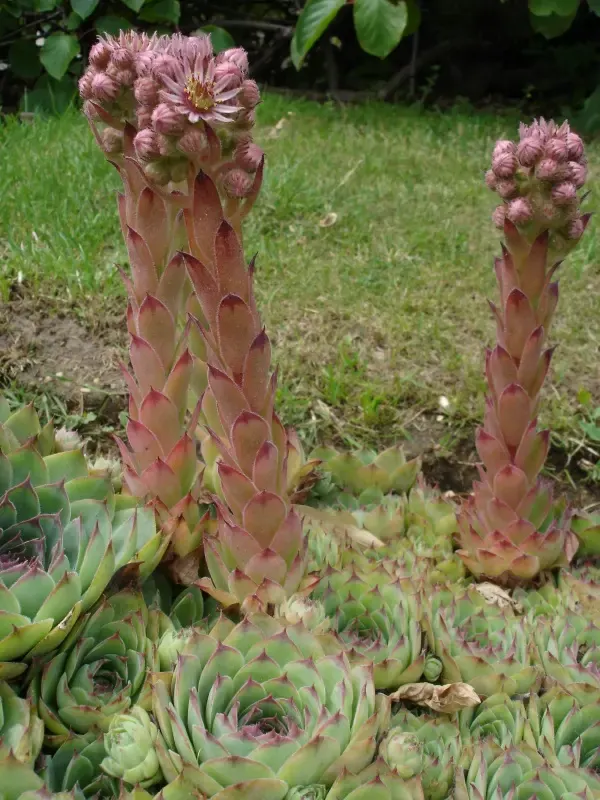
© Bouba · CC BY-SA 3.0 · Commons
Sempervivum tectorum
Dach-Hauswurz · (Sempervivum tectorum)
Stonecrop family (Crassulaceae)
Description
Sempervivum tectorum, the common houseleek, is a species of flowering plant in the family Crassulaceae, native to the mountains of southern Europe, cultivated in the whole of Europe for its appearance and a Roman-era tradition claiming that it protects buildings against lightning strikes.
- RawLeafExternalTraditional use
Fresh leaf juice or halved succulent leaves are applied directly to minor wounds, burns, insect stings, and sunburn. The cooling, astringent action (tannins, mucilage) relieves burning and supports wound healing.
Preparation & dosage
[#src_pfaf_semperv] [#src_wiki_en_semperv] [#src_abram_1999]
- CompressLeafExternalFolk medicine
Poultice from crushed leaves for burns, abrasions, and inflamed skin. Dioscorides and Galen recorded use for skin diseases and eye inflammation; Marcellus Empiricus mentions compresses for contusions.
Preparation & dosage
[#src_wiki_en_semperv] [#src_cabi_semperv] [#src_ethnobotany_2024]
- SalveLeafExternalFolk medicine
Houseleek salve from leaf juice combined with beeswax or lard is used in folk medicine for eczema, warts, corns, and irritated skin. PFAF notes the plant as a wart remedy; the astringency of tannins helps shrink excess tissue.
- RawLeafExternalFolk medicine
Juice from fresh leaves was historically used for skin care and to reduce freckles (documented in medieval household books). Also known as a cooling application for sunburn and insect stings.
- TeaLeafInternalFolk medicine
In folk medicine, a tea from the leaves was occasionally used for diarrhoea. A mixture of juice and honey against thrush (oral candidiasis) is also recorded. Internal use is uncommon and historically little documented; emetic in excess.
Preparation & dosage
Pour 200 ml of hot water over 1–2 g of dried leaves, steep for 8 minutes, strain. Use only short-term and in small amounts.
- Dry amount
- 1–2 g
- Doses per day
- 2×
- RawLeafInternalFolk medicine
Young leaves of common houseleek are edible (slightly sour, mildly astringent due to malic acid) and were used as a food supplement in times of scarcity; today occasionally grown as an ornamental succulent in rock gardens.
- RawLeafExternalTraditional use
Hildegard von Bingen recommended houseleek juice for various applications including external use. The polyphenols (quercetin, kaempferol glycosides, kämpferol) were identified in 1999 in J. Agric. Food Chem. and show antimicrobial activity against Staphylococcus aureus.