© Walther Otto Müller · Public domain · Commons
Salvia officinalis
CautionEchter Salbei · (Salvia officinalis)
Mint family (Lamiaceae)
Description
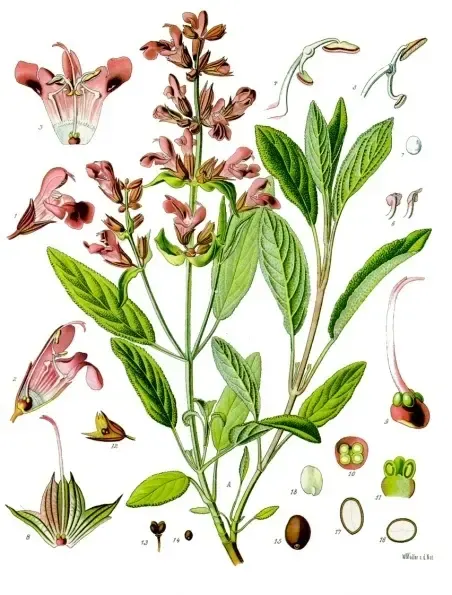
Salvia officinalis, common sage or sage, is a perennial, evergreen subshrub, with woody stems, grayish leaves, and blue to purplish flowers. It is a member of the mint family (Lamiaceae) and native to the Mediterranean region, though it has been naturalized in many places throughout the world. It has a long history of culinary use, and in modern times it has been used as an ornamental garden plant.
CONTRAINDICATED during pregnancy
Culinary amounts as a spice are safe. Avoid therapeutic doses (tea, tincture, essential oil) throughout pregnancy — thujone content is uterine-contracting and potentially fetotoxic; classically used as an emmenagogue.
Critical drug interactions with:
Antikonvulsiva / Antiepileptika
- GargleLeafExternalEMA well-established
Main indication per EMA HMPC and German Commission E: gargling and mouth-rinsing with sage leaf infusion for inflammations of the mouth and throat mucosa (stomatitis, gingivitis, pharyngitis, aphthae). Tannins act astringent, the essential oil antimicrobial and mildly local-anaesthetic.
Preparation & dosage
Pour 150 ml boiling water over 1-3 g finely cut sage leaves, cover and infuse for 10 minutes, strain and cool to body temperature. Gargle and rinse mouth several times a day (3-4 times); do not swallow when used intensively over several days.
- Dry amount
- 1–3 g
- Doses per day
- 4×
- Max duration
- 2 weeks
[#src_ema_salviae_folium] [#src_kommission_e_salbei] [#src_escop_salbei]
- TeaLeafInternalEMA well-established
EMA HMPC and Commission E: sage tea as traditional use for mild dyspeptic complaints such as bloating, heartburn and flatulence. Essential oils and bitter principles act carminative, spasmolytic and choleretic.
Preparation & dosage
Pour 150 ml boiling water over 1-3 g finely cut sage leaves, cover and infuse for 10 minutes, then strain. Drink one cup 2-3 times daily between meals. Use continuously for a maximum of 4-6 weeks — avoid thujone accumulation.
- Dry amount
- 1–3 g
- Doses per day
- 3×
- Max duration
- 4 weeks
- TeaLeafInternalEMA well-established
EMA HMPC: well-established traditional use as antihidrotic for excessive perspiration, particularly hyperhidrosis and menopausal symptoms (hot flushes, night sweats). Onset of action usually 1-2 hours, duration several hours.
Preparation & dosage
Pour 150 ml boiling water over 1-3 g dried sage leaves, infuse for 10 minutes, drink cold (cold preparation suppresses sweating more strongly than hot tea). One cup in the evening before bed for night sweats; for hyperhidrosis twice daily.
- Dry amount
- 1–3 g
- Doses per day
- 2×
- Max duration
- 6 weeks
[#src_ema_salviae_folium] [#src_escop_salbei] [#src_madaus_salbei]
- TinctureLeafInternalTraditional use
Traditional ethanolic tincture for dyspeptic complaints and excessive sweating. More concentrated than tea, easy to transport — caution due to thujone content (ethanolic extracts contain more thujone than aqueous ones).
Preparation & dosage
1:5 tincture in 70 % ethanol from dried sage leaves. Usual daily dose: 1-3 ml (about 20-60 drops) in a little water, 2-3 times daily before meals. Do not use continuously for more than 4 weeks.
- Liquid amount
- 1–3 ml
- Doses per day
- 3×
- Max duration
- 4 weeks
- CompressLeafExternalTraditional use
Traditional folk-medicinal use as astringent and antimicrobial compress for poorly healing wounds, mild skin inflammations, insect bites and weeping eczema. Tannins act astringent, the essential oil bactericidal.
Preparation & dosage
Pour 250 ml boiling water over 3-5 g dried sage leaves, infuse for 15 minutes, strain. Soak a clean cloth in the warm infusion, wring lightly and apply to the affected skin area for 15-20 minutes. Once or twice daily.
- Dry amount
- 3–5 g
- Doses per day
- 2×
[#src_madaus_salbei] [#src_kommission_e_salbei] [#src_heilkraeuter_salbei]
- InhalationLeafExternalTraditional use
Traditional use as steam inhalation for the common cold, bronchitis and catarrhs of the upper respiratory tract. The essential oil with cineole and camphor is mucous-membrane active, expectorant and antimicrobial.
Preparation & dosage
Add 1-2 teaspoons dried sage leaves (or 2-3 drops sage oil) to a bowl with 500 ml hot (not boiling) water, cover head with a towel, close eyes and inhale steam for 5-10 minutes. Do not use in asthma, pertussis or children under 4 years.
- Dry amount
- 1–2 g
- Doses per day
- 2×
⚠ Age restriction: ≥ 4 years — Sage inhalation must not be used in children under 4 years due to thujone, cineole and camphor content — risk of laryngospasm with application near the face.
- SpiceLeafInternalFolk medicine
Classical Mediterranean culinary herb for fatty foods, poultry, pork, saltimbocca and bean dishes. Essential oils stimulate appetite and digestion and reduce belching after fatty meals. Culinary amounts pose no thujone concern.
Preparation & dosage
Distribution in Europe
🪴 Grow at home
- ☀ Light
- full sun
- 💧 Water
- weekly
- 🌱 Soil
- Sandy with drainage
- 🪴 Pot
- 20 cm
- ⭐ Difficulty
- ★☆☆ beginner
- 🐾 Pets
- pet-safe
Tips:
- Very robust — tolerates drought, heat, poor soil.
- Full sun perfect — otherwise leaves go soft.
- Replace every 3-4 years, old plants get woody.
Care tips are general indoor-gardening recommendations, not scientific sources.
🤝 Permaculture Partners
In your garden, this plant acts as:
✨ Best symbiotic partners
- 🌿 Carrot Classic companion-planting partner.
- 🌿 Lavandula angustifolia Classic companion-planting partner.
- 🌿 Matricaria chamomilla Classic companion-planting partner.
- 🌿 Oregano Classic companion-planting partner.
- 🌿 Rosemary Mediterranean dry alliance — same needs.
- 🌿 Thymus vulgaris Both aromatic and drought-tolerant — herb-spiral classic.
🌟 Neutral neighbours
⚠️ Better not planted together
📦 Part of these planting sets:
Source: Helga und Margarete Langerhorst, Mein gesunder Naturgarten (eigene Kuration)