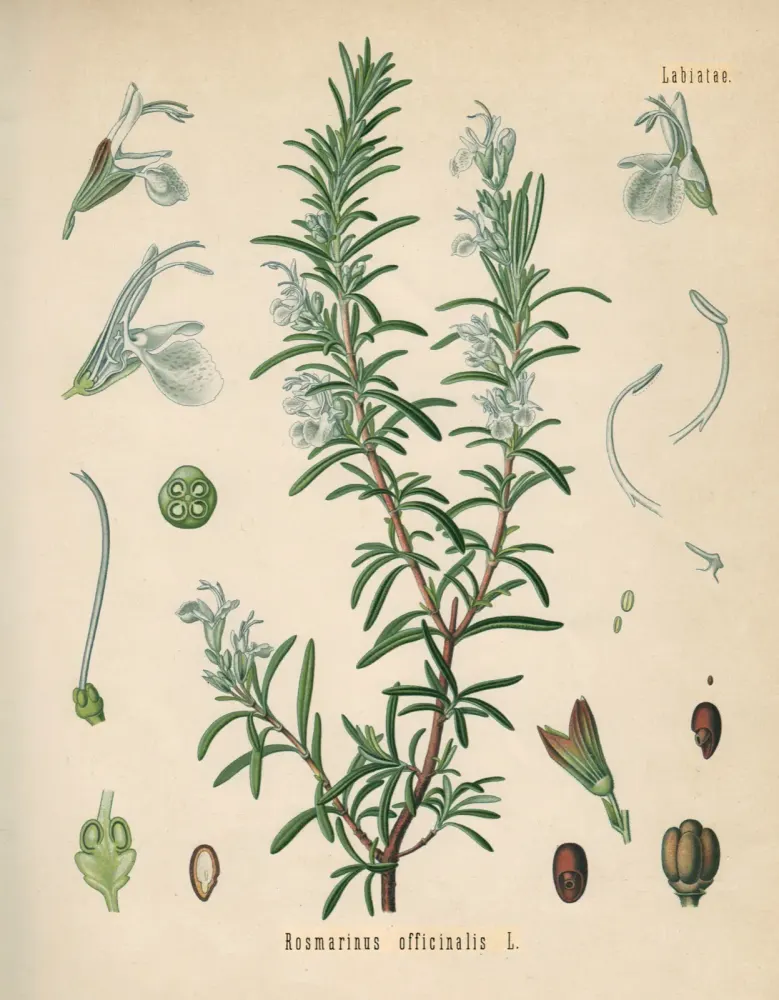
© Unknown (see Commons) · Public domain · Commons
Rosemary
CautionRosmarin · (Rosmarinus officinalis)
Mint family (Lamiaceae)
Description
Salvia rosmarinus, synonym Rosmarinus officinalis, commonly known as rosemary, is a shrub with fragrant, evergreen, needle-like leaves and purple or sometimes white, pink, or blue flowers. It is a member of the mint family, Lamiaceae. The species is native to the Mediterranean region.
- TeaLeafInternalEMA well-established
Well-established traditional use for mild dyspeptic complaints such as bloating, flatulence and upper-abdominal cramps. EMA HMPC and German Commission E list rosemary leaf with a positive assessment for internal use in digestive disorders.
Preparation & dosage
Pour 150 ml boiling water over 1-2 g of finely cut rosemary leaves, cover and infuse for 10 minutes, then strain. Drink a freshly prepared cup three to four times daily between meals.
- Dry amount
- 1–2 g
- Doses per day
- 3×
- Max duration
- 4 weeks
[#src_ema_rosmarini_folium] [#src_kommission_e_rosmarin] [#src_escop_rosmarin]
- TeaLeafInternalTraditional use
Folk-medicinal use as a circulation-stimulating morning tea for hypotensive symptoms such as morning fatigue, weak circulation and low blood pressure. Rosemary oil constituents are mildly stimulating.
Preparation & dosage
Drink one cup of rosemary leaf infusion (1-2 g per 150 ml) in the morning and at midday. Avoid in the evening due to mild stimulating effect.
- Dry amount
- 1–2 g
- Doses per day
- 2×
[#src_kommission_e_rosmarin] [#src_madaus_rosmarin] [#src_heilkraeuter_rosmarin]
- BathLeafExternalEMA well-established
EMA HMPC and Commission E recognise rosemary leaf and rosemary-oil preparations as bath additive for supportive treatment of rheumatic complaints and weak circulation/exhaustion. Skin circulation is stimulated and overall circulation invigorated.
Preparation & dosage
Pour 1 L hot water over 50-100 g dried rosemary leaves, infuse for 30 minutes, strain and add to a full bath (about 35-38 °C, 10-20 minutes). Alternatively 10-50 g rosemary oil as bath additive. Avoid evening baths — stimulating.
- Dry amount
- 50–100 g
- Doses per day
- 1×
[#src_ema_rosmarini_folium] [#src_ema_rosmarini_aetheroleum] [#src_kommission_e_rosmarin]
- Essential oilLeafExternalEMA well-established
Inhalation of rosemary essential oil for catarrhs of the upper respiratory tract. EMA HMPC Rosmarini aetheroleum cites 1,8-cineole- and camphor-rich chemotypes as mucolytic and mucous-membrane active.
Preparation & dosage
Add 2-3 drops of rosemary oil to a bowl with 500 ml hot (not boiling) water, cover head with a towel, close eyes and inhale steam for 5-10 minutes. Do not use in asthma or children under 4 years.
- Liquid amount
- 0.1–0.3 ml
- Doses per day
- 2×
⚠ Age restriction: ≥ 4 years — Not for children under 4 years due to 1,8-cineole and camphor content — risk of laryngospasm with application near the face.
- SpiceLeafInternalFolk medicine
Classical Mediterranean culinary herb for lamb, chicken, potatoes and marinades. Essential oils are appetite- and digestion-stimulating; the diterpenes (carnosol, carnosolic acid) act as antioxidants in cooked meat.
Preparation & dosage
- CompressLeafExternalFolk medicine
Folk-medicinal use as a warming compress for rheumatic pain, muscle tension, bruises and slow-healing skin areas. Essential oils are hyperaemic (circulation-promoting).
Preparation & dosage
- TinctureLeafInternalTraditional use
Traditional use as digestive and circulation-stimulating tincture for nervous stomach upset, bloating and low blood pressure. Ethanolic extracts preserve essential oil and rosmarinic acid well.
Preparation & dosage
1:5 tincture in 70 % ethanol from dried rosemary leaves. Usual daily dose: 20-40 drops (1-2 ml) three times daily in a little water before meals. Avoid in the evening — stimulating.
- Liquid amount
- 1–2 ml
- Doses per day
- 3×
- Max duration
- 4 weeks
Distribution in Europe
🪴 Grow at home
- ☀ Light
- full sun
- 💧 Water
- weekly
- 🌱 Soil
- Sandy-loamy with good drainage
- 🪴 Pot
- 22 cm
- ⭐ Difficulty
- ★★☆ intermediate
- 🐾 Pets
- pet-safe
Tips:
- Winter: bright and cool (5-10 °C) — no heated room.
- Water sparingly — root rot is the most common killer.
- Below -10 °C bring indoors, not hardy in our climate.
Care tips are general indoor-gardening recommendations, not scientific sources.
🤝 Permaculture Partners
In your garden, this plant acts as:
✨ Best symbiotic partners
- 🌿 Carrot Rosemary scent masks carrots from carrot fly.
- 🌿 Laurus nobilis Classic companion-planting partner.
- 🌿 Lavandula angustifolia Mediterranean dry specialists — lavender draws bees, rosemary protects.
- 🌿 Salvia officinalis Mediterranean dry alliance — same needs.
- 🌿 Thymus vulgaris Both Mediterranean and drought-tolerant — perfect herb pairing.
- 🌿 Tropaeolum majus Classic companion-planting partner.
⚠️ Better not planted together
- 🥬 Basil Rosemary likes dry, basil likes moist — water conflict.
📦 Part of these planting sets:
Source: Helga und Margarete Langerhorst, Mein gesunder Naturgarten (eigene Kuration)