Legal notice
Psilocybin and psilocin are scheduled under the UN 1971 Convention on Psychotropic Substances; the mushroom is prohibited in many countries, including Germany.
The legal situation differs greatly by country and changes over time. Check the regulations in your own country. This information is purely educational and is not permission to possess, cultivate, or consume.
For education and documentation only. Not a consumption guide, not legal or medical advice. Possession, cultivation and use are regulated differently by country and species — check the law that applies to you.
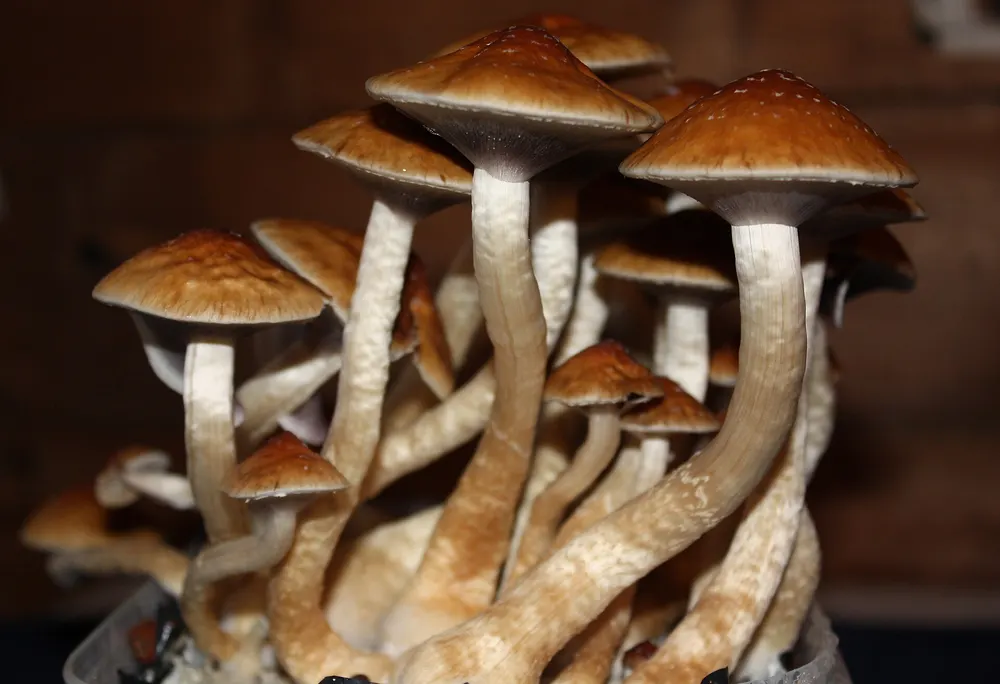
© Mädi (Wikimedia Commons) · CC BY-SA 3.0 · Commons
Golden Teacher
Caution🐾Kubanischer Kahlkopf · (Psilocybe cubensis)
Strophariaceae family (Strophariaceae)
Description
The Golden Teacher (Psilocybe cubensis) is a psilocybin-containing gilled mushroom of the order Agaricales, first described from Cuba in 1906 by Franklin Sumner Earle as Stropharia cubensis and reclassified into the genus Psilocybe by Rolf Singer in 1949. Its fruiting body has a 1.6–8 cm cap that is conic to bell-shaped when young, reddish- to golden-brown, atop a pale yellowish ringed stipe; all parts stain blue when bruised. A dung-loving (coprophilous) and pantropical species, it grows on the dung of large herbivores (cattle, water buffalo) and rich pasture, having spread worldwide alongside cattle ranching. Its principal active compounds are the indole alkaloids psilocybin and psilocin. Mushrooms of this genus featured in Mesoamerican ritual and, since the 2010s, psilocybin has become a focus of clinical mental-health research.
🌿 Risk of confusion — read before wild-harvesting!
SERIOUS RISK OF CONFUSION: deadly poisonous lookalike mushrooms of the genera Galerina and Pholiotina (Conocybe) can cause fatal poisoning.
- RawWhole plantInternalTraditional use
Mushrooms of the genus Psilocybe (e.g. P. mexicana) were used ritually and divinatorily in Mesoamerican cultures; Aztec sources call them 'teonanácatl'. Historical research shows traditional use was limited and culturally specific. Educational context only, not a usage instruction.
- RawWhole plantInternalClinical trial
Synthetic psilocybin (the active compound of P. cubensis) is being investigated in randomized controlled trials as a psychotherapy-assisted treatment for treatment-resistant depression. The evidence is mixed: early studies suggested symptom reductions, but large controlled trials (e.g. EPISODE) missed their primary endpoint and reported safety concerns (including increased suicidal ideation on dosing days). Research context only — not an approved therapy and not self-medication.