Legal notice
Psilocybin and psilocin are internationally controlled substances under Schedule I of the 1971 UN Convention on Psychotropic Substances; consequently psilocybin-containing mushrooms are prohibited or regulated in many countries.
The specific legal situation differs substantially by country (fresh vs. dried mushrooms, possession, cultivation, research) and changes over time. Inform yourself about the current rules in your country. This note does not permit or recommend consumption.
For education and documentation only. Not a consumption guide, not legal or medical advice. Possession, cultivation and use are regulated differently by country and species — check the law that applies to you.
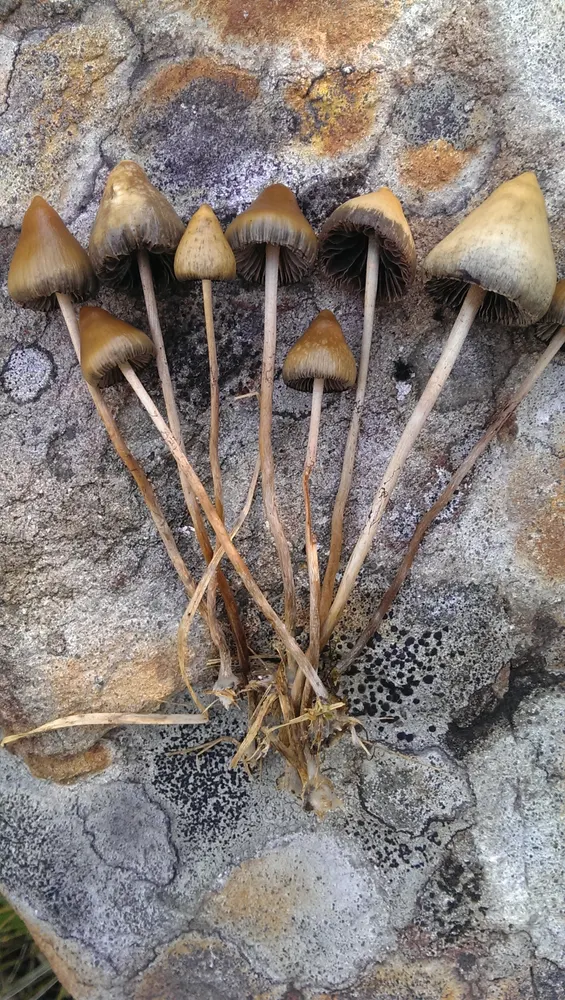
© Scienceman71 · CC BY-SA 4.0 · Commons
Liberty cap
Caution🐾Spitzkegliger Kahlkopf · (Psilocybe semilanceata)
Strophariaceae family (Strophariaceae)
Description
The liberty cap (Psilocybe semilanceata) is a small saprobic gilled mushroom with a distinctive sharply conical to bell-shaped, hygrophanous cap roughly 0.5–2.5 cm wide, topped by a characteristic nipple-like papilla. It does not grow on dung directly but among grasses in nutrient-rich meadows and pastures of the temperate Northern Hemisphere, and is now found worldwide. It contains the psychoactive tryptamines psilocybin and psilocin and is the type species of the genus Psilocybe. The earliest reliable record of intoxication dates to London in 1799, and in the early 1960s Albert Hofmann first confirmed psilocybin in a European mushroom. Cap and stem often stain bluish when bruised.
🌿 Risk of confusion — read before wild-harvesting!
WARNING: High risk of confusion with deadly poisonous small mushrooms, especially the funeral bell (Galerina marginata, amatoxin-containing), muscarine-containing fibrecaps (Inocybe) and the kidney-damaging Cortinarius rubellus — misidentification can be fatal.
- RawWhole plantInternalTraditional use
Psilocybin-containing mushrooms (chiefly Mexican Psilocybe species such as P. mexicana) were used ritually and religiously in Mesoamerican cultures ('teonanácatl'); the European liberty cap, by contrast, has no documented pre-industrial ritual tradition. Purely historical and ethnomycological context, not a usage recommendation.
- RawWhole plantInternalClinical trial
The compound psilocybin (a prodrug of psilocin, a 5-HT2A agonist) is being studied in controlled clinical trials as a rapid-acting treatment approach for, among others, treatment-resistant depression; meta-analyses of randomised trials report marked effects. This is regulated research under medical supervision — not evidence for self-use.