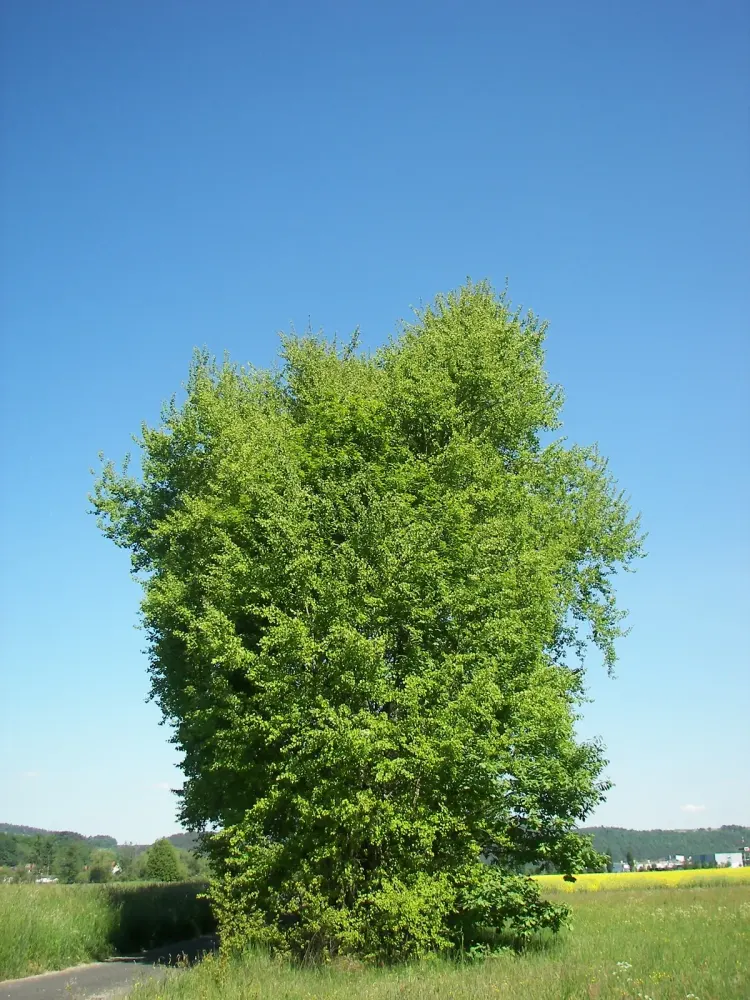
© Willow · CC BY-SA 2.5 · Commons
Populus tremula
CautionEspe · (Populus tremula)
Willow family (Salicaceae)
Description
Even the faintest breeze sets the rounded leaves of the European aspen (Salicaceae) trembling, thanks to their flattened petioles — hence its name. Bark harvested in spring contains phenyl glycosides such as salicortin, populin and tremulacin, which are converted to salicylates in the body and, similarly to acetylsalicylic acid, act as fever-reducing and anti-inflammatory agents. This effect is best documented for the standardised combination remedy Phytodolor® (with ash and goldenrod), studied clinically for osteoarthritis and rheumatic complaints; folk medicine used a plain bark tea or tincture for the same purpose. In Bach flower therapy, aspen is remedy no. 36 for vague, unfocused anxiety — a use without scientific proof of efficacy. Because of its salicylate content, caution is needed in known aspirin allergy, with anticoagulant therapy, and in children under 12 years.
Phytodolor®, a standardised combination of extracts from Populus tremula, Fraxinus excelsior, and Solidago virgaurea, is the best-documented phytotherapeutic preparation containing aspen. Okpanyi and Arens-Corell (1990) documented anti-inflammatory, analgesic, and antipyretic activities of the individual extracts and the combination in pharmacological studies. Bonaterra et al. (2007) confirmed anti-inflammatory effects via COX-2 inhibition in human monocytes. Phytodolor has been investigated in clinical studies for osteoarthritis and rheumatic complaints; Meyer and Elstner (1990) described the antioxidant contribution of Populus extracts.
Preparation & dosage
The bark of the European aspen was traditionally used in European folk medicine as a fever-reducing and antirheumatic agent. The phenyl glycosides (salicortin, populin, tremulacin) are hydrolysed to salicylates after oral uptake, explaining the antipyretic and anti-inflammatory effect analogous to acetylsalicylic acid. Maud Grieve documents the use against intermittent fever and rheumatism in 'A Modern Herbal' (1931).
Preparation & dosage
Simmer 2–4 g dried, chopped aspen bark in 250 ml water for 15 minutes, strain. Up to 3 cups daily. Do not use if allergic to salicylates or intolerant to aspirin.
- Dry amount
- 2–4 g
- Doses per day
- 3×
Alcoholic bark tincture of European aspen is traditionally used for chronic rheumatic complaints and osteoarthritis pain. The higher salicylate ester content in the tincture (salicortin, tremulacin) allows a more concentrated daily dose. Botanical reference: PFAF and Arzneipflanzenlexikon describe use in northern Europe and the Alpine region.
Preparation & dosage
Bark tincture 1:5 (40–60 % ethanol): 30–50 drops up to 3 times daily, not longer than 4–6 weeks without medical consultation. Contraindicated in salicylate allergy.
- Doses per day
- 3×
Populus tremula (European aspen) is known as Bach Flower No. 36 'Aspen' (Bach Flower Remedies). Edward Bach described these flower essences in 1936 as a remedy for vague anxiety, diffuse foreboding, and apprehensiveness without discernible cause. The essence is traditionally applied highly diluted in water or alcohol. No scientific evidence for efficacy beyond placebo exists; the use belongs to traditional complementary medicine.
Preparation & dosage
Bud salve from Populus buds (often Populus nigra or hybrids; also aspen buds in folk medicine) contains resinous phenyl glycosides and flavonoids, applied externally for joint pain, muscle soreness, and skin problems. Documented in the folk medicine traditions of Northern Europe and the Alpine region. Antioxidant properties of Populus extracts demonstrated by Meyer and Elstner (1990).
Preparation & dosage
Populus tremula (European aspen) contains salicylate esters (salicortin, populin, tremulacin) that are hydrolysed to free salicylates in the body. Use is contraindicated in persons with known salicylate allergy or ASA hypersensitivity. Caution with anticoagulant therapy (additive platelet function inhibition). In children under 12 years, caution is advisable analogous to the ASA warning due to the theoretical risk of Reye's syndrome. Medical consultation recommended during pregnancy and lactation.
⏱ Max continuous use: 6 weeks
Salicylates may promote premature closure of the ductus arteriosus in the third trimester. Use only after medical consultation; avoid in the third trimester.
Salicylates may pass into breast milk. Use only after medical consultation as a precaution.
Analogous to the ASA warning, salicylate-containing plant preparations should be avoided in children under 12 years with febrile illness due to the theoretical risk of Reye's syndrome.
Drug interactions
Antikoagulanzien (Phenprocoumon, Warfarin)
Salicylates from Populus extracts may potentiate platelet function inhibition and prolong bleeding time; combination with coumarins increases bleeding risk.
Thrombozytenaggregationshemmer (ASS, Clopidogrel)
Additive inhibition of platelet aggregation through salicylates from Populus tremula; increased bleeding risk.
NSAR (Ibuprofen, Naproxen)
Additive gastrointestinal irritation and mucosal damage through concurrent salicylate exposure from Populus extracts.
Contraindications
- Known hypersensitivity to salicylates (acetylsalicylic acid, NSAIDs of the salicylate group)
- Gastric or duodenal ulcers (salicylates may irritate mucosa)
- Third trimester of pregnancy (premature ductal closure possible)
Harvested part: bark, buds
- Time of day:
- Peel bark from young branches (2–4 cm diameter) in spring before or just after bud break; phenyl glycoside content is highest at this time.
- Drying:
- Dry bark pieces at max. 40 °C until brittle. Essential oils are better preserved at lower temperatures.
- Storage:
- 24 months — Dry, dark, well-sealed in paper bags or dark glass jars. Salicortin content remains stable for 2 years.
- Time of day:
- Harvest buds in early spring (February–March) before they burst open; resin content (phenyl glycosides, flavonoids, essential oil) is highest at this point.
- Drying:
- Steep buds fresh in oil or fat (bud salve) or dry at max. 35 °C. Fresh processing preferred.
- Storage:
- 12 months — As salve or tincture: in dark containers, stored cool. Dried buds: protected from light and dry, max. 12 months.
- SalicortinGlycosideContent: 2–10 %Bark
Phenyl glycoside; main active compound in bark and leaves of Populus tremula; hydrolysed to salicylic acid and hydroxycyclohexenone; anti-inflammatory and antipyretic.
- TremulacinGlycosideContent: 1–5 %Bark
Diglycosidic phenyl glycoside in Populus tremula; also hydrolysed to salicylate metabolites; structurally described by Pearl and Darling (1971).
- Populin (Benzoylsalicin)GlycosideContent: 0,5–3 %Bark
Benzoylated salicin; further salicylate precursor molecule from Populus bark; analgesic; referred to in classical phytotherapy as 'natural aspirin'.
- CinnamylsalicylatPhenolic acidBark
Ester compound of cinnamic acid and salicylic acid; found in Populus bark and buds; antioxidant properties demonstrated.
- CatechinFlavonoidBark
Flavan-3-ol; antioxidant and anti-inflammatory; in bark and leaves of Populus tremula; contributes to COX-2 inhibitory activity in the Phytodolor complex.
- QuercetinFlavonoidLeaf
Dominant flavonoid in Populus leaves; potent antioxidant; inhibits lipoxygenase and COX in vitro; synergistic with salicylates in the Phytodolor complex.
- Ätherisches Öl (Terpene, Aldeyhde)Essential oilFlower
Buds and flowers contain a resinous aromatic essential oil with terpene aldehydes; responsible for the characteristic scent of bud salves.
- TannineTanninBark
Condensed and hydrolysable tannins in bark; astringent; support the anti-inflammatory effect; partly responsible for the antioxidant properties of Populus extracts.
- [1]MonographOkpanyi SN, Arens-Corell M (1990): Anti-inflammatory, analgesic and antipyretic activities of dried extracts of Populus tremula, Solidago virgaurea and Fraxinus excelsior. European Journal of Pharmacology 183(6):2276–2277(accessed: 2026-05-24)
- [2]MonographBonaterra G et al. (2007): Anti-inflammatory effects of Populus tremula, Fraxinus excelsior, Solidago virgaurea extracts and their combination Phytodolor® in human monocytes. Planta Medica 73(09)(accessed: 2026-05-24)
- [3]MonographMeyer B, Elstner EF (1990): Antioxidative Properties of Leaf Extracts from Populus, Fraxinus and Solidago as Components of the Anti-inflammatory Plant Drug 'PHYTODOLOR®'. Planta Medica 56(06)(accessed: 2026-05-24)
- [4]MonographFeistel F et al. (2015): The Absolute Configuration of Salicortin, HCH-Salicortin and Tremulacin from Populus trichocarpa × deltoides Beaupré. Molecules 20(4):5566–5573(accessed: 2026-05-24)
- [6]BookPlants For A Future (PFAF): Populus tremula — European Aspen(accessed: 2026-05-24)
- [7]BookMaud Grieve: A Modern Herbal — Poplar, White (botanical.com, 1931)(accessed: 2026-05-24)
- [5]WikipediaWikipedia DE: Zitter-Espe (Populus tremula)(accessed: 2026-05-24)