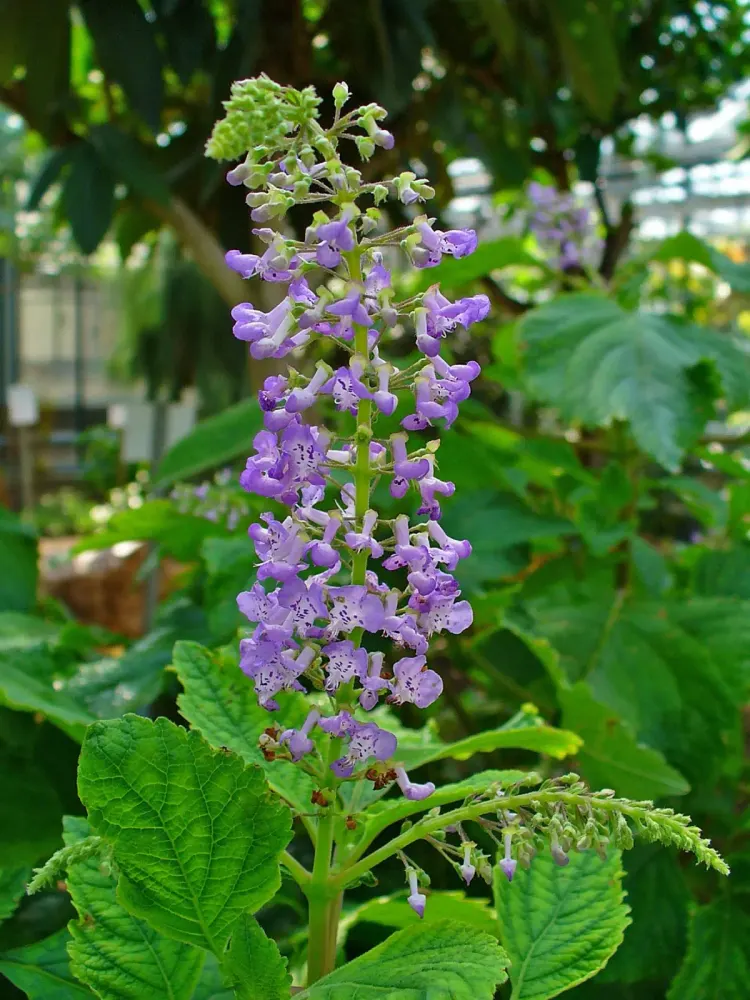
© H. Zell · CC BY-SA 3.0 · Commons
Coleus barbatus
CautionHarfensträucher · (Plectranthus barbatus)
Mint family (Lamiaceae)
Description
Coleus barbatus, also known by the synonyms Plectranthus barbatus and incorrectly Coleus forskalaei, is a tropical perennial plant related to the typical coleus species. It is known by the common name woolly plectranthus. It produces forskolin, an extract useful for pharmaceutical preparations and research in cell biology.
CONTRAINDICATED during pregnancy
Forskolin stimulates cAMP in smooth uterine muscle and may alter uterine tone. Contraindicated during pregnancy; no safety data available.
- TeaLeafInternalTraditional use
In Brazilian and African folk medicine, the leaves of Indian coleus ('falso boldo') are used as a tea for digestive complaints, liver ailments, and flatulence. Coleon E and rosmarinic acid contribute to the antispasmodic and digestive properties. This use is well documented ethnobotanically; no EMA monograph exists.
Preparation & dosage
Pour 200 ml boiling water over 2–4 g dried leaves, steep 10 minutes, strain. Up to 3 cups daily, not longer than 4 weeks without medical advice.
- Dry amount
- 2–4 g
- Doses per day
- 3×
- TinctureRootInternalClinical trial
Forskolin-rich root extracts of Plectranthus barbatus directly activate adenylyl cyclase and elevate intracellular cAMP levels, producing positive inotropy and vasodilation. This mechanism has been characterised in vitro and in animal studies. Clinical human trials with standardised extracts for heart failure are limited; the underlying pharmacology is established.
Preparation & dosage
Prefer standardised ready-made preparations (forskolin content 10–20 mg/dose). Use only under medical supervision for cardiovascular indications.
[#src_plect_mol_pharm] [#src_plect_skin_diffusion] [#src_plect_review1]
- TeaLeafInternalTraditional use
In East Africa and the Arabian Peninsula, leaf infusions are traditionally used for colds, bronchitis, and coughs. Forskolin derivatives can relieve bronchospasm; cAMP elevation relaxes smooth bronchial muscle. The antitussive effect is well attested ethnobotanically; clinical data are sparse.
Preparation & dosage
Steep 2–3 g leaves in 200 ml boiling water for 10 minutes, strain. Twice daily for respiratory complaints.
- Dry amount
- 2–3 g
- Doses per day
- 2×
- TinctureLeafInternalClinical trial
Rosmarinic acid and scutellarein 4'-methyl ether 7-O-glucuronide from Plectranthus barbatus inhibit acetylcholinesterase (AChE) in vitro. This inhibition may support cholinergic neurotransmission, relevant for memory and cognitive function. Efficacy has been demonstrated in cell culture and enzyme assay studies.
Preparation & dosage
Ethanolic leaf extract (1:5, 40% ethanol): 2–3 ml twice daily. Supplement only — do not self-treat cognitive disorders.
- CompressLeafExternalFolk medicine
In African folk medicine, fresh leaves are crushed and applied as a poultice to wounds, ulcers, and skin infections. Abietane diterpenoids from the leaves show antimicrobial activity against gram-negative and gram-positive bacteria.
- Essential oilLeafExternalFolk medicine
The essential oil from leaves and calyx glands contains camphor, cineole, and other monoterpenes. It is used in folk medicine externally for skin irritations, insect stings, and as an antiseptic. Antimicrobial activity of the terpene components is confirmed in vitro.
- TinctureRootInternalTraditional use
Root extracts of Plectranthus barbatus are used in Ayurvedic and Brazilian folk medicine for immune support and as a general tonic. Forskolin modulates cAMP-dependent immune signalling pathways. Robust clinical data for immunomodulatory effects in humans are lacking.
Distribution in Europe
🪴 Grow at home
- ☀ Light
- bright, indirect
- 💧 Water
- weekly
- 🌱 Soil
- Standard potting compost
- 🪴 Pot
- 20 cm
- ⭐ Difficulty
- ★☆☆ beginner
- 🐾 Pets
- pet-safe
Tips:
- Very robust — forgives care mistakes.
- Cuttings root easily in a glass of water.
Care tips are general indoor-gardening recommendations, not scientific sources.