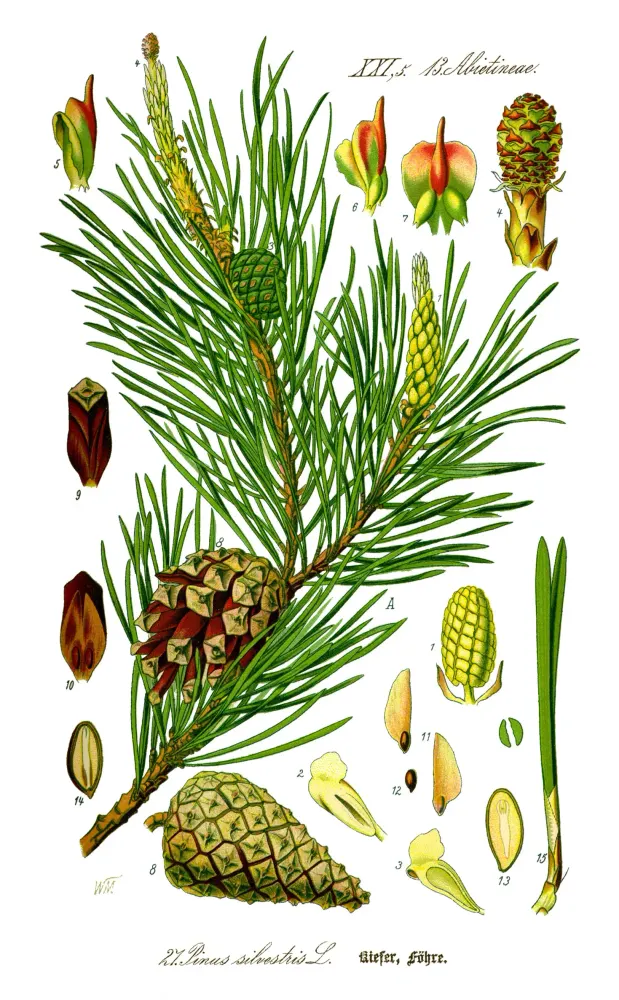
© floranet|]] · Public domain · Commons
Pinus sylvestris
CautionWaldkiefer · (Pinus sylvestris)
Pine family (Pinaceae)
Description
Pinus sylvestris is a species of tree in the pine family Pinaceae that is native to Eurasia. It is commonly known as the Scots pine in English; it is also known as the Scotch pine in the United States, and occasionally called the Baltic pine or European red pine. It can readily be identified by its combination of fairly short, blue-green leaves and orange-red bark.
CONTRAINDICATED for children
Pine needle essential oil must not be applied near the nose, mouth, or throat of children under 2 years (risk of laryngospasm). Not generally recommended for children under 4 years.
- InhalationAerial partsExternalCommission E
Inhalation of pine needle oil (Pini aetheroleum) or an infusion of young shoots traditionally relieves catarrh of the upper and lower respiratory tract. Alpha-pinene and bornyl acetate act as secretolytics and mild antiseptics on the bronchial mucosa.
Preparation & dosage
⚠ Age restriction: ≥ 2 years — Pine needle essential oil must not be applied near the face of children under 2 years — risk of laryngospasm leading to respiratory arrest.
[#src_komm_e_pinus] [#src_arzneipflanzenlexikon_pinus] [#src_altmeyers_pini_turiones]
- BathAerial partsExternalCommission E
Pine needle oil baths are traditionally used for colds and rheumatic complaints. The essential oil is absorbed through the skin and exerts circulation-promoting and muscle-relaxing effects.
Preparation & dosage
- TeaAerial partsInternalFolk medicine
Tea from young pine shoots (Pini turiones) acts as an expectorant and mild antiseptic. Flavonoids (quercetin, kaempferol) and vitamin C contribute to immune-supporting effects, used in folk medicine for colds and bronchitis.
Preparation & dosage
Pour 250 ml boiling water over 2–3 g dried young pine shoots, steep 10 min, strain. Drink 3 times daily.
- Dry amount
- 2–3 g
- Doses per day
- 3×
[#src_altmeyers_pini_turiones] [#src_violapharm_pinus] [#src_permaculture_pinus]
- Essential oilAerial partsExternalCommission E
Externally applied pine needle oil (diluted in fatty carrier oil) is traditionally rubbed in for mild muscle and nerve pain and rheumatic complaints. The circulation-promoting effect of alpha-pinene supports local warming.
Preparation & dosage
[#src_komm_e_pinus] [#src_arzneipflanzenlexikon_pinus] [#src_altmeyers_pini_turiones]
- InhalationAerial partsExternalFolk medicine
In Transylvanian folk medicine, syrup from fresh pine shoots (Pini turiones) has been used for generations for asthma, coughs, catarrh, and laryngitis. The preparation — shoots boiled with water, then cooked down with sugar in a 1:1 ratio — corresponds to a mucosa-soothing cough remedy.
Preparation & dosage
- CompressWhole plantExternalFolk medicine
Resin compresses from pine resin (Resina Pini) are used in folk medicine for wounds, furuncles, and skin infections. Resin acids and phytoncides have antibacterial and antifungal effects.
Preparation & dosage