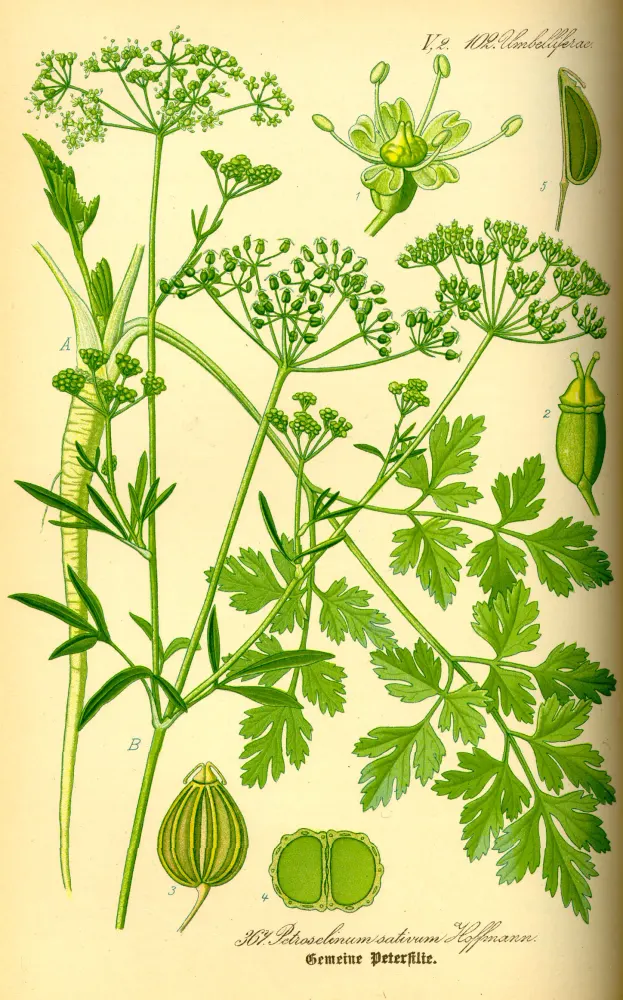
© Prof. Dr. Otto Wilhelm Thomé · Public domain · Commons
Parsley
Caution🐾Petersilie · (Petroselinum crispum)
Carrot family (Apiaceae)
Description
Few culinary herbs are as widespread in Central Europe as parsley, whose curly or flat leaves are harvested between May and September and are exceptionally nutrient-rich, providing around 160 mg of vitamin C and about 1640 µg of vitamin K per 100 g. The essential oil is characterised by apiole and myristicin, which give parsley its typical smell. As a tea made from leaf or root, parsley is recognised by Commission E for irrigation therapy of urinary complaints, while in the kitchen it is eaten raw or used as a spice. Crucially, therapeutic preparations such as tea, tincture or essential oil are contraindicated during pregnancy, since apiole and myristicin can be uterotonic, hepatotoxic and neurotoxic at higher doses — parsley seeds were historically even misused as a life-threatening abortifacient. Culinary amounts as a garnish or in salad, by contrast, are considered safe. Due to its furanocoumarin content, consuming large amounts of the fresh plant can increase skin sensitivity to light, and the pure essential oil must never be taken internally.
🌿 Risk of confusion — read before wild-harvesting!
CRITICAL: Therapeutic use (tea, tincture, extracts, essential oil) CONTRAINDICATED in pregnancy — apiol and myristicin in essential oil are abortifacient (uterotonic), hepatotoxic and neurotoxic at higher doses. Parsley fruit/seed oil was historically misused as abortifacient (life-threatening). Culinary amounts (garnish, salad) considered safe. Phototoxic reactions from furanocoumarins (bergapten, psoralen) possible, especially in fair-skinned individuals. Pure essential oils MUST NOT be taken internally. Ensure ample fluid intake during irrigation therapy. ASPCA classification (accessed 2026-08-10): toxic to dogs, cats and horses.
CONTRAINDICATED during pregnancy
-
Irrigation therapy for mild lower urinary tract complaints
Preparation & dosage
Aquaretic for irritable bladder and urinary tract inflammation (folk use, Commission E positive for herb/root)
Preparation & dosage
Source of vitamin C and folate, digestive support, breath freshener (culinary use)
Preparation & dosage
Culinary herb for broths, herb quark, tabbouleh, gremolata (traditional spice)
Preparation & dosage
Compress for insect bites, bruises and skin irritation relief (folk medicine)
Preparation & dosage
CRITICAL: Therapeutic use (tea, tincture, extracts, essential oil) CONTRAINDICATED in pregnancy — apiol and myristicin in essential oil are abortifacient (uterotonic), hepatotoxic and neurotoxic at higher doses. Parsley fruit/seed oil was historically misused as abortifacient (life-threatening). Culinary amounts (garnish, salad) considered safe. Phototoxic reactions from furanocoumarins (bergapten, psoralen) possible, especially in fair-skinned individuals. Pure essential oils MUST NOT be taken internally. Ensure ample fluid intake during irrigation therapy. ASPCA classification (accessed 2026-08-10): toxic to dogs, cats and horses.
⏱ Max continuous use: 4 weeks
-
-
-
Drug interactions
Vitamin-K-Antagonisten (Warfarin, Phenprocoumon)
Parsley is very rich in vitamin K — larger or fluctuating amounts can reduce the effect of coumarin anticoagulants and destabilise INR. Keep intake consistent.
Lithium
Aquaretic/diuretic effect may reduce renal lithium clearance and raise plasma levels (toxicity risk).
Diuretika (Schleifen-, Thiaziddiuretika)
Additive diuretic effect — risk of dehydration and electrolyte shifts, especially in elderly patients.
MAO-Hemmer
Myristicin in essential oil has weak MAO-inhibiting activity — potentially additive with pharmaceutical MAOIs (relevant only at high doses / essential oil).
Contraindications
- Pregnancy (therapeutic dose, essential oil, tincture, seeds); oedema due to impaired cardiac or renal function (Commission E, irrigation therapy contraindicated); acute nephritis (glomerulonephritis, pyelonephritis); known allergy to Apiaceae family; essential oil internally contraindicated in general.
Harvested part: leaves
- Apiol (Parsley camphor)Essential oilContent: 0.3-0.7 % (Kraut), bis 80 % im Samenöl
Main essential oil component in root and seeds. HEPATOTOXIC, neurotoxic, at high doses abortifacient (uterotonic) and nephrotoxic. Historically misused as abortifacient — sometimes fatally. Apiol is the principal reason for strict pregnancy and high-dose warnings.
- MyristicinEssential oilContent: in Kraut-Öl dominierend, in Samen-Öl 6-30 %
Phenylpropanoid with weak hallucinogenic and MAO-inhibiting properties at very high doses. Harmless in culinary amounts, but neurotoxic in concentrated essential oil.
- Apiin (Apigenin-7-apiosylglucosid)FlavonoidContent: bis 2 % in Früchten
Flavone glycoside; aglycone is apigenin. Contributes to spasmolytic, anti-inflammatory and weak diuretic activity.
- Apigenin & Luteolin (freie Flavone)FlavonoidContent: Spuren bis 0.5 %
Antioxidant, anti-inflammatory, vasoprotective. Apigenin is considered the key bioactive marker of the leaves.
- Furanocumarine (Bergapten, Psoralen, Imperatorin, Xanthotoxin)OtherContent: ca. 0.003 % in Früchten
Phototoxic — can trigger phytophotodermatitis-like skin reactions on UV exposure, especially in fair-skinned persons and on intensive contact with fresh plant juice.
- Vitamin C, Vitamin K, FolsäureVitaminContent: Vit C ca. 160 mg/100 g Frischkraut, Vit K ca. 1640 µg/100 g
Fresh leaf parsley is one of the most vitamin-rich culinary plants. Very high vitamin K content — clinically relevant for patients on vitamin K antagonists (warfarin/phenprocoumon).
- Eisen, Kalium, CalciumMineralContent: Fe ca. 6 mg/100 g, K ca. 1000 mg/100 g
Parsley provides notable amounts of iron and potassium at culinary intake. The high potassium content contributes to the aquaretic effect.
- [1]Monographkomme_petersilie(accessed: 2026-05-19)
- [6]Monographdrugs_vitk_warfarin(accessed: 2026-05-19)
- [7]Monographmedscape_parsley(accessed: 2026-05-19)
- [8]Monographpmc_repro_tox(accessed: 2026-05-19)
- [9]MonographASPCA Animal Poison Control — Parsley (Petroselinum crispum): Toxic to Dogs, Toxic to Cats, Toxic to Horses(accessed: 2026-08-10)
- [10]MonographCliniTox Giftpflanzen — Petroselinum crispum (Mill.) Fuss: schwach giftig (+) (Institut für Veterinärpharmakologie und -toxikologie, Universität Zürich)(accessed: 2026-08-10)
- [4]Bookwelt_wappen_petersilie(accessed: 2026-05-19)
- [2]Wikipediapfaf_petroselinum(accessed: 2026-05-19)
- [3]Wikipediaheilpraxis_petersilie(accessed: 2026-05-19)
- [5]Wikipediaeatsmarter_petersilie(accessed: 2026-05-19)
Distribution in Europe
🪴 Grow at home
- ☀ Light
- partial shade
- 💧 Water
- every few days
- 🌱 Soil
- Humus-rich, moist
- 🪴 Pot
- 18 cm
- ⭐ Difficulty
- ★★☆ intermediate
- 🐾 Pets
- toxic to pets
Tips:
- Slow to germinate (3-4 weeks) — be patient or buy pregrown.
- Harvest stalks at base, don't pluck from top.
- Flowers in 2nd year → plant ages, re-sow.
Care tips are general indoor-gardening recommendations, not scientific sources.
🤝 Permaculture Partners
In your garden, this plant acts as:
✨ Best symbiotic partners
- 🌿 Garlic Classic companion-planting partner.
- 🌿 Tarragon Classic companion-planting partner.
- 🌿 Fragaria vesca Classic companion-planting partner.
- 🌿 Lovage Classic companion-planting partner.
- 🌿 Basil Classic companion-planting partner.
- 🌿 Tomato Parsley attracts lacewings that eat aphids.
- 🌿 Tropaeolum majus Classic companion-planting partner.
⚠️ Better not planted together
- 🥬 Apium graveolens Classic companion-planting partner.
- 🥬 Fennel Classic companion-planting partner.
- 🥬 Lettuce Parsley and lettuce inhibit each other (root exudates).
- 🥬 Peppermint Classic companion-planting partner.
📦 Part of these planting sets:
Source: Gertrud Franck, Gesunder Garten durch Mischkultur (1980, eigene Kuration) | Helga und Margarete Langerhorst, Mein gesunder Naturgarten (eigene Kuration)