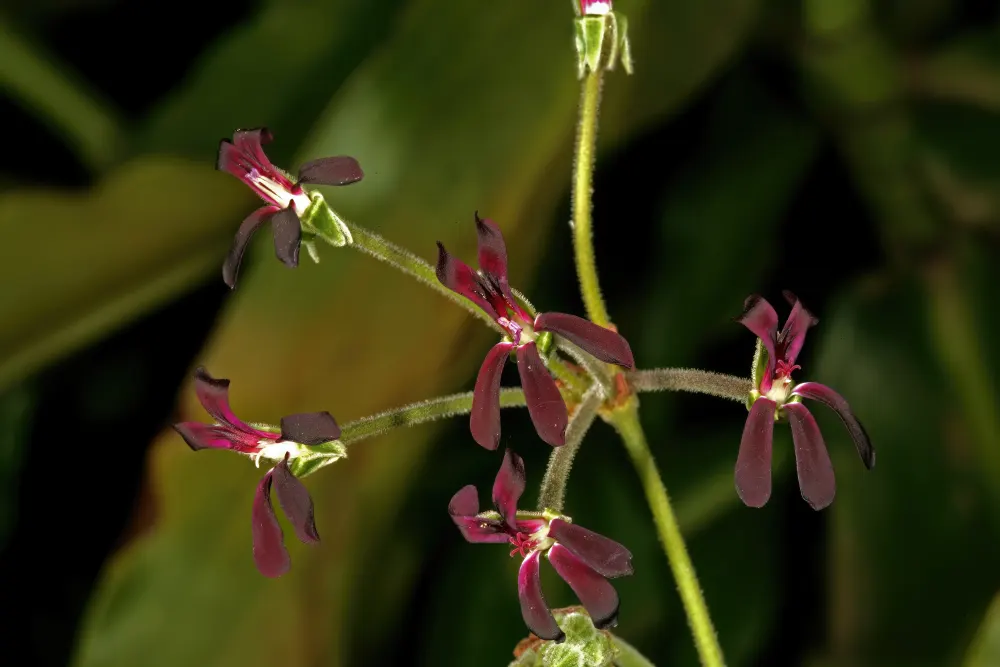
© SAplants · CC BY-SA 4.0 · Commons
South African geranium (Umckaloabo)
Caution🐾Kapland-Pelargonie (Umckaloabo) · (Pelargonium sidoides)
Geranium family (Geraniaceae)
Description
The South African geranium is a perennial herb native to southern Africa (South Africa, Eswatini, Lesotho). It forms a basal rosette of heart-shaped, velvety leaves and bears striking dark red to nearly black five-petalled flowers nearly year-round. The medicinal part is the tuberous root (Pelargonii radix), from which the standardised ethanolic special extract EPs 7630 (trade name Umckaloabo) is produced. Unlike many European herbal remedies, this plant comes from South African traditional medicine rather than the European herbal canon.
The root extract is used traditionally to relieve common cold symptoms. The European Medicines Agency (HMPC) classifies this as 'traditional use' – plausible effectiveness with over 30 years of safe use, based on long-standing experience rather than robust clinical trials.
Preparation & dosage
The standardised ethanolic root extract EPs 7630 (Umckaloabo) is used. Adults and adolescents from 12 years: 30 drops three times daily (about 1.5 ml of liquid root extract). Use until symptoms subside, generally no longer than 3 weeks. Home-made tinctures do not reach the defined composition of the licensed product; children use age-banded lower doses per the package leaflet.
- Liquid amount
- 1.5–1.5 ml
- Doses per day
- 3×
- Max duration
- 3 weeks
⚠ Age restriction: ≥ 6 years — Not for children under 6 years; adult dosing from 12 years (EMA HMPC). Liquid forms may contain ethanol.
A Cochrane review (Timmer et al. 2013) assessed controlled trials of EPs 7630 in acute respiratory infections and found an overall positive but inconsistent effect on acute bronchitis symptoms such as cough and sputum. Overall evidence quality was rated low and many trials were manufacturer-funded. The EMA therefore does not recognise bronchitis as an approved indication.
Preparation & dosage
For acute bronchitis the special extract EPs 7630 was tested in clinical trials mostly at 30 drops three times daily over about 7 days. Use only after medical assessment; do not self-treat in cases of persistent fever, shortness of breath or bloody sputum.
- Liquid amount
- 1.5–1.5 ml
- Doses per day
- 3×
- Max duration
- 3 weeks
⚠ Age restriction: ≥ 6 years — Not for children under 6 years; adult dosing from 12 years (EMA HMPC). Liquid forms may contain ethanol.
Rare cases of liver disorders (hepatotoxicity) have been reported in connection with pelargonium root products; a corresponding warning has been mandatory in the package leaflet since 2014. If signs of liver damage occur (jaundice, dark urine, upper abdominal pain), discontinue use immediately and seek medical advice. Due to the coumarin content, mild bleeding has rarely been observed; use with caution in people with a bleeding tendency or taking anticoagulants. Gastrointestinal complaints and allergic hypersensitivity reactions may occur. Liquid preparations contain ethanol. ASPCA classification (accessed 2026-08-10): toxic to dogs and cats. The ASPCA classifies the whole genus this way.
Use in pregnancy is not recommended due to lack of safety data (EMA).
Use during breastfeeding is not recommended due to lack of safety data (EMA).
Not for children under 6 years (EMA HMPC). Age-banded dosing for children 6+ per package leaflet; liquid forms contain ethanol.
Drug interactions
Anticoagulants/antiplatelets
The root's coumarin content may affect blood clotting and theoretically potentiate anticoagulant or antiplatelet drugs, increasing bleeding risk.
Contraindications
- Severe liver disease.
- Severe kidney disease.
- Increased tendency to bleed or blood clotting disorders.
- Hypersensitivity to Pelargonium sidoides.
Harvested part: Root (tuber)
- Umckalin (highly oxygenated coumarin)OtherRoot
Characteristic highly oxygenated coumarin of the pelargonium root; regarded as a lead marker compound.
- Scopoletin (coumarin)OtherRoot
Further coumarin found in the root.
- Gallic acidPhenolic acidRoot
Phenolic acid contributing to the extract's antimicrobial activity.
- Methyl gallatePhenolic acidRoot
Methyl ester of gallic acid.
- Prodelphinidins (condensed tannins)TanninContent: ca. 6-10%Root
Condensed tannins contributing to astringent and antimicrobial effects.
- FlavonoidsFlavonoidRoot
Accompanying polyphenols in the root.
- [1]MonographEuropean Union herbal monograph on Pelargonium sidoides DC and/or Pelargonium reniforme Curt., radix (Pelargonii radix) — EMA/HMPC, Revision 2, traditional use(accessed: 2026-06-12)
- [2]MonographTimmer A, Günther J, Motschall E, Rücker G, Antes G, Kern WV. Pelargonium sidoides extract for treating acute respiratory tract infections. Cochrane Database of Systematic Reviews 2013, Issue 10: CD006323(accessed: 2026-06-12)
- [3]MonographPubMed entry PMID 24146345 — Pelargonium sidoides extract for treating acute respiratory tract infections (Cochrane 2013)(accessed: 2026-06-12)
- [8]MonographASPCA Animal Poison Control — Geranium (Pelargonium species)(accessed: 2026-08-10)
- [4]WikipediaPelargonium sidoides — Wikipedia (English)(accessed: 2026-06-12)
- [5]WikipediaUmckaloabo — Wikipedia (Deutsch)(accessed: 2026-06-12)
- [7]CommonsFile:Pelargonium sidoides 1DS-II 2-0714.jpg — Wikimedia Commons(accessed: 2026-06-12)
- [6]WikidataPelargonium sidoides (Q163234) — Wikidata(accessed: 2026-06-12)
🤝 Permaculture Partners
In your garden, this plant acts as: