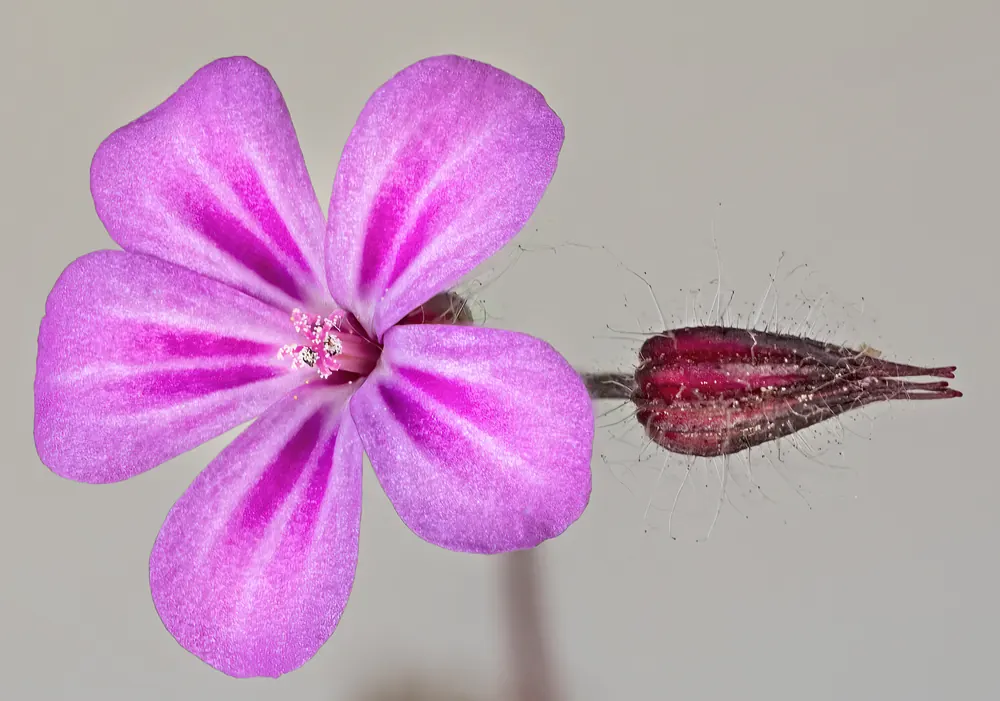
© Didier Descouens · CC BY-SA 4.0 · Commons
Herb Robert
CautionRuprechtskraut (Stinkender Storchschnabel) · (Geranium robertianum)
Cranesbill family (Geraniaceae)
Description
Herb Robert is an annual to biennial, much-branched herbaceous plant about 10 to 55 cm tall, with reddish-tinged stems and deeply five-lobed, fern-like leaves. The small pink to purple flowers measure roughly 12 to 16 mm and bear ten stamens; the fruits eject their seeds via a beak-like coiling awn. When crushed, the whole plant releases a strong, often unpleasant odour ('stinky Bob') arising from traces of essential oil. In folk medicine the aerial parts (herb) are used, and occasionally the whole plant including the root. Its activity is attributed chiefly to a high content of tannins, above all the ellagitannin geraniin.
- TeaAerial partsInternalFolk medicine
Folk tea for mild diarrhoea and gastrointestinal complaints; the astringent action of the tannins is the main rationale.
Preparation & dosage
Pour 250 ml of boiling water over 1 to 2 g of dried herb, cover and steep for 10 minutes, then strain. Because of the tannins, do not use over an extended period.
- Dry amount
- 1–2 g
- Doses per day
- 2×
- Max duration
- 2 weeks
- GargleAerial partsExternalFolk medicine
Traditional use of the tannin-rich decoction for mild inflammation of the mouth and throat.
Preparation & dosage
Prepare a slightly stronger infusion (2 to 3 g per 250 ml), let it cool and use several times a day as a gargle or rinse. Do not swallow.
- Dry amount
- 2–3 g
- Doses per day
- 3×
- Max duration
- 2 weeks
- CompressAerial partsExternalFolk medicine
Compress with the astringent infusion as supportive care for minor, slow-healing wounds and bruises; an antibacterial effect of extracts has been described in laboratory studies.
Preparation & dosage
Make an infusion from 3 to 5 g of herb in 250 ml of water, soak a clean cloth and apply to the affected area. Use only on intact or slightly damaged skin.
- Dry amount
- 3–5 g
- Doses per day
- 2×
- Max duration
- 2 weeks
- BathAerial partsExternalFolk medicine
Wash or partial bath with the tannin-rich extract for irritated or impure skin, handed down in folk practice.
Preparation & dosage
Extract 20 to 30 g of herb in 1 litre of water, strain and add the extract to a wash or partial bath. For external use.
- Dry amount
- 20–30 g
- Doses per day
- 1×
- Max duration
- 2 weeks
- RawLeafExternalFolk medicine
Crushed fresh leaves were folk-rubbed onto the skin to keep mosquitoes away; the characteristic smell is responsible for this.
Preparation & dosage
Crush a few fresh leaves between the fingers and rub onto the skin. Traditionally used as a mosquito deterrent because of the strong smell.
- Dry amount
- 1–3 g
- Doses per day
- 2×
- Max duration
- 1 weeks
- TinctureAerial partsInternalFolk medicine
Diluted tincture from the fresh herb, used in folk medicine for gastrointestinal and mild urinary complaints.
Preparation & dosage
1 to 2 ml of tincture diluted in a little water, twice a day. Folk dosage; seek medical advice if complaints persist.
- Liquid amount
- 1–2 ml
- Doses per day
- 2×
- Max duration
- 2 weeks
🤝 Permaculture Partners
In your garden, this plant acts as: