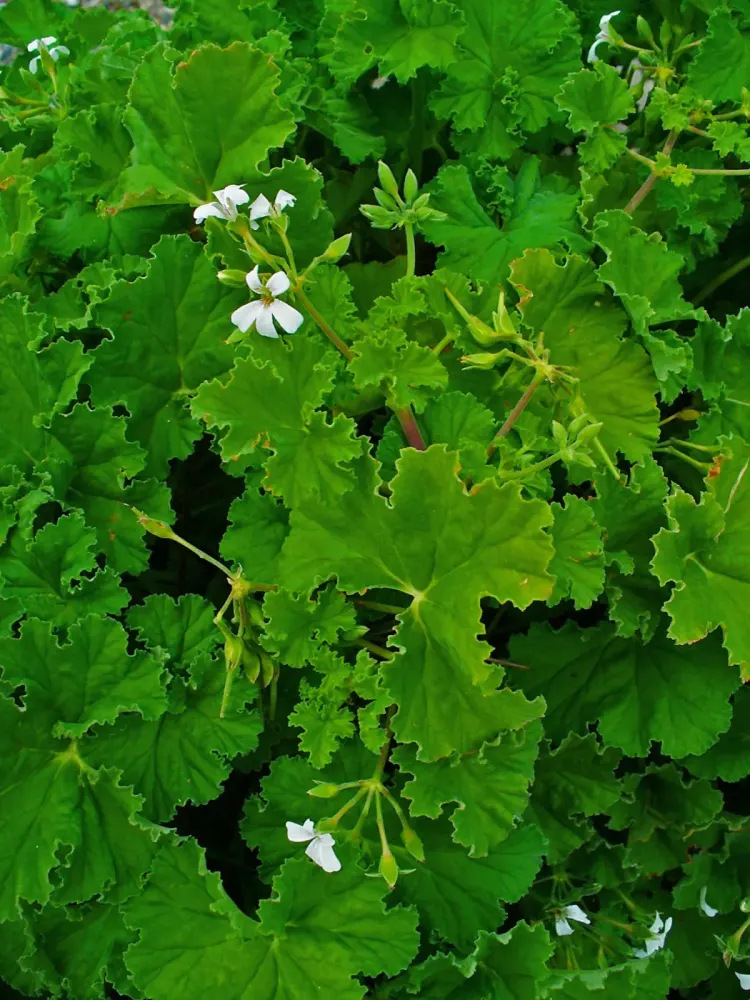
© H. Zell · CC BY-SA 3.0 · Commons
Pelargonium odoratissimum
Caution🐾Apfel-Geranie · (Pelargonium odoratissimum)
Cranesbill family (Geraniaceae)
Description
The apple geranium from South Africa bears soft, velvety, rounded leaves that smell distinctly of fresh apple when touched — one of the oldest scented pelargoniums in European collections, documented in England since 1724. The fragrance comes from an essential oil high in citronellol and geraniol along with pronounced citronellyl esters. In the kitchen the leaves flavour jellies and preserves, especially apple and quince, as well as syrups, sorbets and sugar confectionery; EU flavouring rules permit pelargonium leaves as a natural flavouring ingredient. Infused, they make a gentle evening tea, used in South African folk medicine for restlessness and mild stomach upsets. A relaxing bath and use in fragrance care are also part of the tradition. The essential oil belongs on the skin only heavily diluted, since citronellol, geraniol and linalool can provoke allergies.
Traditional infusion of fresh or dried apple geranium leaves as a gently calming evening tea with the characteristic fruity apple aroma. In South African folk medicine, aqueous extracts of Pelargonium odoratissimum are used for nervous restlessness, mild stomach upset and colds; in European scented-garden traditions the apple tea is mainly a pleasure tea.
Preparation & dosage
Chop 1-2 g (about 2-3 fresh or 1 tsp dried) apple geranium leaves, pour 200 ml boiling water over them, cover and infuse 8 minutes, then strain. 1-2 cups daily, preferably in the afternoon or evening. Fresh leaves give the fuller apple aroma.
- Dry amount
- 1–2 g
- Doses per day
- 2×
- Max duration
- 4 weeks
Aromatherapy use of apple geranium essential oil for relaxation, nervous tension and stress. The fruity-rosy scent profile with high citronellol/geraniol content and pronounced citronellyl esters gives the apple geranium its characteristic apple note; in aromatherapy it is regarded as mildly calming and mood-balancing.
Preparation & dosage
Diffuser: 3-5 drops apple geranium essential oil in 100 ml water, vaporise for 20-30 minutes. Massage oil: 5-10 drops in 50 ml carrier oil (almond, jojoba) — corresponds to 0.5-1 %. NEVER apply undiluted. Patch test 24 h before first use.
- Doses per day
- 2×
- Max duration
- 4 weeks
⚠ Age restriction: ≥ 6 years — In children under 6 years, avoid intensive diffuser use in the bedroom due to citronellol/geraniol content. Avoid entirely in infants and toddlers.
Folk-medicinal insect repellent: fresh leaves of the apple geranium are crushed in the garden and dabbed onto exposed skin to keep biting insects away. The citronellol/geraniol-rich scent shares its repellent effect with classical citronella and rose geranium oil, but in vitro it is weaker than the 'Citrosa' cultivar and true Cymbopogon citronella. Especially common in South African folk practice and English cottage-garden traditions.
Preparation & dosage
Culinary herb: the apple-scented leaves flavour jellies, jams (especially apple and quince jelly), syrups, sorbets, puddings and cakes — the EU flavouring legislation permits pelargonium leaves as a natural flavouring. Apple geranium sugar and leaf-perfumed confectionery are an English cottage-garden classic.
Preparation & dosage
Folk-medicinal relaxation bath for nervous tension, exhaustion and irritated skin. The essential oils act via skin and inhaled air; warm water releases muscle tension. The apple scent makes the bath a classical 'wellbeing bath' from South African and English folk traditions.
Preparation & dosage
Pour 1.5 L hot water over 50-100 g dried or a large handful of fresh apple geranium leaves, infuse for 20 minutes, strain and add to a full bath (35-38 °C, 15-20 minutes). Avoid concentrated use on sensitive skin.
- Dry amount
- 50–100 g
- Doses per day
- 1×
Scented-garden classic: the apple geranium is one of the historically oldest scented-pelargonium varieties in European collections (documented in England since 1724) and, with its small white flowers and intensely apple-scented foliage, is considered a key plant for scented beds, sensory gardens and therapeutic gardens (e.g. for dementia care homes).
NEVER apply apple geranium essential oil undiluted to the skin — citronellol, geraniol and linalool are listed allergens in the EU Cosmetics Regulation. Maximum concentration 1-3 % in a carrier oil; patch test 24 h before first use. Avoid in known Geraniaceae or citronella allergy. Internally only as a diluted tea or flavouring — NEVER drink or take pure essential oil by the spoon. IMPORTANT: the EMA HMPC 'Pelargonium' monograph refers exclusively to Pelargonium sidoides (respiratory colds); there is NO EMA monograph and no 'well-established use' status for Pelargonium odoratissimum — all uses listed here are traditional or folk-medicinal. ASPCA classification (accessed 2026-08-10): toxic to dogs and cats. The ASPCA classifies the whole genus this way.
⏱ Max continuous use: 4 weeks
Culinary amounts (leaves in jam, occasional cup of tea) are considered safe. Use therapeutic tea amounts and aromatherapy/skin essential-oil applications cautiously in pregnancy due to insufficient safety data; avoid internal use of essential oil.
Culinary amounts are safe. Use therapeutic amounts and essential oil cautiously due to insufficient data; do not apply essential oil to chest or nipples while breastfeeding.
Do NOT use apple geranium essential oil on the skin of infants and children under 2 years (no bedroom diffuser, no massage oils). In children 2-6 years only highly diluted (max. 0.5 %) and not on the face. Tea is safe in moderate amounts from school age.
Drug interactions
CYP2B6-/CYP3A4-Substrate
Citronellol, geraniol and linalool can modulate cytochrome P450 enzymes at higher concentrations. Theoretical interactions with bupropion, efavirenz, ketamine and other CYP2B6/3A4 substrates are conceivable — clinically barely relevant for topical aromatherapy, caution with oral use of essential oils.
Sedativa / ZNS-Dämpfer
Apple geranium oil used in aromatherapy has a mild calming effect; combined with sleep medications, benzodiazepines or alcohol, the dampening effect may add up.
Contraindications
- Known hypersensitivity to pelargoniums (apple or rose geranium), citronellol, geraniol, linalool or other Geraniaceae.
- Infants and children under 2 years — no skin contact with essential oil.
- Acute weeping skin inflammation or irritated mucous membranes — postpone use until healed.
- Cats and small dogs in the household: geranium essential oil is toxic to pets (per ASPCA — applies to all Pelargonium species). Use a diffuser only in rooms the animal can leave; no direct application on the pet.
Harvested part: leaves
- Time of day:
- Early morning in dry weather once the dew has dried and before midday heat — essential-oil content and apple aroma are then highest. Prefer non-flowering shoots.
- Drying:
- Spread leaves and leafy shoots in a thin layer on cloths or mesh racks in a warm, airy, shaded room (max 35 °C). Avoid direct sunlight — the fruity apple note is otherwise quickly lost. After drying, store airtight in dark glass jars.
- Storage:
- 6 months — Store in dark, tightly closed glass or tin containers, cool and dry. The fruity apple aroma evaporates faster than the rosier P. graveolens — use within 6 months, fresh is noticeably more aromatic.
- Time of day:
- At full flowering (July to August in Central Europe) on sunny, dry weather in the early morning — for home distillation, fresh leafy shoots with flower stalks are ideal.
- Drying:
- Hang leafy flowering shoots in small bundles upside down in the shade, or process immediately by steam distillation — fresh material gives a higher yield.
- Storage:
- 12 months — Store distilled essential oil in dark 5-10 ml dropper bottles, protected from light and cool (refrigerator) — stable up to 12 months.
- Ätherisches Öl (Apfel-Geranien-Öl)Essential oilContent: 0.1-0.3 %Leaf
Steam distillate from fresh leaves. Compared to the classical geranium Bourbon oil from P. graveolens, the P. odoratissimum profile is dominated by higher ester levels (citronellyl formate) — giving the characteristic apple-like top note. Main components: citronellol, geraniol, linalool and isomenthone.
- citronellolEssential oilContent: 15-35 %Leaf
Monoterpene alcohol — main component. Responsible for the rose-citrus undertone, antimicrobial activity and mosquito-repellent effect. EU-declarable fragrance allergen.
- geraniolEssential oilContent: 8-20 %Leaf
Second leading substance. Sweet rosy scent, antioxidant, antimicrobial and mildly anti-inflammatory. EU-declarable allergen.
- linaloolEssential oilContent: 3-12 %Leaf
Monoterpene alcohol with calming, mildly anxiolytic effect — acts synergistically with citronellol. EU-declarable fragrance allergen.
- isomenthoneEssential oilContent: 2-10 %Leaf
Monoterpene ketone; contributes a mildly minty-fresh note. Consistently reported as accompanying compound in Pelargonium odoratissimum studies.
- citronellyl formateEssential oilContent: 3-8 %Leaf
Ester accompanying compound — gives the oil its fruity-apple top note that distinguishes P. odoratissimum from the rosier P. graveolens. Contributes to the relaxing aromatherapy effect.
- flavonoids (quercetin, kaempferol glycosides)FlavonoidContent: Spuren-1 %Leaf
Polyphenolic accompanying compounds, primarily extracted in aqueous tea preparations — antioxidant and mildly anti-inflammatory; relevant for internal tea use.
- condensed tanninsTanninContent: 2-4 %Leaf
Astringent polyphenols — typical of Pelargonium leaves; contribute to the slightly puckering effect of tea and compresses and are partly responsible for the folk-medicinal use against diarrhoea and mouth/skin irritation.
- [3]MonographPlants For A Future — Pelargonium odoratissimum(accessed: 2026-05-27)
- [4]MonographRoyal Botanic Gardens Kew — Plants of the World Online: Pelargonium odoratissimum (L.) L'Her.(accessed: 2026-05-27)
- [5]MonographHerbal Reality — Scented Pelargonium (Pelargonium spp.) monograph(accessed: 2026-05-27)
- [6]MonographLalli J.Y.Y., Viljoen A.M., Baser K.H.C., Demirci B., Oezek T. (2008) — The essential oil composition and chemotaxonomical appraisal of South African Pelargoniums (Geraniaceae). Journal of Essential Oil Research 20(2): 152-160.(accessed: 2026-05-27)
- [7]MonographASPCA Animal Poison Control — Geranium (Pelargonium species)(accessed: 2026-08-10)
- [1]WikipediaPelargonium odoratissimum (Wikipedia EN)(accessed: 2026-05-27)
- [2]WikipediaDuftpelargonien (Wikipedia DE)(accessed: 2026-05-27)
Distribution in Europe
🪴 Grow at home
- ☀ Light
- full sun
- 💧 Water
- every few days
- 🌱 Soil
- Geranium compost with drainage
- 🪴 Pot
- 18 cm
- ⭐ Difficulty
- ★☆☆ beginner
- 🐾 Pets
- toxic to pets
Tips:
- Apple scent when touched — great on the windowsill.
- Winter: cool (5-12 °C) and very little water.
- Fresh leaves in salads or as tea.
Care tips are general indoor-gardening recommendations, not scientific sources.