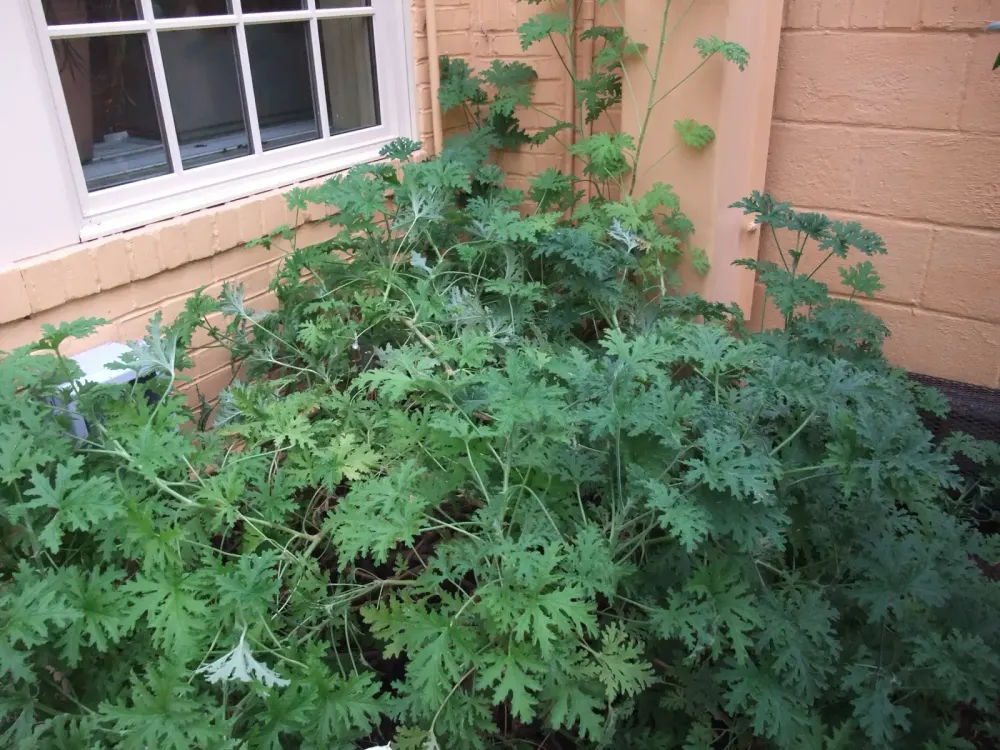
© Chhe (talk) · Public domain · Commons
Pelargonium 'citrosum'
Caution🐾Citronella-Geranie · (Pelargonium citrosum)
Cranesbill family (Geraniaceae)
Description
Pelargonium 'citrosum' is a perennial subshrub with fragrant leaves that are reminiscent of citronella.
- RawLeafExternalFolk medicine
Folk belief and marketing claim: the hybrid sold as 'citronella geranium', 'mosquito shocker' or 'mosquito plant' is marketed as an allegedly mosquito-repelling potted plant. SCIENTIFICALLY DISPUTED: the controlled field study by Matsuda et al. (1996, Journal of the American Mosquito Control Association) showed that P. citrosum offered no better mosquito protection than a control pot — mosquito landings were statistically equivalent. Tisgratog et al. (2016) confirmed this for Aedes mosquitoes. The intact plant releases too little volatile geraniol/citronellol to act as a repellent; only a crushed leaf rubbed directly on the skin produces a very weak, locally confined, short-lived effect. The plant nonetheless remains a popular hobby-garden element — as a scented plant, not as a reliable mosquito shield.
Preparation & dosage
⚠ Age restriction: ≥ 2 years — No skin contact with crushed pelargonium leaves in children under 2 years — citronellol and geraniol are potent skin allergens.
[#src_matsuda_citrosa_1996] [#src_tisgratog_pelargonium_2016] [#src_cdc_mosquito_repellents]
- RawWhole plantExternalFolk medicine
Scented-garden plant: despite the disproven mosquito advertising claims, the citronella geranium is an attractive, robust potted plant with citrus-rosy leaf scent, small pink-violet flowers and attractively dissected foliage. Valued in sensory and scented gardens for the haptic experience (scent release on touch) and as a low-maintenance balcony or windowsill plant. Suitable for therapy and dementia gardens, since brushing the leaves produces olfactory stimulation.
- TeaLeafInternalFolk medicine
Folk practice (rare, weakly documented compared to P. graveolens and P. odoratissimum): infusion of fresh leaves as a light, citrus-rose-scented pleasure tea. The aroma resembles a mix of citronella grass and rose geranium. Because of the comparatively recent hybrid history (commercially from the 1980s onward), there is no traditional herbal-medicine use — the application is purely modern and recreational.
Preparation & dosage
Pour 200 ml boiling water over 1-2 g (2-3 fresh or 1 tsp dried) chopped citronella geranium leaves, cover and infuse for 8 minutes, then strain. 1-2 cups daily. Fresh leaves give a markedly stronger aroma than dried.
- Dry amount
- 1–2 g
- Doses per day
- 2×
- Max duration
- 4 weeks
- Essential oilLeafExternalFolk medicine
Folk aromatherapy use: crushed fresh leaves or a homemade infused-oil maceration emit a citrus-rosy scent considered relaxing and mood-lifting in hobby aromatherapy. Important: there is no industrial steam-distilled genuine 'P. citrosum' oil on the market — commercial geranium oils come from P. graveolens or P. capitatum. The effect is very mild compared to true geranium Bourbon oil.
Preparation & dosage
⚠ Age restriction: ≥ 6 years — In children under 6 years, avoid intensive use due to citronellol/geraniol content. Avoid entirely in infants and toddlers.
Distribution in Europe
🪴 Grow at home
- ☀ Light
- full sun
- 💧 Water
- every few days
- 🌱 Soil
- Geranium compost
- 🪴 Pot
- 20 cm
- ⭐ Difficulty
- ★☆☆ beginner
- 🐾 Pets
- pet-safe
Tips:
- Effect is strongest when leaves are touched or crushed.
- Place on balcony table or seating area for dining mosquito repellent.
- Winter: bright and cool (5-12 °C).
Care tips are general indoor-gardening recommendations, not scientific sources.