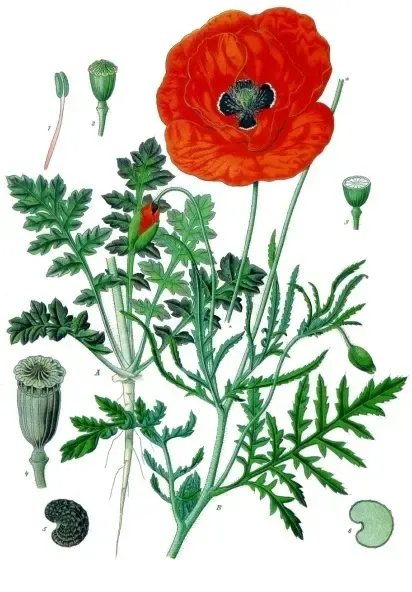
© Franz Eugen Köhler, Köhler's Medizinal-Pflanzen · Public domain · Commons
Papaver rhoeas
CautionKlatschmohn · (Papaver rhoeas)
Poppy family (Papaveraceae)
Description
The bright red, paper-thin petals of the common poppy mark cornfields and roadsides in early summer, often dropping again after just a few days. The flowers are gathered between May and July; they contain mucilaginous polysaccharides, anthocyanins and small amounts of the alkaloid rhoeadine. As tea or tincture, common poppy is used in folk medicine for nervous unrest as well as cough and throat irritation, while the seeds are eaten raw as food. Importantly, the rhoeadine alkaloids of common poppy are chemically unrelated to the morphine alkaloids of the controlled opium poppy (Papaver somniferum) and are not addictive. Still, the plant has a mild sedative effect, so overdosing and combination with alcohol or sleep aids should be avoided. When foraging in the wild, there is also a risk of confusing it with similar poppy species.
🌿 Risk of confusion — read before wild-harvesting!
Lay-collection risk through confusion with similar poppy species.
CONTRAINDICATED during pregnancy
Common poppy alkaloids may have uterotonic effects; use during pregnancy is contraindicated. No consumption of leaves or flowers during pregnancy.
CONTRAINDICATED during breastfeeding
Alkaloids could pass into breast milk and have a sedating effect on the infant. No use during breastfeeding as a precautionary measure.
Folk medicinal use of common poppy petals as a mild sleep and calming tea. The alkaloid rhoeadine has a mild sedative effect. NO relation to Papaver somniferum — no opiates, no addiction risk.
Preparation & dosage
Traditional use as soothing cough tea for dry irritant cough. Mucilage compounds in the petals coat irritated mucous membranes. Historically used in herbal cough syrups.
Preparation & dosage
Historical use in herbal liqueurs and tinctures for nervous gastrointestinal complaints. Combines sedative properties of rhoeadine with antispasmodic effect on the digestive tract.
Preparation & dosage
Seeds of common poppy are alkaloid-free and edible. Traditional use as baking ingredient in bread and pastries. Good source of unsaturated fatty acids and minerals. No medicinal effect from the seeds.
Preparation & dosage
Folk medicinal external application of fresh petals as a moist compress for skin irritation and mild inflammation. Mucilage compounds have a skin-soothing and cooling effect.
Preparation & dosage
Historical use of common poppy herb (leaves and stems) before flowering as a spring herb in cooking and folk medicine. Caution: after bud formation the alkaloid content increases — do not consume then.
Preparation & dosage
Common poppy (Papaver rhoeas) must NOT be confused with opium poppy (Papaver somniferum) — P. somniferum contains morphine-group alkaloids and is controlled in many countries. Common poppy alkaloids (rhoeadine group) are not related to opiates and do not cause dependence. Still: note mild sedation; no overdosing; do not combine with alcohol, sleeping pills or other sedating substances. Lay-collection risk through confusion with similar poppy species.
Common poppy alkaloids may have uterotonic effects; use during pregnancy is contraindicated. No consumption of leaves or flowers during pregnancy.
Alkaloids could pass into breast milk and have a sedating effect on the infant. No use during breastfeeding as a precautionary measure.
Historical poppy children's sleep syrups (with flower extracts) were banned due to sedation risk. No internal use in children under 12 years. External application (compress) only after consulting a doctor.
Drug interactions
ZNS-Depressiva (Benzodiazepine, Barbiturate, Opioide, Antihistaminika)
Rhoeadine has sedative properties; additive central depressant effect when combined with sleeping pills, sedatives or alcohol theoretically possible. Not systematically studied clinically.
Contraindications
- Pregnancy — possible uterotonic effect of alkaloids
- Breastfeeding — possible transfer of alkaloids into breast milk
- Known hypersensitivity to Papaveraceae (cross-reaction)
- Combination with CNS depressants — additive sedation
Harvested part: flowers (early summer)
- Time of day:
- Morning after dew has dried, shortly after flower opening for highest anthocyanin and mucilage content
- Drying:
- Immediately dry flat at max. 35 °C in the shade; sensitive anthocyanins lose color at higher temperatures and active compound content decreases; drying time 12–24 hours.
- Time of day:
- Harvest spring leaves BEFORE bud formation — after bud formation alkaloid content increases significantly
- Drying:
- Dry fresh leaves quickly at 40 °C or use fresh; after bud formation no longer for consumption.
- RhoeadineAlkaloidContent: 0.01-0.1 %
Main isoquinoline alkaloid of common poppy with seven-membered azepane ring; mildly sedative; structurally NOT related to morphine or other opiates; studied for possible application in morphine withdrawal.
- RhoeagenineAlkaloidContent: Spuren
Companion alkaloid of the rhoeadine group; pharmacological properties similar to rhoeadine; little studied.
- Papaveric acidAlkaloidContent: Spuren
Acid derivative from the isoquinoline group; identified in common poppy petals; toxicologically not significant at usual amounts.
- Anthocyanine (Cy-3-G, Dp-3-G)FlavonoidContent: nicht quantifiziert
Pigments responsible for the red flower color (cyanidin-3-glucoside, delphinidin-3-glucoside); antioxidant properties; no direct medicinal effect proven.
- Mucilage (Pektine, neutrale Polysaccharide)MucilageContent: 1-5 %
Mucilage polysaccharides of the petals; responsible for the soothing effect on mucous membranes; basis of folk medicinal cough application.
- Meconic acidOtherContent: Spuren
Present in very small amounts; not an alkaloid; in Papaver somniferum in higher concentration and used as a marker for opium content — in P. rhoeas only trace amounts without toxicological relevance.
- Quercetin, Kaempferol-GlykosideFlavonoidContent: nicht quantifiziert
Flavonol glycosides in leaves and flowers; antioxidant; anti-inflammatory in vitro; non-specific secondary plant compounds.
- Fatty acids (Linolsäure, Ölsäure)OtherContent: Samenöl 40-60 %
In the seed — mainly linoleic and oleic acid; nutritionally valuable; no alkaloid content in seeds (to be assessed separately from flowers/leaves).
- [5]MonographCliniTox Giftpflanzen — Papaver rhoeas L.: giftig + (Institut für Veterinärpharmakologie und -toxikologie, Universität Zürich)(accessed: 2026-08-10)
- [4]BookPlants for a Future — Papaver rhoeas(accessed: 2026-05-24)
- [1]WikipediaPapaver rhoeas — Wikipedia (EN)(accessed: 2026-05-24)
- [2]WikipediaKlatschmohn — Wikipedia (DE)(accessed: 2026-05-24)
- [3]WikipediaRhoeadine — Wikipedia (EN)(accessed: 2026-05-24)