Legal notice
Narcotic; opium and poppy straw internationally controlled.
The opium poppy, opium and its alkaloids fall under the UN Single Convention on Narcotic Drugs of 1961. Cultivation, possession and use are regulated differently from country to country - inform yourself about the law that applies to you. This information is not a permission to cultivate or consume.
For education and documentation only. Not a consumption guide, not legal or medical advice. Possession, cultivation and use are regulated differently by country and species — check the law that applies to you.
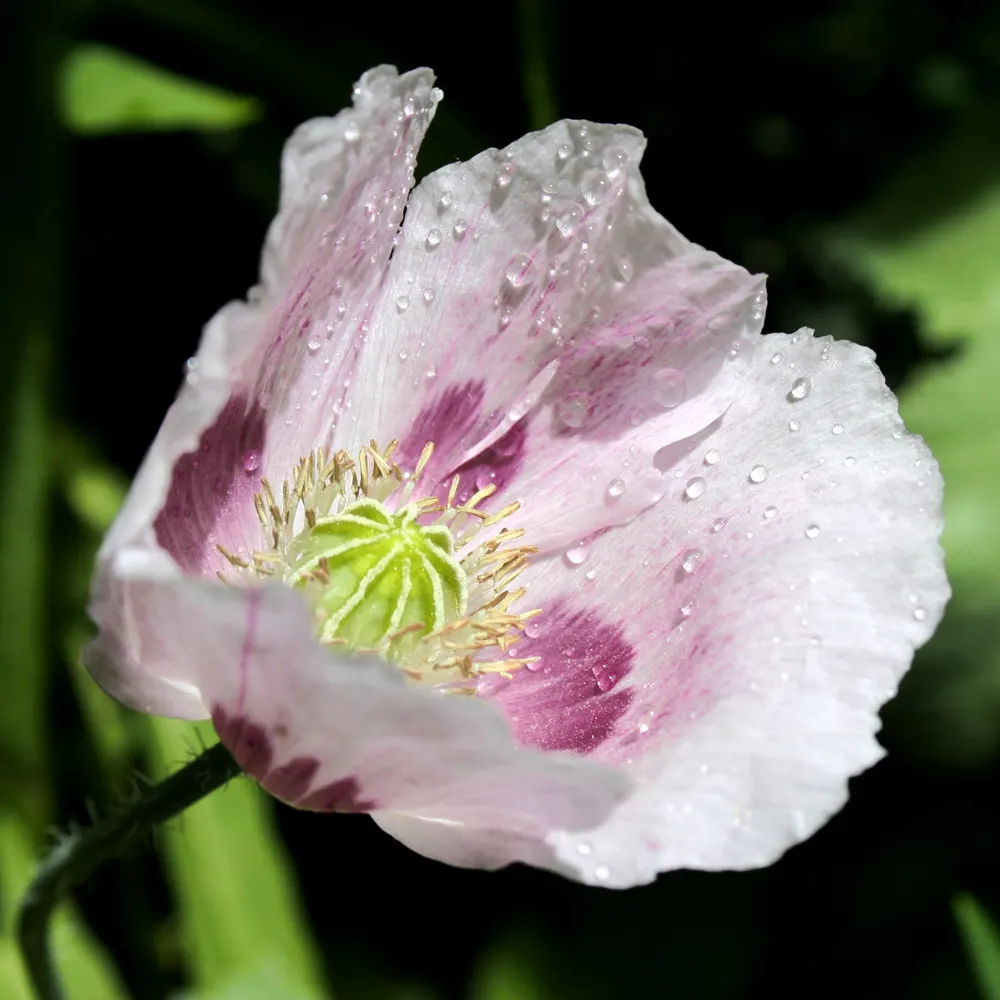
© Takkk · CC BY-SA 3.0 · Commons
Opium poppy
Toxic🐾Schlafmohn · (Papaver somniferum)
Poppy family (Papaveraceae)
Description
The opium poppy (Papaver somniferum) is an annual herb of the poppy family, growing 0.3-1.5 m tall, with greyish-green foliage and large, usually four-petalled flowers in white, red or mauve. Its rounded seed capsule is topped by 12-18 radiating stigmatic rays. Scoring the unripe capsule releases a milky latex (opium) that contains around 40 alkaloids. The plant has been cultivated in Central Europe since the Neolithic (from roughly 5200 BCE); in ancient Greece the poppy capsule symbolised Hypnos, the god of sleep, and served both cultic and medicinal purposes. Its alkaloids remain the source of key analgesics in modern medicine.
- TinctureFruitInternalEMA well-established
Morphine, the principal opium alkaloid, is a well-established strong analgesic in modern medicine for treating severe and chronic pain. Historically opium was used as a tincture (laudanum). Use only under medical supervision - not for self-medication.
- TinctureFruitInternalEMA well-established
Codeine, another poppy alkaloid, is used in medicine as an antitussive against dry, irritating cough. Only as an approved medicine under medical supervision.
Historical documentation only — do NOT use
These internal applications are historically documented. This plant is highly toxic — self-treatment can cause severe poisoning or death. For documentation only, explicitly NOT a recommendation.
- TinctureFruitInternalTraditional use
Papaverine acts as a smooth-muscle relaxant (spasmolytic) on various organs and was traditionally used for spasms and colic. Use only as a medicine.
- TeaWhole plantInternalFolk medicine
Historically and in folk medicine, opium was used against asthma, stomach illnesses, sleeplessness and pain; in antiquity the poppy capsule was regarded as sleep-inducing. These uses are historical and are not recommended today owing to the high risk of dependence and poisoning.
- SpiceSeedInternalTraditional use
The ripe poppy seeds are virtually alkaloid-free and are used as a baking ingredient and source of edible oil (e.g. poppy-seed cake and rolls).