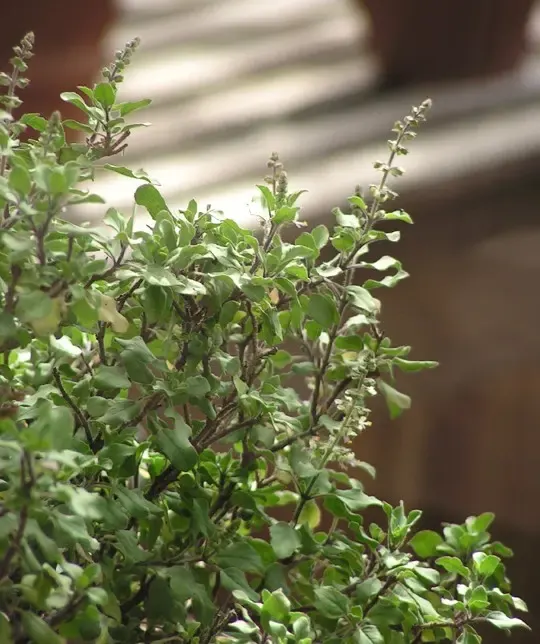
© en:User:GourangaUK · Public domain · Commons
Ocimum tenuiflorum
CautionIndisches Basilikum · (Ocimum tenuiflorum)
Mint family (Lamiaceae)
Description
Ocimum tenuiflorum, commonly known as tulasi, tulsi, or holy basil, is an aromatic perennial plant in the family Lamiaceae. It is widely cultivated throughout the Southeast Asian tropics. It is native to tropical and subtropical regions of Asia, Australia and the western Pacific.
- TeaAerial partsInternalTraditional use
Tulsi tea from dried leaves and flowers has been used in Ayurveda for centuries as a rasayana (rejuvenating agent) and adaptogen. It is regarded as a balancing tonic for stress, mental exhaustion, and general immune support. Modern reviews (Srivastava 2021) confirm the adaptogenic profile, attributed primarily to eugenol, ursolic acid, and rosmarinic acid.
Preparation & dosage
Pour 250 ml of boiling water over 2–5 g of dried Tulsi leaves and flower stalks, steep covered for 10 minutes, strain. Up to 3 cups daily.
- Dry amount
- 2–5 g
- Doses per day
- 3×
[#src_srivastava_tulsi_adaptogen] [#src_pooja_phytoconstituents] [#src_verma_phytopharmacology]
- TeaLeafInternalTraditional use
In Ayurvedic and traditional Indian medicine, Tulsi leaf tea is used for coughs, colds, bronchitis, and febrile infections. Eugenol exerts antibacterial and antiviral effects; camphor and caryophyllene support bronchial clearance. Efficacy is well documented traditionally; clinical RCT data for respiratory infections are lacking.
Preparation & dosage
Infuse 3–6 g fresh or dried leaves in 250 ml hot water for 15 minutes. Optionally combine with fresh ginger and honey. Drink warm 3 times daily.
- Dry amount
- 3–6 g
- Doses per day
- 3×
[#src_bokelmann_holy_basil] [#src_verma_phytopharmacology] [#src_pooja_phytoconstituents]
- TinctureAerial partsInternalClinical trial
A placebo-controlled double-blind trial (Lopresti et al. 2022, Frontiers in Nutrition, DOI 10.3389/fnut.2022.965130) investigated Holixer™ — a standardised Ocimum tenuiflorum extract — in 53 adults with subjective stress over 8 weeks. The primary endpoint was the Perceived Stress Scale score. The extract showed significant improvements in stress, mood, and sleep quality vs. placebo.
Preparation & dosage
Standardised extract (Holixer™) per manufacturer instruction: 250–500 mg extract twice daily with water. Ready-made tincture 1:5 (40–60% ethanol): 30–40 drops up to 3× daily.
- Doses per day
- 2×
- TeaLeafInternalTraditional use
In Ayurvedic tradition, Tulsi is considered a Deepana (digestive fire stimulant) and Vata-pacifier for bloating reduction. Aqueous leaf extracts are used for dyspeptic complaints, nausea, flatulence, and liver support. Eugenol exerts spasmolytic effects on gastrointestinal smooth muscle.
Preparation & dosage
Steep 2–4 g dried leaves in 200 ml hot water for 10 minutes. Drink after meals.
- Dry amount
- 2–4 g
- Doses per day
- 2×
- Essential oilLeafExternalTraditional use
Tulsi essential oil (methyl-eugenol or eugenol chemotype) is used topically in diluted form (1–2% in carrier oil) for skin infections, insect bites, and as an inhalant for respiratory infections. Yamani et al. (2016) documented significant antimicrobial activity against E. coli, P. aeruginosa, and S. aureus in vitro.
- RawLeafInternalTraditional use
Fresh Tulsi leaves are consumed daily in India as a puja offering and as a functional food (chewed in the morning on an empty stomach). This practice is considered immune-boosting and purifying in Ayurveda. Chewing raw leaves is regarded as gently antibacterial for oral flora due to eugenol content.
[#src_bokelmann_holy_basil] [#src_srivastava_tulsi_adaptogen]
- TeaAerial partsInternalFolk medicine
In the folk medicine of Southeast Asia and India, Tulsi infusions are used for mild rheumatic joint pain and to promote circulation. The anti-inflammatory activity of ursolic and oleanolic acid is demonstrated in vitro via inhibition of COX-2 and 5-LOX; clinical data for this specific indication are lacking.
Preparation & dosage
Steep 3–5 g dried Tulsi herb in 300 ml boiling water for 10 minutes. Drink one cup morning and evening.
- Dry amount
- 3–5 g
- Doses per day
- 2×
Distribution in Europe
🪴 Grow at home
- ☀ Light
- full sun
- 💧 Water
- every few days
- 🌱 Soil
- Loose herb compost
- 🪴 Pot
- 18 cm
- ⭐ Difficulty
- ★★☆ intermediate
- 🐾 Pets
- pet-safe
Tips:
- Like regular basil but a bit more robust.
- Regularly harvest tips for bushy growth.
- Likes morning water, afternoon sun.
Care tips are general indoor-gardening recommendations, not scientific sources.
🤝 Permaculture Partners
In your garden, this plant acts as:
✨ Best symbiotic partners
- 🌿 Garlic Classic companion-planting partner.
- 🌿 Calendula officinalis Classic companion-planting partner.
Source: Helga und Margarete Langerhorst, Mein gesunder Naturgarten (eigene Kuration)