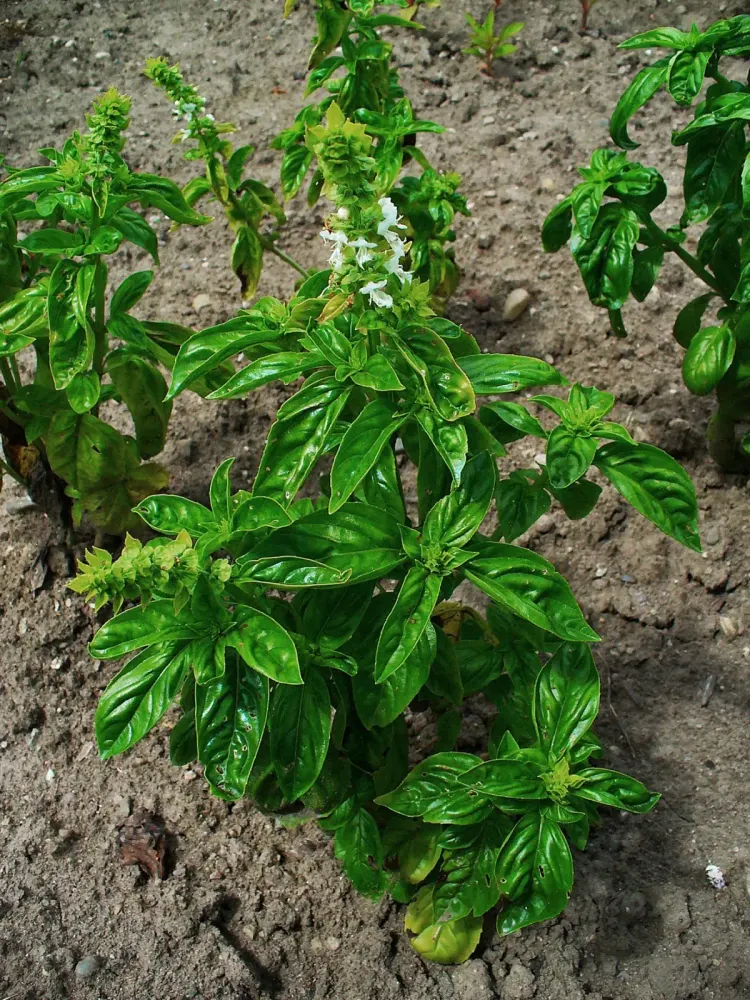
© H. Zell · CC BY-SA 3.0 · Commons
Basil
CautionBasilikum · (Ocimum basilicum)
Mint family (Lamiaceae)
Description
Basil, also called great basil, is a culinary herb of the family Lamiaceae (mints). It is a tender plant, and is used in cuisines worldwide. In Western cuisine, the generic term "basil" refers to the variety also known as Genovese basil or sweet basil.
- SpiceLeafInternalFolk medicine
Fresh leaves are used as a primary culinary herb in southern European – especially Italian – cuisine. Aroma is most intense just before flowering. Volatile oils dissipate with heat; add at the end of cooking.
Preparation & dosage
- TeaLeafInternalFolk medicine
Basil tea made from fresh or dried leaves is used in folk medicine for flatulence, bloating and stomach cramps (carminative and antispasmodic effect of the essential oil). Commission E considered the evidence insufficient to approve therapeutic use.
Preparation & dosage
Pour 150 ml hot water over 1–2 g dried leaves, steep 10 minutes, strain.
- Dry amount
- 1–2 g
- Doses per day
- 3×
- Essential oilAerial partsExternalFolk medicine
The essential oil (main constituents linalool and eugenol) shows pronounced antibacterial and antifungal activity in vitro. Used externally, well diluted (1–2 % in carrier oil), in folk medicine for skin infections, insect stings and acne. Never apply undiluted to the skin.
- InhalationAerial partsExternalFolk medicine
Aromatherapeutically, fresh leaves or the essential oil are used for exhaustion, migraine, insomnia and mild respiratory irritation. Linalool is regarded as calming; clinical evidence is lacking.
- RawLeafInternalFolk medicine
Fresh basil leaves are rich in vitamin K (ca. 415 µg/100 g), manganese and iron, as well as rosmarinic acid, a phenolic antioxidant. Basil oil and seeds are used as components of herbal liqueurs and macerations.
- GargleLeafExternalFolk medicine
In folk medicine a basil infusion is used as a gargle for mild inflammation of the oral and pharyngeal mucosa. The antiseptic effect of eugenol is well known in dentistry.
Distribution in Europe
🪴 Grow at home
- ☀ Light
- full sun
- 💧 Water
- every few days
- 🌱 Soil
- Herb compost, loose
- 🪴 Pot
- 18 cm
- ⭐ Difficulty
- ★★☆ intermediate
- 🐾 Pets
- pet-safe
Tips:
- Supermarket basil is usually overplanted — split into 3 pots when repotting.
- Harvest tips, NEVER individual leaves — plant becomes bushy.
- Water in the morning, never on leaves.
Care tips are general indoor-gardening recommendations, not scientific sources.
🤝 Permaculture Partners
In your garden, this plant acts as:
✨ Best symbiotic partners
- 🌿 Garlic Basil supports garlic growth.
- 🌿 Capsicum annuum Basil deters pests and improves pepper aroma.
- 🌿 Capsicum chinense Classic companion-planting partner.
- 🌿 Eruca sativa Classic companion-planting partner.
- 🌿 Oregano Classic companion-planting partner.
- 🌿 Parsley Classic companion-planting partner.
- 🌿 Tomato Tomato gives basil partial shade during midday heat.
- 🌿 Eggplant Basil protects eggplant from whitefly.
- 🌿 Tagetes patula Classic companion-planting partner.
- 🌿 Thymus vulgaris Classic companion-planting partner.
🌟 Neutral neighbours
⚠️ Better not planted together
- 🥬 Peppermint Mint overgrows basil and competes for water.
- 🥬 Rosemary Rosemary likes dry, basil likes moist — water conflict.
- 🥬 Salvia officinalis Sage essential oils inhibit basil.
📦 Part of these planting sets:
Source: Helga und Margarete Langerhorst, Mein gesunder Naturgarten (eigene Kuration)