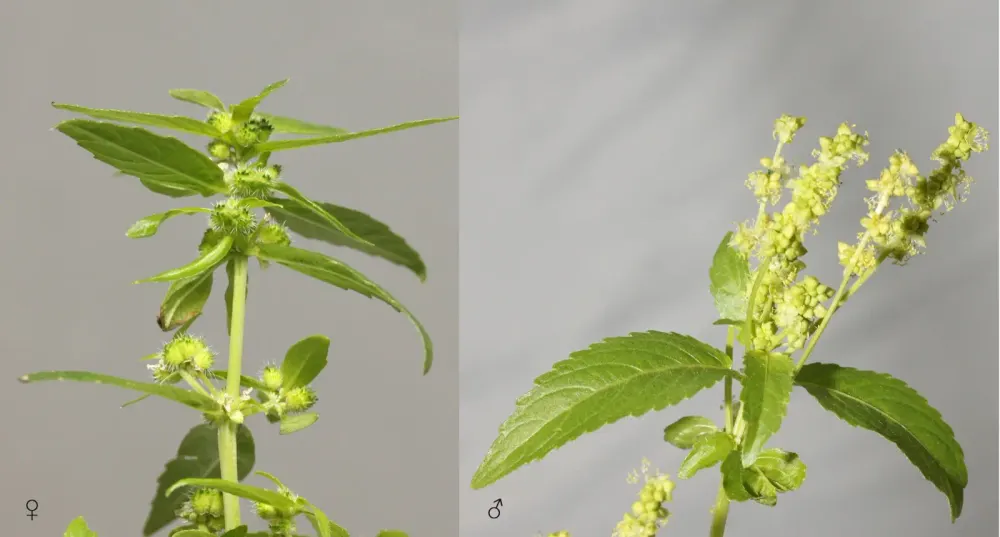
© Jan Eckstein · CC BY-SA 3.0 · Commons
Mercurialis annua
Caution🐾Einjähriges Bingelkraut · (Mercurialis annua)
Spurge family (Euphorbiaceae)
Description
Mercurialis annua, annual mercury, is a species of flowering plant in the spurge family Euphorbiaceae. It is native to the Middle East and the Mediterranean region, where it grows on bare, sandy soils. Its seeds are dispersed by harvester ants, which remove an oily coating that delays germination.
🌿 Risk of confusion — read before wild-harvesting!
Risk of confusion with the more toxic Mercurialis perennis (perennial root, unbranched stem), with brooklime (Veronica beccabunga) and with Chenopodium species in the young stage — caution when foraging.
CONTRAINDICATED during pregnancy
Internal use during pregnancy is STRICTLY CONTRAINDICATED. Historical sources attribute emmenagogue and abortifacient action to bingelkraut (Hildegard, medieval gynaecology) — saponins and methylamines can affect smooth muscle including the uterus. External contact with plant sap (e.g. during dye experiments) should also be avoided during pregnancy, as data on percutaneous absorption are lacking.
CONTRAINDICATED during breastfeeding
Internal use during lactation is CONTRAINDICATED — methylamines and saponins may pass into breast milk and cause nausea, vomiting and gastrointestinal irritation in the infant. Historical 'breast poultices' for milk stasis are obsolete and explicitly not recommended.
CONTRAINDICATED for children
STRICTLY AVOID in children — children are more sensitive to saponins and methylamines than adults. Accidental ingestion of a few leaves while playing usually causes only nausea and vomiting, but larger amounts can lead to gastroenteritis and circulatory problems. If ingestion is suspected: rinse the mouth, give plenty of water, DO NOT induce vomiting, and contact a poison control centre.
Critical drug interactions with:
Herzglykoside (Digitoxin, Digoxin) · Diuretika und Abführmittel · Antikoagulantien und Thrombozytenaggregationshemmer
- RawAerial partsExternalFolk medicine
Historic dye tradition (vivid blue plant pigment): for centuries Mercurialis annua was one of Europe's most important dye plants for blue-violet and purple shades — especially in France (Languedoc, Provence) and on the Iberian peninsula. Enzymatic oxidation of the colourless precursor hermidin yields chrysohermidin and related quinoid pigments. These were traded mainly as 'tournesol en drapeaux' or 'tournesol des teinturiers' (dyers' tournesole): linen rags impregnated with Mercurialis sap and ammonia (from urine), used to colour cheese rinds (Edam, Gouda), sugar loaves and inexpensive textiles. Owing to its pronounced light sensitivity the dye is suitable only for temporary markings and ephemeral colourings.
[#src_wiki_de_bingelkraut] [#src_wiki_en_mercurialis_annua] [#src_jep_mercurialis_dye] [#src_swain_chrysohermidin]
- TeaAerial partsInternalFolk medicine
Medieval folk medicine (today OBSOLETE, historical documentation only): Hildegard of Bingen mentions bingelkraut ('Bingilcrut') in her 'Physica' (12th century) as a mild laxative for constipation and 'mucus in the belly'. Dioscorides (1st c.) and Galen (2nd c.) already described Mercurialis as digestion-stimulating, vermifuge and 'evacuating bad humours'. Infusions of the fresh or dried herb were considered a gentle laxative until the 18th century. Owing to the now-known toxicity of saponins and methylamines (nausea, gastroenteritis) and the absence of modern efficacy data, this use is TODAY OBSOLETE and is documented purely for the history of medicine — not for self-medication.
[#src_wiki_de_bingelkraut] [#src_madaus_lehrbuch] [#src_hildegard_physica]
- RawLeafInternalFolk medicine
Famine food (RISKY, only historically documented): in some Mediterranean regions (Spain, southern Italy, Greece) young shoots of Mercurialis annua were boiled extensively in lean times — typically boiled several times in fresh water, discarding the cooking water each time to leach out saponins and methylamines — and eaten with other wild greens. The practice is well attested for crisis and war years of the 19th and early 20th century. Owing to unreliable detoxification and the risk of confusion with the more toxic perennial dog's mercury (Mercurialis perennis), M. annua is NOT a recommended wild vegetable. Modern culinary use is explicitly not advised.
[#src_jep_mercurialis_dye] [#src_pfaf_mercurialis_annua] [#src_wiki_en_mercurialis_annua]
- CompressLeafExternalFolk medicine
Historical external use (OBSOLETE, documentation only): in medieval and early modern folk medicine, crushed fresh bingelkraut leaves were applied as poultices to ulcers, poorly healing wounds and skin rashes ('itch', eczema). Lonicerus (herbal of 1557) and Matthioli additionally mention its use as a chest compress for milk stasis and as an 'emollient plaster'. No pharmacological basis for these applications is documented; the saponin-containing plant can in fact cause redness on sensitive skin. Today: documentary interest only — no application recommended.
[#src_madaus_lehrbuch] [#src_henriette_lonicerus] [#src_wiki_de_bingelkraut]
- RawWhole plantExternalFolk medicine
Ecology and garden indicator: annual mercury is a typical nitrogen- and tilled-crop weed of loose, nutrient-rich soils (gardens, fields, vineyards, waste places). It indicates fresh, basic-to-neutral, well-fertilised soil with mull or mull-moder humus (Ellenberg indicator values N=8, R=7). For home gardeners it is a useful indicator of well-supplied beds; at the same time it competes vigorously with vegetable crops as an early-spring germinator. Mechanical weeding before seed set is the usual control method — the wind-pollinated, dioecious species produces large amounts of readily germinable seed.
[#src_wiki_de_bingelkraut] [#src_floraweb_mercurialis] [#src_infoflora_mercurialis]